

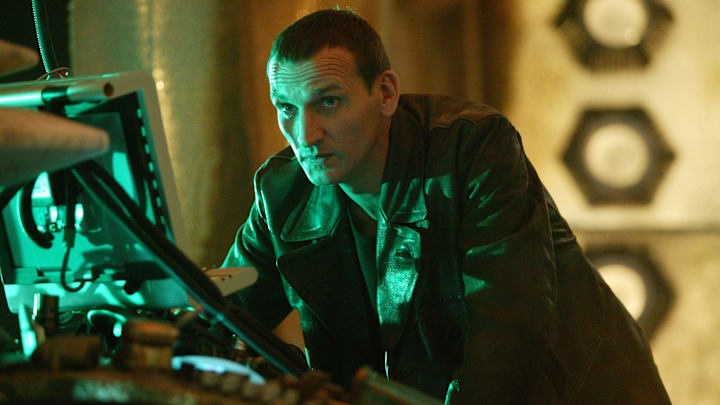
Steven Moffat's connection to canon Doctor Who projects dates back to Christopher Eccleston's Ninth Doctor in 2005, but writing for the first star of the show's revival era is only a tiny part of what the writer has achieved within the franchise. Moffat has become so synonymous with Doctor Who that he now holds an impressive record, and he has completely transformed the long-running British sci-fi saga in the process.
After spending four seasons writing under Russell T Davies, Moffat was eventually promoted to Doctor Who showrunner when both Davies and David Tennant left in early 2010. Moffat brought in Matt Smith to replace Tennant and went on to serve as the Doctor Who showrunner until stepping away after 2017's Christmas special.
Moffat's era is most remembered for adopting a gradually darker tone as it progressed, especially when Peter Capaldi replaced Matt Smith as Doctor Who's leading man. However, the former showrunner also made some bold additions to franchise canon that were incredibly well received. Although he no longer helms the show, he returned to pen two scripts for the Ncuti Gatwa era following Davies' return. That said, the specific Steven Moffat I'm talking about was already set before he wrote for Gatwa, and his comeback didn't affect said record in any way.

Steven Moffat has written for the most consecutive Doctors (within the world of the show)
In suitably timey-wimey circumstances, Moffat's Doctor Who tenure actually predates the revival era, whichever way it's viewed. Viewed most simplistically, Moffat's first Doctor Who script was 1999's The Curse of Fatal Death, a comedy special starring Rowan Atkinson and a number of other British stars as the Time Lord. This is, of course, not part of the franchise canon, but it is still worth mentioning.
Moffat's official Doctor Who scripts begin with a 2005 two-parter: "The Empty Child" and "The Doctor Dances," which feature Christopher Eccleston as Nine. From there, Moffat went on to write for David Tennant's Tenth Doctor, Matt Smith's Eleventh Doctor, and Peter Capaldi's Twelfth. Capaldi was the final consecutive Doctor for whom Moffat wrote, as incoming showrunner Chris Chibnall wrote the first lines for Jodie Whittaker's Thirteenth Doctor in the episode that saw Capaldi's exit.
Starting with Eccleston and ending with Capaldi would give Moffat a streak of four consecutive Doctors, but that would be ignoring two very special adventures that extend his record by two. Both installments came about as a result of Doctor Who's 50th anniversary, and they both canonically precede the Ninth Doctor.
In a 2013 Doctor Who short called "The Night of the Doctor," Moffat recalled Paul McGann to briefly lead the franchise as the Eighth Doctor — the first time since 1996's failed Doctor Who TV movie. The short served as a short prequel/companion piece to "The Day of the Doctor," which also aired in 2013, and was the cornerstone of Doctor Who's 50th anniversary celebrations. The episode is the only substantial appearance for John Hurt's War Doctor, who was unveiled to be a previously unseen iteration of the Time Lord who came between Eight and Nine, and was the Doctor to fight in the Time War.
So, following the Doctor's timeline, Moffat has written for the Eighth Doctor, the War Doctor, the Ninth Doctor, the Tenth Doctor, the Eleventh Doctor, and the Twelfth Doctor. No other Doctor Who writer has written for six consecutive versions of the character. Combined with the fact that Moffat also wrote for the First Doctor (David Bradley) in 2017, and also Gatwa's Fifteenth Doctor, then Moffat's overall record of most Doctors written for looks ready to stand the test of time.

A separate Steven Moffat Doctor Who revival-era record has recently been broken by Russell T Davies
Throughout Doctor Who's 60+ year history, there have been certain writers who have penned more scripts than others. Showrunners generally tend to be near the top of the list of most frequent contributors, and Moffat is no exception. When he returned to write 2024's "Joy to the World," Moffat hit an impressive milestone, as the Christmas special was his 50th Doctor Who episode. No other Doctor Who writer had hit figure in the modern era, although Robert Holmes has the overall record thanks to his work between 1968 and 1986, when he contributed over 70 scripts across five Doctors.
When another season aired in 2025, Davies not only matched Moffat's 50-episode count, but also surpassed it. Now, Doctor Who's current leader has written the most scripts for the show. That said, it could easily be argued that Davies had this record for a while. While Moffat was out in front for a long while when it came to the most Doctor Who episodes either man had written, Davies was also the mind behind two spinoffs, Torchwood and The Sarah Jane Adventures, and he wrote for them both.
Either way, Davies is now Doctor Who's most prolific writer since the revival, and depending on how long he intends to stay on as showrunner, he could even surpass Robert Holmes. The 2026 Christmas Special that will serve as the show's comeback is confirmed to be written by RTD, as well as most of the upcoming spinoff, The War Between the Land and the Sea. So, while Davies has written for the Thirteenth Doctor in Gatwa's final episode, and presumably has an unbroken chain through to the Sixteenth, he'd still need to oversee two more consecutive Doctors on either side of his current streak to take Moffat's other Doctor Who record.

Steven Moffat's Doctor Who scripts have arguably been more impactful than Davies' overall
There's no denying that Davies has written some great Doctor Who scripts over the years, but they generally tend to consist of self-contained adventures that rarely impact the show's future or bleed into other eras. He is also perhaps a little too overly reliant on bringing back villains from before the revival, rather than introducing all that many new bad guys.
Inversely, while Moffat does make use of some classic-era lore, he tends to favor original storylines that push Doctor Who forward. Villains like the Weeping Angels have resurfaced many times since Moffat introduced them in 2007's "Blink," and he likes to revisit his own storylines more often than he draws on other people's ideas. There is merit to the approaches of both Moffat and Davies, but I personally believe Moffat's Doctor Who formula makes him stand out far more among the upper echelon of the show's writers.
Doctor Who returns with a Christmas special on December 25, 2026. The War Between the Land and the Sea will also air its first two episodes on December 7, 2025, but only for UK audiences. International Whovians will need to wait for 2026.
 Add us as a preferred source on Google