

This article contains FULL SPOILERS for the Stranger Things finale.
Stranger Things' final episode ended with a deeply emotional sequence that softly predicted many of the characters' potential futures. While witnessing these prospective flashforwards, the show very much seemed to be acknowledging a wild theory that would surely have created uproar if proven correct. Thankfully, the theory remained just that, but Stranger Things came closer to canonizing it than you might think.
While there are portions of the fan base who disagreed with how the Duffer Brothers ended Stranger Things, "The Rightside Up" has been generally well-received as the iconic Netflix show's feature-length climax. The last scene, especially, has received a lot of praise for its open-endedness, allowing the audience to decide between two versions of events when it comes to the fate of Millie Bobby Brown's Eleven. Still, as annoyed as some fans are about the ending, another option for the finale would likely have irritated them even more.

Many Stranger Things fans believed the show was just one big Dungeons & Dragons campaign
The first time we meet the kids in the Stranger Things premiere, they're playing Dungeons & Dragons. The tabletop role-playing game would go on to be vital to the show's lexicon, with the characters using D&D terms to refer to key villains and locations within Stranger Things lore. The show also ends with a D&D campaign, which is what many fans predicted. However, rather than a new campaign set years after the premiere, it was generally believed that Stranger Things would end back where it started.
The theory centers around the possibility that Stranger Things' ending had already been filmed as far back as season 1, possibly even at the same time as the scene where we meet the main characters for the first time. When Vecna (Jamie Campbell Bower) was inevitably defeated, a lot of the show's fan base was convinced that the Duffer Brothers were going to opt for a creative spin on the "it was all a dream" ending.
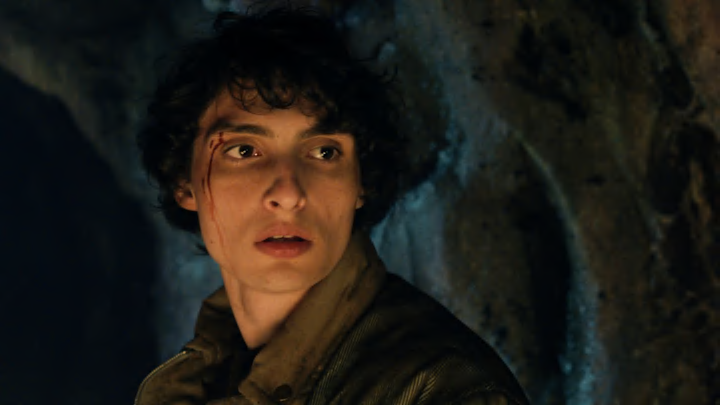
Rather than everything that had happened from the start of Stranger Things being part of the official canon, it was gently assumed that all the fantastical goings on were little more than a high-production representation of what the kids were imagining as they played their Dungeons & Dragons campaign. After Vecna's defeat, many were anxiously waiting for a cut back to Will's (Finn Wolfhard) basement, where he and his friends looked exactly as they did in the first episode.

The final scene in "The Rightside Up" felt like a meta acknowledgement of this theory
There is already an ongoing debate about the Stranger Things finale that doesn't look like it's going to end anytime soon. In short, fans are arguing whether Mike's stories about the characters' futures are canonical flashforwards or not. Personally, I don't think they are. Especially not Eleven's. I don't think the Duffer Brothers present these sequences as real either, or they wouldn't have framed them in the way they did.
Rather than talking about his friends as real people, Mike predicts their futures while addressing them by their D&D character names. As such, everything that's shown during these moments is likely to be optimistic musings rather than fans being treated to a glimpse into what's actually going to happen to them all. When Mike is done telling his stories, everyone is just back at the table as they were before he started. Intentional or otherwise, the entire sequence definitely comes across as a nod to the theorized "it was all a dream" ending for Stranger Things.

Stranger Things was right to avoid this type of ending
While it would certainly have been cool for previously unseen season 1 footage to suddenly appear and wrap up the story, that would have been about the only positive of ending Stranger Things with the reveal of it being a D&D campaign. The decision would have just been one big retcon, scrubbing almost a decade of storytelling away and replacing it with nothing.
The show's canon would shrink drastically, meaning all the carefully written lore about the Upside Down, Demogorgons, and more would have been reduced to the daydreams of a bunch of kids. Perhaps most saliently, it would also have meant that Eleven never existed, as she doesn't enter the story until after the opening scene. So how would Mike have known about her? The Stranger Things universe would have been retroactively transformed into what is essentially just the real world — but still set in the 1980s.
All episodes of Stranger Things are streaming now on Netflix.
 Add us as a preferred source on Google