

The release of the new Hunger Games film, Sunrise on the Reaping, has come with a great deal of fanfare. The film’s marketing has gone out of its way to stress just how connected this prequel is to the original series of Jennifer Lawrence-starring films, and there were rumors for months that legacy performers like Woody Harrelson, Josh Hutcherson, and even Lawrence herself would be reprising their original roles in some kind of nebulous capacity within the film.
All of this has led to a lot of buzz for the prequel and caused many people to revisit the original series, but in the midst of all the hubbub, it does kind of feel like one film is getting a bit forgotten: the 2023 prequel The Hunger Games: The Ballad of Songbirds & Snakes.
And sure, that title is certainly a mouthful and the film itself is far less directly connected to the events of the original series of films than this new prequel is to be. But there’s a critical reason why no one doing a Hunger Games retrospective or rewatch should simply rule out The Ballad of Songbirds & Snakes; because it’s actually the best movie of the whole bunch.
The Ballad of Songbirds & Snakes is the franchise’s most ambitious

The Hunger Games is not a franchise driven by some revolutionary concept. The central idea behind the series, as people like Quentin Tarantino have pointed out time and again in far crueler ways that I will, has been done several times before and will be done several times again. It’s Kinji Fukasaku’s Battle Royale, it’s Fortnite; it’s a narrative device unto itself at this point.
The reason that The Hunger Games resonated with audiences was because of the characters and larger themes that inhabited that narrative structure. Suzanne Collins wrote a story of a generation feeling repressed by the governing systems that dictated their lives, and wouldn’t you know it, that really resonated for young audiences who had grown up in the shadow of 9/11. This all became even more clear with the films, where you could literally watch Lawrence evolve into a full-blown movie star before your very eyes across the Hunger Games installments, as her take on Katniss became an icon to a whole new generation of audiences.
I say all of this to say, The Ballad of Songbirds & Snakes is the film in the franchise that most adeptly understands what the strengths of these films can and should be, and leans all the way into it in the most articulate of ways. Whereas the majority of the other films, the new Sunrise on the Reaping included, revolve so centrally around the games themselves, Songbirds & Snakes has its sights set on far more ambitious territory. It’s a much larger scale story that unfolds across years rather than days, and within its run, the games themselves are complete by the third act.
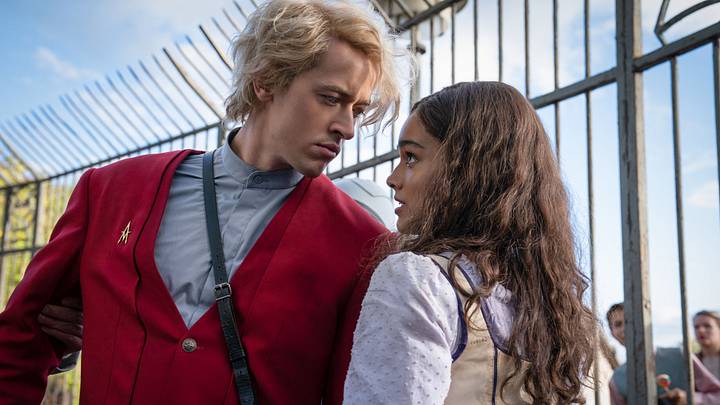
This allows screenwriters Michael Arndt and Michael Lesslie and director Francis Lawrence to platform the relationship at the heart of the movie in unconventional and deeply affecting ways. It also doesn’t hurt matters that said central relationship is the inherently operatic and ill-fated romance between Snow and Lucy Gray, and that those characters are played by Tom Blyth and Rachel Zegler.
Blyth and Zegler have such phenomenal chemistry together and are able to bring such kinetic and impactful resonance into this story and these characters. Rather than ending in a generic and lackluster action climax (looking very much at you, every other Hunger Games movie that isn’t Catching Fire), The Ballad of Songbirds & Snakes is bold enough to bet it all on black, and close out the film with a far more intimate, invasive, and emotionally rich finale.
It all comes down to these two characters, each one representing the dual sides of this conflict that will come to characterize so much of this larger franchise. And yet, through it all, the film never loses sight of this story. There are certainly connections to be made to other entries in the franchise, but you can also watch this divorced of everything else and it functions entirely on its own terms.
Compare this to the new Sunrise on the Reaping, a prequel which is worried that if it doesn’t explain how Woody Harrelson’s character got the gap in his front teeth that audience might jeer at it, and the strength and audacity of The Ballad of Songbirds & Snakes comes into sharper focus.
The Ballad of Songbirds & Snakes may not be The Hunger Game fandom’s favorite movie, but it is the most ambitious, accomplished, and artistically invigorated of the bunch. Where some other Hunger Games films seem content to barely scratch the surface of the rich themes and metatext inherent to the franchise, The Ballad of Songbirds & Snakes took audiences on a deep-dive plunge straight into the bona fide substance of such things, and I think that rules.
 Add us as a preferred source on Google