

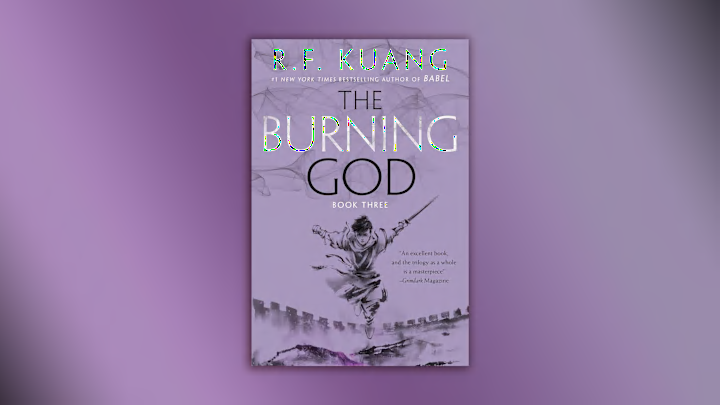
The Burning God is the final installment of R.F. Kuang's brilliant The Poppy War trilogy. In book 3, she continues her unique writing style of mixing real history into a fantasy world and making it seamless.
These three novels were Kuang's first published, and the progression in her writing skills is obvious. Each volume is better written than the one before, especially in terms of character development, world-building, and plot advancement.
Her storytelling is unblinking, blunt, gut-wrenching, unapologetic, and thorough. Not many nice things happen in this series. Yet, it is appealing in its uniqueness within the fantasy genre. Kuang has her own voice, and it will not be confused with anyone else's. That is a good thing.

The Burning God is a fitting end to an entrancing story
There was some hope toward the end of the second book, The Dragon Republic, that the world might be kinder to the lead character, Rin. That slight glimmer was shattered by events at the end of that book, and readers see the results on Rin almost immediately.
After the first half of the first book, Rin is seldom likable. She is much more an antihero than a hero, and her experiences have forged her into a very damaged, flawed person. Kuang wastes little time in letting her readers know that Rin is not turning soft.
Early in The Burning God, Rin commits murder. She feels justified in it and feels no remorse, but it is a means to justify her power grab over some of the warriors from Southern Nikara that are fighting against the Republic and the foreign Hesperians. The Republic, of course, is a parallel to Chiang Kai-shek's regime in the 1930s and 1940s in China. The Hesperians resemble European influences on China pre-World War II.
Rin has been impulsive throughout the series, and having god-bestowed powers hasn't made that situation any better. She always thinks she knows best, and she does not play well with others.
Those things come back to haunt her, and she gets a bit of comeuppance. Her heart is usually in the right place, but she is unable to force events toward her vision of what is right. Still, she rebounds from her personal setbacks and helps save the battered southern army.
Again, she trusts the wrong people, and that nearly costs her everything in The Burning God. She somehow survives her mistakes and gains even more overall power. Of course, this makes her even more sure of herself.
The events of The Burning God seem to reflect those that take place in China in the 1940s and 1950s. Rin may be a fantastical representation of Mao Zedong to a certain extent. Rin comes from nothing and rises to power through war and chaos, much like Zedong does. Kuang, however, uses her pulpit to show how hard it is to govern effectively once power is gained. Rebuilding the infrastructure of a war-torn country, one in which famine, poverty, and displacement run rampant, isn't a job to be taken on lightly.
It is a story of how easily power can corrupt, and that having power doesn't mean an ability to lead effectively. Warlords seldom make good leaders in times of peace.
The ending of the series was moderately surprising, but in hindsight, there was plenty of foreshadowing. Removing the historical parts of the story, Kuang left hints of how The Poppy War story would end. These hints were subtle enough at the time, but seem more obvious in retrospect.
The end was justified by the overall narrative of the story and how Rin's character developed throughout the series. She went from a driven yet innocent overachiever at the beginning to a brutal, murderous, battle-hardened warlord by the end. It is not a pretty story full of happy moments and nostalgia, but one that reflects a sad, abused history.
Still, Kuang's storytelling was on point. She wasn't trying to make readers feel good, but was telling a fantasy genre story without an oblique historical background. The results were original and epic, and The Poppy War trilogy is well worth the read.
 Add us as a preferred source on Google