

The Hunger Games franchise is something of an enduring oddity. In an age in which the entire YA dystopian subgenre that it was largely responsible for starting has faded from the zeitgeist entirely, this series has persevered both in the form of Suzanne Collins’ books and in the form of their shortly-thereafter cinematic adaptations.
The latest of these is the prequel The Hunger Games: Sunrise on the Reaping, a big-budget holiday season blockbuster that is gearing up for a gangbusters opening weekend and features a genuine embarrassment of riches with regards to its cast. All of this goes to show just what an exception-to-the-rule Hunger Games truly is; as you certainly don’t see new Divergent installments getting rolled out featuring a cast comprised of Academy Award-winning actors in 2026.
But in a strange turn of events, having now seen the film, I can unfortunately confirm that for as delightful as the A-list supporting performers are in isolation, their inclusions throughout the film actually wind up making the movie kind of all the worse.
The many famous faces actually distract from the story

The Hunger Games: Sunrise on the Reaping tells the tale of the second Quarter Quell (a dystopian way of saying that it’s the 50th Hunger Games), meaning that it is set a full 25 years before the events of the original Jennifer Lawrence-starring films that centered on Katniss.
Instead, this film focuses on the character of Haymitch Abernathy, Katniss’ mentor in the original films, in which he was played by Woody Harrelson. In Sunrise on the Reaping, Joseph Zada takes on the role of this younger Haymitch, whom the entire story revolves around. However, he is very much not alone; not only are there brand-new characters introduced for the games themselves, but there are also many, many younger versions of established characters from prior films.
This is, one has to imagine, how the film netted so much A-list talent for these relatively minor roles. The appeal of playing a tyrannical dictator who is only in a few minutes of the film’s nearly three-hour runtime might not have immediately earned a sign-on from the ever-amazing Ralph Fiennes, but the appeal of playing a younger iteration of a tyrannical dictator who was previously played by the late-great Donald Sutherland? That’s something else entirely.

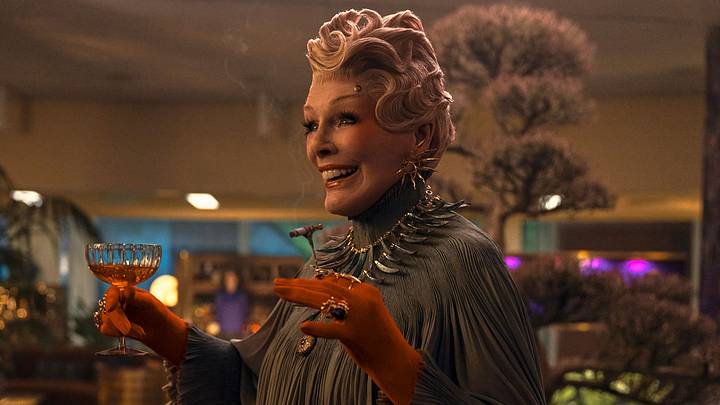
Thus, Sunrise on the Reaping features the likes of Glenn Close, Jesse Plemons, the aforementioned Fiennes, Elle Fanning, Maya Hawke, and Kieran Culkin in roles of fairly small sizes. This can make watching the first hour of the movie a bit of a delirious experience, as the movie keeps one-upping itself in terms of revealing beloved character actors taking on eccentric roles. They are infinitely watchable and captivating, and that’s kind of the problem.
The sheer fact that Sunrise on the Reaping features so many explicit crossovers with the prior films and that the performers in these roles are so good often pulls focus away from the character of Haymitch himself, in ways that feel dissonant and highly unintentional.
The film’s overarching emotional catharsis rests squarely on the shoulders of Haymitch as a character and Zada as a performer, but so much real estate within the runtime is allocated to playing with these obscenely talented actors’ new takes on these legacy characters that the central character is constantly struggling to measure up.
This is not a dig necessarily at Zada’s acting abilities; I think pretty much everyone would pale in comparison to actors like Plemons or Fiennes. It just means that when the film loops around to its drawn-out conclusion, the emotional through-line of the film just feels so thin and underdeveloped, because the film’s edit has consistently favored other tangentially related characters and performers.
 Add us as a preferred source on Google