

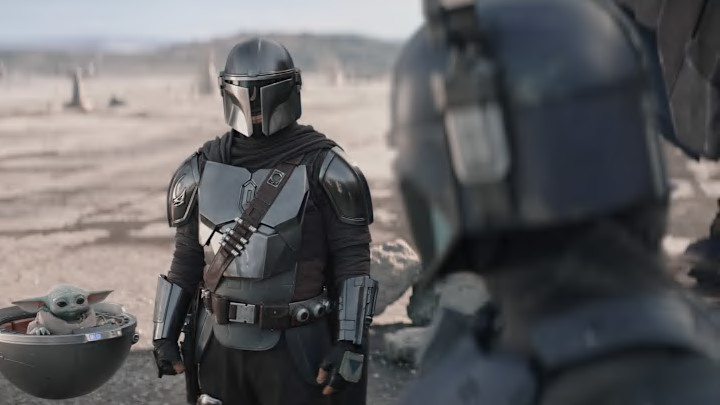
How long can a work of media realistically keep a character invested in a fundamentally broken belief system that is both morally reprehensible and actively at odds with what audiences want to see from the work and character themselves? That is the question that creator Jon Favreau is unintentionally exploring with The Mandalorian, whether he realizes it or not. With the show now transforming into a full-blown cinematic offering with The Mandalorian and Grogu and with rumors swirling about potential sequel plans, it’s time to state the obvious though: if audiences are going to continue connecting with central character Din Djarin (Pedro Pascal), he needs to be allowed to grow beyond his fervent belief in the death cult he’s in.
What death cult, you ask? Death Watch. Death Watch is a Mandalorian terrorist organization that splintered off from central Mandalorian culture, and are essentially a bunch of religious zealots. They steadfastly believe that Mandalorians should not remove their helmets, should not form connections with others of any kind, and should be steadfastly solitary beings. That all sounds pretty villainous, especially when it comes to what is objectively a children’s space-opera franchise, right? Well, not only would you be correct in thinking that, but that is also the very context in which Death Watch was originally introduced back in Star Wars: The Clone Wars animated series; as villains.
So when it is ultimately revealed at the end of the first season of The Mandalorian that Din Djarin is a foundling of not just any Mandalorian tribe, but of Death Watch, it adds a fascinating wrinkle to this in-progress story. Suddenly, all of those “this is the way” quotes take on a much more sinister undercurrent, as you realize the dogma that Din has been acting off of this entire time is actually a grossly misaligned one that puts him at odds with pretty much every other noble character in Star Wars. This, paired with the fact that same season 1 finale also ends with him having to remove his helmet for the first time and reaffirming his bond with Grogu as they help to save one another, seemed to set some pretty clear expectations moving forward: Din was going to realize the error of his ways and grow beyond the narrow view of Death Watch’s beliefs.

These ideas were even further entrenched and firmly set up during The Mandalorian season 2, as Favreau elected to have numerous characters from other Star Wars media enter the show and come into conflict with Din and his belief systems. Two of these characters, Bo Katan and Boba Fett, were Mandalorian-related characters who could help to show him there were other ways of operating within his culture, and another two of them, Ahsoka Tano and Luke Skywalker, were literal Jedi who could help to show him the value of nobility, friendship, and connection. Then, that season ended with Din removing his helmet not out of necessity, but because he wanted to look upon Grogu with his own eyes one last time before the little guy left with Luke. This felt like real progress, and as if Favreau was well on his way to charting this course for the character. And then, for inexplicable reasons, he decided to undo all of that development in the third season.
The entire third season of The Mandalorian is slavishly devoted to Din attempting to make up for his transgressions against Death Watch’s culture in the prior season. Everything that happens is a direct result of him attempting to re-immerse himself in this fractured faction’s culture, and Favreau consistently frames it as a good thing that audiences should be cheering on. He even opens the season by forcing audiences to watch a literal indoctrination ceremony of another child into Death Watch, a moment which should feel horrific and yet Favreau plays as a fun and jovial action sequence.
Then, for the sum total of season 3, Din refuses to remove his helmet at all, regressing to a place that feels more entrenched in this death cult’s belief system than ever before. So now, heading into The Mandalorian and Grogu, it begs the question: does Jon Favreau really just think Death Watch is some cool and neat thing, and not like, you know, a pretty obvious fictional analogue for real-world fanatics?
As it stands, if Din Djarin is ever going to be a character with any kind of lasting, long-term appeal, he needs to be allowed to grow beyond these rigid structures. My most optimistic theory about all of this is that Favreau really did have plans to ‘go there’ with this arc, but then Disney and co. realized how that would retroactively paint all of the “this is the way” merch as kind of evil and begged him not to. So then he just kind of turned the ship 180-degrees around and hoped no one would notice the main character’s entire belief system was messed up. Well, I’m sorry to break it to you Jon, but we noticed. Everyone noticed, and I am begging you to please right this ship before it's too late and Din just permanently becomes entrenched in Star Wars mythos as some crazy zealot who thinks being in a death cult is fun and cool, actually.
The Mandalorian and Grogu premieres in theaters on May 22, 2026.
 Add us as a preferred source on Google