

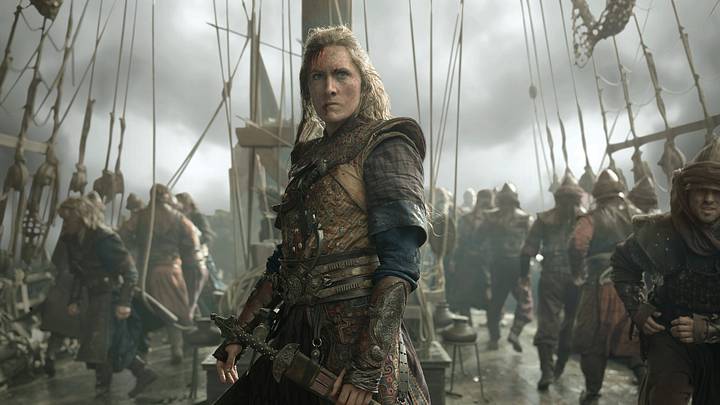
After two long years, House of the Dragon has returned for its third season — and it kicked things off in explosive fashion with the Battle of the Gullet, the single most devastating naval battle in Westeros' history. This clash sees a fleet of pirates sailing for the Triarchy ambush the Sea Snake's blockade in the titular Gullet, a waterway through which nearly all trade to King's Landing passes.
Yet while this may seem to start out as a simple assault by allies of the Greens on the Blacks, it devolves into a grudge match between the Triarchy captain Sharako Lohar (Abigail Thorn) and Corlys Velaryon (Steve Toussaint). In case you forgot, Corlys and Daemon Targaryen (Matt Smith) spent decades waging war on the Triarchy pirates on a contested island chain called the Stepstones in House of the Dragon season 1 — they're the group that featured prominently in episode 3, when Daemon killed the Crabfeeder.
The Triarchy is an alliance of three Free Cities: Lys, Myr, and Tyrosh. Throughout the course of Essos' history, these sorts of alliances have come and gone, but the Triarchy is one which had a particularly strong impact on Westeros as well, thanks to all those years of territorial warfare in the Stepstones and the Battle of the Gullet.

The Triarchy is House of the Dragon's chaotic rogue faction
Despite its outsize influence on the Dance of the Dragons civil war, the Triarchy actually hasn't been around that long — the three Free Cities only forged their alliance around 7 years before the start of House of the Dragon, when they joined forces to defeat another Free City, Volantis, in the Disputed Lands.
While many great houses of Westeros side with the Greens or the Blacks, and even switch that allegiance at key points in the war, the Triarchy is unique in that it's totally outside the reach of the Seven Kingdoms. The result of the Dance of the Dragons matters to Lys, Tyrosh, and Myr, but it's only one of several concerns in the larger geopolitical landscape.
Sharako Lohar's fate is very different in Fire & Blood
That said, it does have a massive impact. House of the Dragon played up the idea that Sharako Lohar has held a grudge against Corlys Velaryon for all the Triarchy pirates killed in the Stepstones, which gives this battle a personal angle. However, in George R.R. Martin's book Fire & Blood, squabbling over the result of the Battle of the Gullet also directly affects the future of the Triarchy itself, leading to an eventual civil war between the three Free Cities and severing their alliance.
In the novel, Lohar survives — and only their own ships loyal to Lys return them, leading to speculation from the other two Free Cities that the pirate captain held their own ships in reserve at the Gullet. This distrust is the beginning of the end for the Triarchy.
Yet even in Martin's book, it's noted that the dissolution of the Triarchy — a conflict called the Daughters' War — is beyond the purview of the Dance's story, so I wouldn't expect to see it dramatized in House of the Dragon. But with the Gullet, we've seen the Triarchy come back into the story for its most crucial role in the Targaryen civil war. The Triarchy itself may not survive, but neither will the balance of power in Westeros.
House of the Dragon season 3 premieres new episodes Sundays on HBO and HBO Max. Read our full spoiler review of the season premiere here.
 Add us as a preferred source on Google