

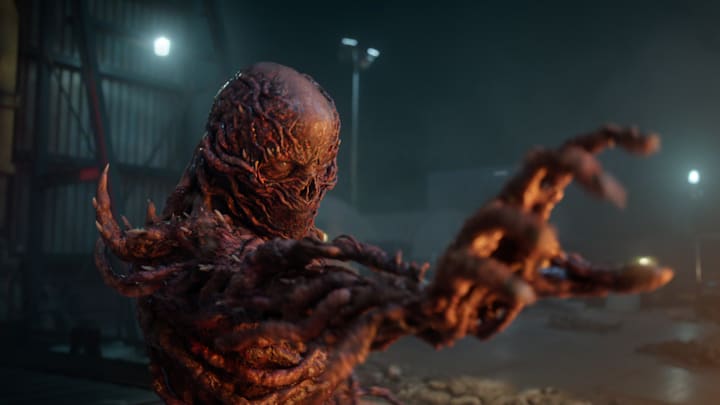
What makes a great villain? Is it a wickedly good performance? A ton of menace? The right ominous kind of presence? All of those elements undoubtedly vital roles in the making of a truly memorable antagonist, but the key defining trait of the best villains throughout history can be distilled to a single thing: they present a meaningful opposition to the protagonist.
A truly great villain needs to stand in the way of the story’s hero or heroes in a way that challenges them both on a surface and deeper level, enhancing the themes of the story and adding dynamic dimensions to the hero’s character arc. However, it is for this very reason that I am beginning to worry about Vecna’s role as the primary antagonist of the final season of Stranger Things.
Prior to the fourth season of the hugely popular Netflix series, Stranger Things was more or less a monster-of-the-season kind of story. The first season focused exclusively on the Demogorgon, the second on the Mind Flayer and his gang of Demo-dogs, and the third season spotlighted a fleshy real-world iteration of the Mind Flayer known as the Spider Monster.
Thus, the argument could be made that the central antagonist of these initial three seasons was the Mind Flayer; a faceless monster who changed forms and sent other faceless monsters after the heroes. This made the show’s famous Upside Down more of a nebulous zone, from which monsters emerged, but which audiences understood little about and empathized with even less. All of this was why the introduction of Vecna in the series’ fourth season was so exciting.
While Vecna, played by Jamie Campbell Bower, initially seemed like yet another monster-of-the-season (albeit with a bit more personality), it was revealed by the season’s midpoint that he was far more than that: he was the big bad of the whole series, who was retconned to having been responsible for everything that had emerged from the Upside Down thus far. This connected all of the previous seasons narrative into a single serialized story, all of which had been (unbeknownst to audiences) leading to Vecna; a character with a face, a personality, and a tragic backstory with real motivations.
This all seemed incredibly promising and set the show up to have an emotionally charged, high-stakes finale season. But with the first four episodes now released, Stranger Things’ final season is either playing things extremely close to the vest, or has little actual motivations for Vecna beyond the stock-standard material of ‘end the world.’
While the character was kept predominantly offscreen for the first three episodes of the season, he made his grand villainous entrance in the fourth episode, “Sorcerer,” and seemed poised to reveal his true motivations to Will Byers in a face-to-face encounter. And then he just… doesn’t. He says some standard villainous stuff, talks about kidnapping more children, but he fails to even hint at how any of this serves any purpose for him beyond simply doing villainous things.
With only four episodes left to go, this risks making the confrontation between the gang of Hawkins’ heroes and Vecna feel kind of limp.
If after all of this, Vecna’s motivations don’t extend beyond simply ‘end the world and ruin kids’ lives,’ then he might as well just be another faceless monster-of-the-season.
Stranger Things 5 continues with the release of Vol. 2 on Christmas (Dec. 25) and the series finale on New Year's Eve (Dec. 31).
 Add us as a preferred source on Google