

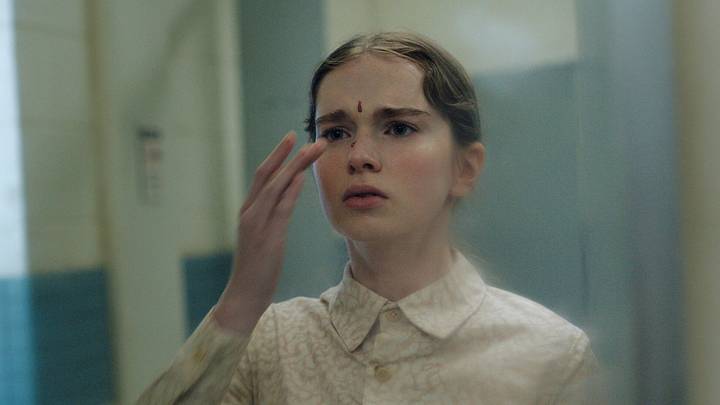
After years of anticipation, Mike Flanagan’s new Carrie TV series has now debuted, dropping all eight episodes simultaneously on Prime Video. In the lead-up to the release of the series, Flanagan revealed that in his “dream scenario,” the project would actually run for three seasons. This was surprising, to say the least, given that many were already dubious of the filmmaker turning one of Stephen King’s shortest novels into a full season of television, much less multiple.
But now, with the series released and the finale readily available for any and all to see, the context of such a quote has come into clearer view.
The reason that Flanagan is planning for multiple seasons for Carrie is because the show ends in a manner that is entirely different than King’s original novel. Instead of the tragic and conclusive final note that the book ends on, Flanagan’s take on Carrie White ends in a very different way that does actively set up further stories, should that be something that audiences and Prime Video executives are keen to see. But what exactly would Flanagan’s proposed “trilogy” of Carrie seasons look like? There are more than a few hints in the finale itself and in some of Flanagan’s other King-related works.

The Carrie finale gives us hints of where the story could go next
First off, let’s break down what’s so different about the ending of Flanagan’s Carrie series. The TV show introduces a new character by the name of Emaline early on, who is revealed to be someone with psychic abilities similar to Carrie’s, but with different actual skills. Emaline can project themselves across great distances and even possess people, to some degree.
This character acts as something of a confidant for Carrie throughout the series, helping the isolated young woman to hone her powers in palpable ways. In the final episode, Emaline plays a critical role in inspiring Carrie to lash out on prom night. By the episode’s end, Carrie has done many of the same things she does in the novel (killed nearly all the attendees of prom, started a fire that spread across Chamberlain, had a final conflict with her mother, etc.) but instead of dying as she did in the novel, she merely loses consciousness and is rescued by Emaline.
The final scene of the season is of Emaline and Carrie driving away from Chamberlain, with the former reassuring the latter that she is taking her somewhere safe.
This pairs with another element that is present throughout the season to a much lesser degree, which is the building up of mythos surrounding psychic individuals and some kind of long-waged war between those with abilities and those that wish to hunt them. Kate Siegel plays the leader of the psychic-users here, and Katee Sackhoff plays a leader of the faction that is hunting them down.
During prom, representatives from each of these warring groups are also present and involved, all of which seems to be setting up conflict for future seasons.
On top of all of this, the first episode of Carrie does give viewers a momentary glance at what appears to be a school for telepathically gifted individuals (very X-Men-esque) that Siegel’s character seems to be running. Thus, it would seem that Emaline would be taking Carrie to this school in the second season, where she would become more aware of others like her and the larger conflict she has unexpectedly stepped into.

The inter-connectedness of the Stephen King universe
Of course, the other big quantifier to all of this from the finale is that Siegel’s character explicitly refers to telepathic abilities as “shining,” which is a very loaded phrase in Stephen King storytelling.
“Shining” obviously relates to The Shining and to King’s sequel novel, Doctor Sleep, which are both about characters with telepathic gifts. Notably, Flanagan actually adapted Doctor Sleep into a feature film back in 2019 (if you haven’t seen it, check out the Director’s Cut, it rules) and helped to flesh out the entire idea of “shining” communities with the character of Rose the Hat (as played by Rebecca Ferguson) and her gang, The True Knot.
Will any of this explicitly tie into Carrie’s follow-up seasons? Not necessarily in such overt ways as having Danny Torrance show up to help save the day, but in more subtle ways, almost certainly. King’s whole multiverse of storytelling is famously interconnected, and Flanagan seems keen to explore other aspects of King’s fictional universes through the lens of Carrie’s future seasons.
 Add us as a preferred source on Google