

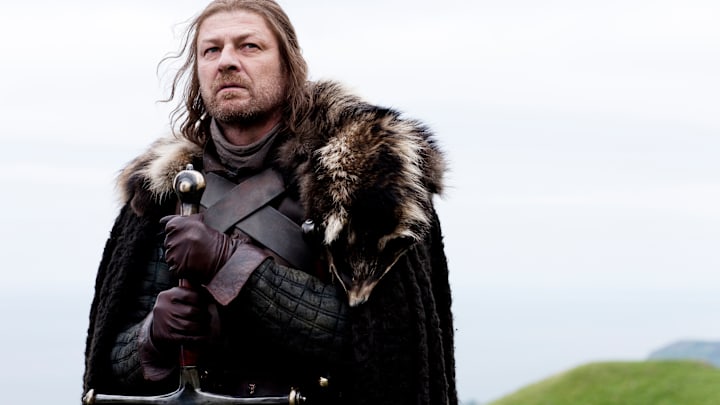
Despite only appearing in the first 10 episodes of Game of Thrones, the death of Sean Bean's Lord Eddard "Ned" Stark in the season 1 finale isn't something that fans have ever really recovered from. His brief arc remains one of the franchise's best-written storylines, even 15 years after HBO's adaptation of George R.R. Martin's fantasy book series broke a new generation of hearts.
Ned was the first major death in Game of Thrones, but he certainly wasn't the last. The show's "anyone can die" formula quickly emerged as one of its most darkly appealing traits. Regardless, even some of the deaths of characters who had appeared far more prolifically than Ned didn't hit quite as hard when they were shown on-screen. So, why is the late Lord of Winterfell's demise still so difficult to take? Let's talk about it.
Ned Stark did nothing to deserve his death
Game of Thrones often shone the brightest when it showcased its villains and morally ambiguous characters. Still, there were a handful of protagonists who were incredibly easy to root for. Ned Stark was the most prominent figure in this respect. Every action he took and everything he even considered stemmed from his intrinsically honorable nature. There was no malice anywhere in his soul, and the way he conducted himself proves that. The biggest stain on his record was the fact that he'd declared Kit Harington's Jon Snow to be his bastard, but even that was a lie put in place to keep his secret nephew safe.
All we ever see Ned do is act in the best interests of his family, friends, and king. As King Robert's (Mark Addy) Hand, Ned served without corruption or self-interest, which is incredibly rare for men who hold the position. It's impossible to analyze his character and find something that would have justified his gravely unfair execution at the hands of Jack Gleeson's King Joffrey Baratheon — an evil boy who should never have inherited the Iron Throne in the first place.
So, Ned's death is an ongoing reminder that Westeros is not a place for good men like Ned. He fought with bravery and honesty in a spirited attempt to keep King's Landing in line and operating as it should. The only reward he was given for his efforts was his head being removed from his body. After Ned was gone, whatever hope there was that things would eventually work out okay dissipated. There aren't many characters in TV where such weight can be placed on their shoulders — this is one of the biggest reasons why his loss is still so raw in 2026. The thought of what might have been is devastating.

Sadly, Game of Thrones doesn't happen without Ned's death
This is perhaps the harshest truth in the entire show. One of the largest tragedies of Ned's death is that it's necessary for the story to unfold as it did. If Ned had been successful in outing Joffrey as a bastard and making sure Stannis (Stephen Dillane) inherited the Iron Throne per the rightful line of succession, then Game of Thrones would have happened very differently. It wouldn't have been nearly as entertaining as a fantasy epic.
Let's imagine for a second that Stannis does become king after Joffrey's true lineage is revealed to the masses, then Game of Thrones likely becomes a fairly bland tale about a peaceful royal transition from Robert to his brother, while Ned stays on as Hand of the King. Westeros wouldn't splinter as it did, as the various armies marching on King's Landing to take revenge and/or the Iron Throne would have less reason to do so. Daenerys (Emilia Clarke) would still make her gradual approach, but with less division between the biggest armies in the Seven Kingdoms, she'd stand much less of a chance at achieving her goal.
So, Game of Thrones essentially introduces Ned as a lamb for the slaughter, framed as the hero that Westeros needs in the wake of Jon Arryn's death. If Bean's character had been allowed to survive, then Game of Thrones' story wouldn't have been worth telling. The tragic, frustrating end to his life is one of the most pivotal elements of the show's narrative design, making him a depressingly necessary loss for Game of Thrones.
Game of Thrones is streaming now on HBO Max.

April 17 marks the 15th anniversary of Game of Thrones' premiere, and our month-long celebration continues! We're ringing in the occasion with more deep dives, quizzes, lists, and retrospectives like this one, so if you're embarking on a rewatch and need some reading material to keep you occupied during the long nights, we've got you covered.
More Game of Thrones:
 Add us as a preferred source on Google