

For months leading up to the release of Zach Cregger’s Resident Evil, the writer-director and his team of collaborators were having to fend off unjust and largely unfounded accusations of unfaithfulness to the franchise from a very small but very vocal subsection of fans.
Despite Cregger making it clear time and again just how ardent of a fan he was of these games (specifically Resident Evil II and Resident Evil 4) these unsatisfied fans become increasingly convinced that Cregger’s film’s lack of established video game characters meant that the film would be a disservice to the franchise.
In actuality, nothing could’ve been further from the truth. Not only did Cregger pretty phenomenally capture the exact feeling of playing a Resident Evil game and put it up there on the big screen, he also created what was far-and-away the most beloved film in the franchise’s history.
Cregger’s Resident Evil broke box office records and netted the strongest reviews of the series by several miles, with nearly everyone in agreement that the film as a whole was exceedingly strong. However, one area of the film that incited a bit more contention was the brutally bleak ending. Some people loved it (yours truly very much included, it rules) and some people decidedly did not. Now, though, Cregger is revealing that the ending to Resident Evil was almost very different.
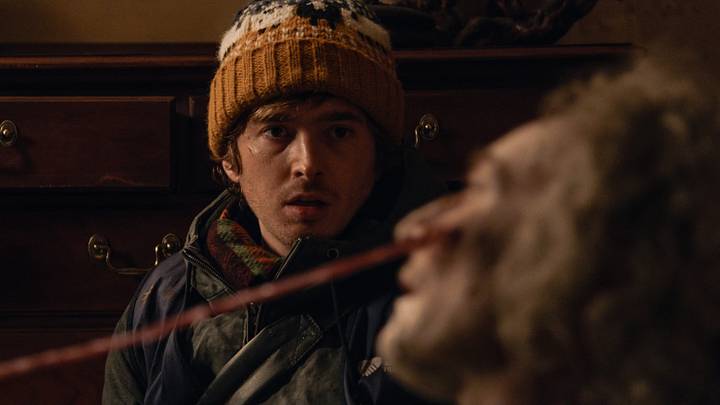
Cregger’s Resident Evil chronicles Bryan (as played by Austin Abrams), a medical courier who is making his way to Raccoon City General to deliver a package. What begins as an ordinary run becomes a descent into literal Hell, as he’s faced with a rapidly spreading infection of the T-Virus, and all the mutations and monsters that spawn from it.
Resident Evil ending explained (and how it almost went)
Around the midpoint of the film, Bryan is bit by one of these creatures, and proceeds to spend the rest of the film desperately trying to make it to Raccoon City General in time, so that the Umbrella Corporation can cure him before he turns. However, he ultimately just missed the mark, transforming into a monster inside the laboratory as the doctors are making the serum.
What ensues in the finished film is a complex sequence, in which Bryan the man is begging for the cure while all of the monstrous parts of him (tentacles, claws, etc.) are attempting to kill the doctors and snuff out the cure before it can be given to him. It all culminates with one last doctor attempting to stick Bryan with the needle, but ultimately being stopped by part of Bryan’s mutation, killed, and the cure destroyed. But, things almost played out very differently, according to Cregger.
In reference to the scene as it exists in the finished film, Cregger says, "Thank God I shot for this as a contingency plan, it was like my plan B.” He goes on to elaborate:
“Originally in the script, that scientist pulls the needle out and as soon as Austin grabs the woman's face, he drops it and it shatters. And then the rest of the movie is just Austin killing the scientist... and people were just like, 'No, like it's over, you know.' But I shot that shot of the scientist putting the needle in his pocket just because I had a feeling I was like, 'I feel like I'm going to need that.' And so then we were able to build a new sequence of the end... It keeps the stakes all the way until the end. It's like 'save him, save him,' whereas before it was just like 'kill them, I guess, kill them all, I don't know.'"
This is a great insight into Cregger’s creative process, and objectively an improvement. The idea to have Bryan turn into a monster in the lab is such a strong one, but the whole sequence would’ve been deflated by having the cure destroyed instantly.
Instead, by keeping that thread through to the film’s final moments, the entire sequence feels that much more devastating and emotionally engaging throughout. Great stuff.
Resident Evil is now playing in theaters.
 Add us as a preferred source on Google