

Science fiction is often known for big ideas and high-stakes plots that move quickly from one moment to the next. It's a genre that usually thrives on faced-paced storytelling that keeps readers hooked through constant forward motion.
But some science fiction stories take a different approach. These books put characters at the center, allowing their thoughts, relationships and personal journeys to lead the story. The alien worlds and advanced technology still matter, but the real plot has to do with the characters' heads and hearts.
These slower-paced stories give you time to really know the characters and feel for them. Today, we’ve put together a list of 10 such character-driven books that fans of thoughtful, slow-burn sci-fi will appreciate.

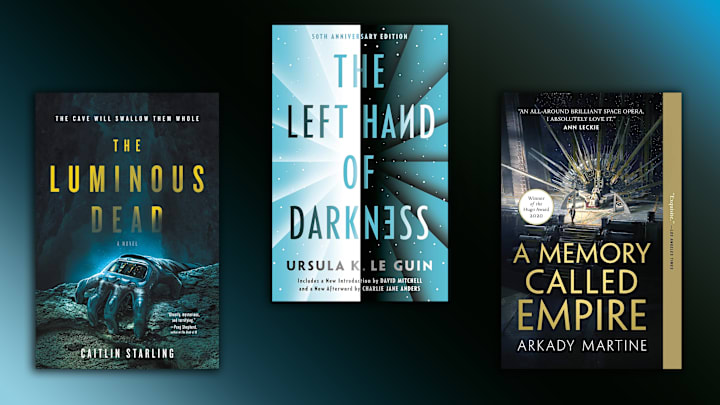
1. A Memory Called Empire by Arkady Martine
Arkady Martine's 2019 debut A Memory Called Empire follows Mahit Dzmare as she arrives at the heart of the vast Teixcalaanli Empire to serve as the new ambassador from Lsel Station, a small independent mining outpost. She carries within her an "imago-machine" which is a neural implant containing the consciousness and memories of her predecessor.
The problem is that something has gone wrong with the imago, leaving Mahit without crucial memories she needs to navigate the Byzantine court politics of the empire while investigating what happened to her predecessor and preventing her home station from being absorbed. She's aided by Three Seagrass, her liaison and unexpected friend, a Teixcalaanli bureaucrat who helps her navigate court intrigue.
Written by a former Byzantine historian, Martine weaves together influences from the Byzantine Empire, the Aztec Triple Alliance and medieval Armenia to create a richly detailed imperial culture. The novel explores questions of identity and cultural absorption. The pacing is deliberately measured allowing readers to immerse themselves in the worldbuilding and the psychological aspects of Mahit's situation as she tries to maintain her identity while carrying another person's fragmented consciousness inside her head.

2. The Left Hand of Darkness by Ursula K. Le Guin
Ursula K. Le Guin's 1969 novel The Left Hand of Darkness takes place on the frozen planet Gethen, also called Winter, where human envoy Genly Ai arrives with a mission to persuade its nations to join an interplanetary alliance called the Ekumen. What makes his task nearly impossible is that Gethen's inhabitants are ambisexual (neither male nor female for most of their lives), only taking on gender characteristics during a brief monthly period called "kemmer."
The novel follows Genly as he struggles to understand this culture through the lens of his own ingrained assumptions about gender and sexuality, constantly misinterpreting the actions and intentions of those around him. His most significant relationship develops with Therem Harth rem ir Estraven, the prime minister of Karhide, whom Genly initially distrusts because he can't read Estraven's motivations without the gender markers he's accustomed to.
The novel won both the Hugo and Nebula Awards for good reason. Le Guin uses the planet's unique biology as a thought experiment to examine how gender shapes our perceptions and societies. The pacing is deliberately measured allowing the relationship between Genly and Estraven to develop organically over months of political maneuvering and deepening understanding. It's as much about the slow building of trust between two individuals from vastly different cultures as it is about interplanetary politics and Le Guin never rushes either the worldbuilding or the emotional journey.

3. The Sparrow by Mary Doria Russel
Mary Doria Russell's 1996 novel The Sparrow unfolds in dual timelines that create an almost unbearable tension as the story progresses. The SETI program detects beautiful music from the vicinity of Alpha Centauri and the Society of Jesus organizes the first expedition to the source, a planet called Rakhat.
One timeline follows the mission as it happens, full of hope and the genuine warmth between the crew members. The other takes place decades later, where the sole survivor Jesuit priest Emilio Sandoz has returned to Earth physically and psychologically shattered. The crew includes linguist Sandoz, physician Anne Edwards and her engineer husband George, former child prostitute turned AI expert Sofia Mendes, one-eyed Texas ex-fighter pilot and Jesuit D.W. Yarbrough, and astronomer Jimmy Quinn, who first intercepted the signal.
Russell's debut novel asks big questions about suffering and the nature of God while never shying away from the brutal realities of first contact. The dual timeline structure means readers know something terrible happened but only slowly discover the details of how good people despite their best intentions, encountered tragedy. Winner of multiple awards including the Arthur C. Clarke Award, the novel takes its time to develop each character so that when things go wrong, it feels genuinely devastating. The slow burn sees Russell build real relationships between crew members before testing those bonds in unimaginable ways.

4. Ancillary Justice by Ann Leckie
Ann Leckie's 2013 novel Ancillary Justice introduces Breq, who was once the Justice of Toren, a massive starship with an AI consciousness distributed across thousands of human bodies called "ancillaries." After an act of treachery, she now exists as a single fragment in one human body seeking revenge against Anaander Mianaai, the Lord of the Radch, who happens to exist in thousands of bodies spread across the empire and is currently at war with herself.
Along the way, Breq encounters Seivarden Vendaai, an officer from the Justice of Toren who was in cryosleep for a thousand years and now grapples with addiction and a changed world. The only novel to win the Hugo, Nebula, Arthur C. Clarke and Locus awards, Ancillary Justice changed space opera through its innovative handling of identity, consciousness and gender.
Leckie uses "she" pronouns for all characters regardless of gender in the Radchaai language, which makes no gender distinctions, forcing readers to experience the same confusion Breq feels when interacting with cultures that do distinguish gender. It's mostly character driven and explores what it means to be a person when you've lost most of yourself, as Breq went from being thousands of bodies with one consciousness to being one body with fragmented memories. Much of the emotional weight comes from her grief over this loss and her struggle to maintain relationships when she can no longer be everywhere at once.

5. Station Eleven by Emily St. John Mandel
Emily St. John Mandel's 2014 novel Station Eleven begins on the night a famous Hollywood actor dies of a heart attack while performing King Lear. It's also the night a devastating flu pandemic begins its sweep across the world. Twenty years later, a traveling theater troupe called the Traveling Symphony moves between small settlements performing Shakespeare and classical music because "survival is insufficient."
The novel jumps between timelines, showing how various characters' lives intersected before the collapse and how those connections echo in the post-apocalyptic world. The cast includes Kirsten Raymonde, a member of the Traveling Symphony who was a child actor in that final performance; Miranda Carroll, the artist who created a graphic novel called "Station Eleven;" Jeevan Chaudhary, who tried to help during the collapse; and Clark Thompson, who becomes curator of a Museum of Civilization at an airport settlement.
Published six years before the COVID-19 pandemic, the novel feels eerily prescient but has a somewhat hopeful tone. Mandel's approach is elegiac, more concerned with grief, memory and the small ways people rebuild civilization than with action or survival sequences. It's a remarkably quiet post-apocalyptic story, winning the Arthur C. Clarke Award and appearing on The New York Times' list of the 100 best books of the 21st century.

6. The Long Way to a Small, Angry Planet by Becky Chambers
Becky Chambers' 2014 novel The Long Way to a Small, Angry Planet introduces Rosemary Harper as she joins the crew of the Wayfarer, a tunneling ship that creates wormholes between star systems.
The crew is a mishmash of species including Captain Ashby, Sissix the Aandrisk pilot, Dr. Chef a multi-limbed Grum physician whose species is considering peaceful extinction, human engineers Kizzy and Jenks (where Jenks is in love with Lovey the ship's AI), grumpy algae specialist Corbin and Ohan, a Sianat navigator whose ability to navigate spacetime is both a gift and a virus. When they take on a job building a tunnel to a distant planet, the journey tests their found family bonds.
Originally crowdfunded via Kickstarter, this cozy space opera prioritizes character development and found family over plot, and is done episodically with each section highlighting different crew members and exploring the nuances of interspecies relationships, sexuality, communication and their own individualities.
Chambers creates a genuinely optimistic vision of the future where humanity has learned from its mistakes and joined a diverse Galactic Commons. The novel tackles weighty themes like discrimination, the ethics of AI personhood and the trauma of war, but maintains a warm, often humorous tone throughout. It's "Star Trek" by way of cozy slice-of-life fiction. The slow burn here is literal and most of the book is just watching these characters live and work together, with the relationships deepening organically through small moments.

7. Solaris by Stanisław Lem
Stanisław Lem's 1961 novel Solaris follows psychologist Kris Kelvin as he arrives at a research station orbiting the planet Solaris which is covered by a vast, possibly sentient ocean. He finds the station in disarray with the remaining scientists acting paranoid and secretive. Kelvin soon discovers why when the ocean begins manifesting physical copies of people from the scientists' deepest memories. For Kelvin, this means the reappearance of someone from his past he'd rather not face.
Polish author Lem's masterpiece is somewhat about the impossibility of truly understanding the alien and, by extension, each other. Despite a century of study, humanity knows almost nothing about the Solarian ocean and Lem deliberately chose an ocean as his alien to avoid anthropomorphization. It's truly other in a way human-shaped aliens can never be. The "visitors" it creates are an inexplicable phenomena we desperately try to interpret through our limited frameworks.
The novel is philosophical and contemplative, spending considerable time on Kelvin reading scientific theories about Solaris and wrestling with complex emotions about memory and grief. The slow pacing serves the novel's meditative quality, forcing readers to sit with uncomfortable questions about consciousness, memory, love and whether communication across fundamentally different types of being is even possible.

8. The Dispossessed by Ursula K. Le Guin
Ursula K. Le Guin's 1974 novel The Dispossessed follows physicist Shevek as he grows up on Anarres, a harsh moon where society has been built on anarchist principles. Everything is shared, there is no government or property, and individual consciousness and group effort guide all decisions. The novel alternates between timelines, with one following Shevek's journey to Urras, the lush capitalist planet that Anarres orbits, and the other tracing his life on Anarres from childhood through his decision to leave.
Shevek is an independent thinker whose intellectual curiosity sets him apart and when he develops a revolutionary theory of time that could enable instantaneous communication across space, he finds himself dealing with the complexities of both societies. His personal life includes his partnership with Takver, a fellow scientist, though their lives are shaped by the challenges of their anarchist world.
Winning the Hugo, Nebula, and Locus awards, the novel is subtitled "An Ambiguous Utopia" because Le Guin refuses to present either society as perfect. The character-driven narrative explores Shevek's internal struggle between his desire for intellectual freedom and his commitment to his community's ideals, all while examining what true freedom might actually mean.

9. The Luminous Dead by Caitlin Starling
Caitlin Starling's 2019 debut The Luminous Dead takes place almost entirely in the claustrophobic confines of a cave system on the planet Cassandra V with only two characters driving the entire narrative. Gyre Price has taken a high-paying job as a cave diver desperate for the money. She expected a full support team on the surface but instead there's only Em, her handler, the voice in her ear and her sole connection to the outside world.
Gyre is sealed inside a specialized caving suit that feeds her, manages her waste and controls her senses through sonar-based reconstructions of the cave around her, making her entirely dependent on Em for survival. The cave itself is home to mysterious creatures and flooded sumps that require blind diving. As Gyre descends deeper, the psychological game between her and Em intensifies. Both women are lying, both are damaged by their pasts and both are using each other even as they develop a complicated emotional connection. Em is manipulative and grief-stricken, while Gyre is desperate and angry.
Nominated for the Bram Stoker Award for Best First Novel, the book is as much psychological horror as it is science fiction, exploring the emotionally complex dynamic between two women trapped in each other's orbit. Starling takes immense risks with the limited cast and single setting, but the character work is so precise and the tension so carefully calibrated that the novel never feels static. Most of the book is Gyre alone in the dark with only Em's voice, and the tension comes not from jump scares but from the gradual revelation of what both women are hiding and what they're willing to do to each other and themselves.

10. Rosewater by Tade Thompson
Tade Thompson's 2016 novel Rosewater, winner of the Arthur C. Clarke Award and the inaugural Nommo Award, is set in Nigeria in 2066, in a city that has grown up around a mysterious alien biodome. The dome appeared decades earlier when an alien entity called Wormwood crashed and eventually created this structure, releasing a fungal organism called xenoforms that interact with human nervous systems.
Once a year, the dome opens and miraculous healings occur but there are side effects. A small number of humans called "sensitives" can use the xenoforms to access the xenosphere, a shared information network that connects all living things. Kaaro, the protagonist, is one such sensitive and a former thief who uses his abilities for work with Section 45, a covert arm of the Nigerian government.
The story alternates between the present, where sensitives are mysteriously dying and Kaaro is investigating, and flashbacks to different periods of Kaaro's complicated past. Kaaro is a deeply flawed protagonist, cynical and self-serving, but Thompson never lets him off the hook for his behavior while also making him compelling and human.
The novel explores his relationships and his complicated feelings about being connected to the xenosphere while also wanting privacy. Thompson's Afrofuturist vision is visceral and biological. The character development is extraordinary with Kaaro's past slowly revealing how he became the damaged complex person he is in the present and the story never rushes this process.
If you're looking for science fiction that will stick with you, pick up any of these 10 books. They'll take you to frozen planets and alien oceans, to anarchist moons and imperial courts. But more importantly, they'll show you the people of the story up close and how they deal with the many impossible situations. And that's what the best science fiction has always been about.
 Add us as a preferred source on Google