

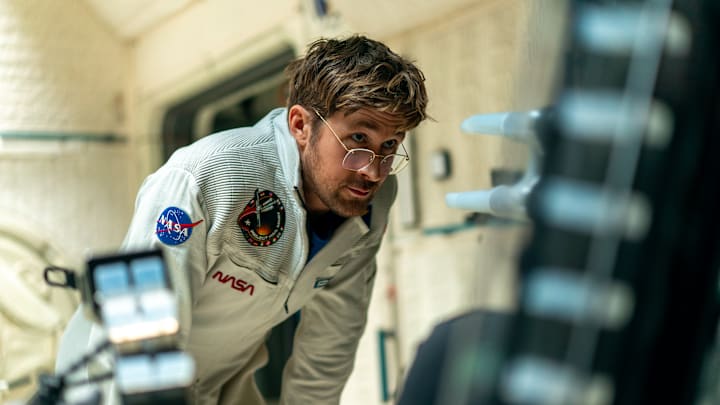
Project Hail Mary has finally landed in theaters and fans of Andy Weir's beloved novel are discovering just how directors Phil Lord and Christopher Miller, along with screenwriter Drew Goddard, reimagined Ryland Grace's journey for the big screen.
While the film stays true to the heart of the story that is the friendship between Grace and Rocky, there are some significant changes worth revisiting. Let's take a look at what the screen adaptation did differently than the book, and how those changes still nailed it.
11. The mystery of the crew's death (and Grace's amnesia)
In the film, the exact reason for Yao and Ivanovich's deaths isn't explored in much detail. More significantly, the amnesia drug subplot is largely omitted.
In Andy Weir's novel, there's a dark twist. Eva Stratt intentionally drugged Grace with a memory-suppressing medication before launch to prevent him from panicking or sabotaging the mission. The book also reveals that only 1 in 7,000 people possess a rare genetic trait that allows them to survive the induced coma, making Grace literally the only viable candidate for the mission.
The movie vaguely simplifies Grace's amnesia as a side effect of the coma itself, removing some of the moral complexity around Stratt's decision to essentially mind-wipe and shanghai Grace into space. It makes for a cleaner narrative, even if it loses some of the book's darker ethical questions.
10. Dimitri Komorov, the missing engineer
The movie completely removes Dimitri Komorov, the Russian engineer who designed the revolutionary spin drive. In the book, Dimitri is a significant character who works closely with Grace throughout the development of the Hail Mary mission. His expertise and presence were pretty important to the international cooperation aspect of the story.
While streamlining the cast makes sense for a film adaptation, losing Dimitri means losing some of the global collaborative spirit that made the book's Earth-side sequences feel truly worldwide in scope. But with all that going on with limited run time, perhaps one can't be too harsh with the directorial choices.

9. Eva Stratt gets to sing (And we love her human side)
The movie adds a karaoke scene where Eva Stratt, played brilliantly by Sandra Hüller, sings the heartwrenching Harry Styles song "Sign of the Times." The entire sequence, from the party gathering to Stratt taking the mic, is a movie invention designed to humanize her character.
According to the filmmakers, Ryan Gosling heard Sandra Hüller singing to herself on set between takes and asked if she'd sing in the movie. She agreed with one condition that she got to pick the song. With just 36 hours' notice, she chose "Sign of the Times," which Hüller described as coming from a playlist of "goodbye songs." The fact that it also references "breaking through the atmosphere" was, incredibly, a coincidence that lined up perfectly with the film's themes.
In the book, Stratt is portrayed as much harsher and more utilitarian, someone who makes the hard calls without showing much vulnerability or emotion. She is effective but not warm, though her human side is not exactly absent between the pages in the novel either.
God, I love the movie Eva Stratt and I love Sandra Hüller. Grace and Eva have such cool chemistry throughout the film, from their conversations on the deck to that moment when she later comes to do karaoke. The scene itself adds so much emotional depth to her character.
It's a farewell, a moment of shared humanity before the most important mission in human history. And honestly? It's one of the film's most powerful moments.
8. Grace's teaching motivation gets downplayed
The movie simplifies Grace's motivation for joining (or rather, being forced into) the Hail Mary mission. In the book, Grace returns to teaching after initially working on the Astrophage project and has a profound revelation when he looks at his students, realizing that these kids, all kids, will be the ones suffering if Earth's sun dies.
This "for the kids" motivation becomes central to his character and why he ultimately commits to the mission (before he has his memory wiped and is sent on a suicide mission, anyway).
In the movie, this specific teaching revelation and the "do it for the kids" angle isn't emphasized nearly as much. Grace's teaching background is established, but the emotional weight of that moment wasn't as cliché as I expected.
7. Antarctica climate countermeasures cut out entirely
The movie removes an entire subplot about buying Earth more time. In the book, Dr. François Leclerc proposes and implements a desperate measure by bombing Antarctica to release greenhouse gases, essentially creating controlled global warming to counteract the cooling from the dimming sun.
It's a fascinating and morally complex stopgap solution that shows humanity trying everything possible while the Hail Mary mission is being prepared.
The film is already juggling complex science and a dual timeline structure. Removing this subplot helps maintain focus on Grace's journey and the central Astrophage threat without getting bogged down in Earth-side parallel solutions.

6. Grace visits Rocky's ship — The movie's coolest gift (My absolute favorite!)
In what might be the movie's most exciting addition, Grace gets a xenonite suit and actually visits Rocky's ship, the Blip-A. In the book, thai never happens. Rocky always comes to Grace's ship instead.
In the film, after Grace gifts Rocky a laptop (now Rocky's "personal portable human thinking machine") and an Earth globe from his classroom (the same one we see him playing with in class and that Stratt also handles at some point in the movie, a nice recurring visual element), Rocky asks what he can give Grace in return. Grace asks to see Rocky's ship and Rocky arranges it.
So many, many, many thanks to directors Phil Lord and Christopher Miller and screenwriter Drew Goddard for this addition. You know how in nasapunk movies you're often disappointed when they tell you there are aliens but you don't really get to see them, it's just us humans somehow (yes, Interstellar I'm looking at you)? Project Hail Mary not only gives us our alien buddy Rocky, but we also get additional alien content in the ship itself!
The xenonite suit looks so cool, like diamond material, and you can actually feel the shininess and otherworldliness. And the whole inside of the ship, the reflective surfaces, everything is so carefully crafted. It's an extension of the original source material. The imaginative design work on display, even though we don't see the ship for very long, is still fantastic. I love it.
And I love how it comes about. Rocky wants to give Grace something meaningful after receiving such thoughtful gifts. Grace asking to see the ship is essentially the movie doing fan service by having Grace ask for fan service. It's perfect.
5. Who saves who: Rocky's near-death and recovery
The most dramatic rescue sequence in Project Hail Mary differs significantly between book and film, and both versions are intensely emotional in their own ways.
In the movie, during the disastrous sample collection mission from Adrian's atmosphere, the ship is damaged and Grace is crushed by centrifugal force and loses consciousness. Rocky, desperate to save his friend, breaks out of his protective ball spacesuit and enters Grace's oxygen environment knowing full well it could kill him. The oxygen causes Rocky's internal furnace to literally combust. Despite this, Rocky drags the unconscious Grace to the medical bay, where the ship's automated systems can help him. Rocky then barely makes it back to an intact section of his ammonia-filled tunnels before collapsing himself. When Grace wakes up, he finds this ominous trail of black stains (Rocky's mercury-based blood and burns from the oxygen exposure) leading through the ship and follows it to find Rocky in a vulnerable state, veering off into unconsciousness until he slowly recovers on his own.
The movie version is incredibly dramatic and intense. The audience sees Rocky's sacrifice in real time, watching him break free knowing it could kill him, desperately working to save Grace. It's powerful and I cried multiple times during the film. Even though I'd read the book and knew Rocky would survive, it was still so emotional watching it unfold on screen.
In the book, it plays out differently but is equally intense. Rocky still saves Grace first by entering the oxygen environment and getting him to safety, suffering the same internal combustion from oxygen exposure. But Rocky doesn't make it all the way back to his compartment. He collapses in the human section of the ship. Grace then has to save Rocky in return. He extends the centrifuge cables to reduce the spin, carries Rocky's 200-pound superheated body through the ship and opens the emergency ammonia valve to flood Rocky's side of the airlock with 210°C ammonia at 29 atmospheres. The process gives Grace severe chemical burns on his eyes, lungs and skin, and the ship's computer has to intubate him.
When Grace wakes six hours later, Rocky still hasn't moved, as his radiator vents are clogged with combustion soot. Grace builds a sealed steel box with a drill and air pump, attaches it to the airlock wall and blind-fires compressed air through Rocky's vents in a grid pattern until black smoke billows out, clearing the blockage. He's essentially performing emergency alien CPR. What Grace doesn't know until later is that the black "soot" he's clearing is actually part of Rocky's healing process and by trying to help, he accidentally made recovery harder. It's a long, desperate chapter of Grace doing everything he can think of to save his friend while not knowing if any of it will work.
Both versions are incredibly moving. The book gives us Grace's active, desperate attempt to save Rocky and Grace's willingness to burn himself and risk everything. The movie gives us Rocky's sacrifice captured visually, with him viscerally breaking out of the suit, the determination, the trail of evidence Grace follows to find his friend. Different mechanics of the rescue, but the same truth that they would die for each other.
4. Food crisis and Taumoeba eating plot cut
The final dilemma Grace faces at the end differs between book and film, though both present equally heart-wrenching decisions. In the movie, the concern is fuel. Grace discovers that the evolved Taumoeba can penetrate xenonite, meaning Rocky's ship made almost entirely of that material is vulnerable. The Taumoeba will consume Rocky's Astrophage fuel, leaving him stranded and doomed. Grace doesn't have enough fuel to both return to Earth and save Rocky. He has to choose. Go home to his planet or turn back to rescue his friend and save the Eridian species, knowing he'll likely never see Earth again.
In the book, the fuel issue is the same but there's an additional layer of horror. Grace also faces starvation. When he makes the choice to rescue Rocky instead of returning to Earth, he does so knowing he's on a suicide mission. The Hail Mary has limited food supplies and Eridian food is toxic to humans because of heavy metals. Grace accepts that he will slowly starve to death on Erid after he saves Rocky, but it's the price of doing the right thing.
But then Rocky refuses to let Grace die. Rocky suggests Grace try eating Taumoeba and it works. Sort of. Taumoeba keeps Grace alive, but barely. It doesn't provide adequate nutrition and Grace nearly dies from malnutrition anyway. Years pass. Eventually, Eridian scientists figure out a solution as they clone Grace's muscle tissue in a lab and create synthetic vitamins. Grace survives on Erid by eating lab-grown meat derived from his own DNA, which he grimly nicknames "me-burgers."
I think the movie's approach is more elegant in a way. The fuel dilemma creates a cleaner emotional choice, going home or saving Rocky. Skipping the whole Taumoeba-eating subplot and the deeply unsettling "me-burgers" detail keeps the focus squarely on the relationship between Grace and Rocky and the sacrifice he's willing to make for friendship.
3. The Beatles probes return and Eva Stratt's moment of closure
How we learn about Earth's fate differs significantly. In the book, Rocky explicitly tells Grace that Earth's sun is being restored and Grace knows the mission succeeded.
In the movie, Grace doesn't learn whether the mission worked. However, we as the audience do see a separate scene of Eva Stratt receiving the Beatles probes (the automated data-collection ships) in what appears to be a frozen research station. She's smiling at the video logs and toward the end she even does the Eridian goodbye gesture looking out the window that Rocky taught Grace, which he performed as a goodbye while closing the last recorded footage. She makes a call saying they're about to get started, which implies that the Taumoeba solution has reached Earth and they believe it will work.
This is a full-circle moment that provides closure not just for the mission, but for the relationship between Grace and Eva. We see that they don't have bad blood, and the ending suggests the audience shouldn't have any hard feelings toward Eva for sending Grace against his will either.
It's a closed, sweet, resolved moment. The fact that she performs the Eridian gesture shows she's watched all of Grace's logs and absorbed his experience, including his friendship with Rocky.

2. Time, age and open endings
The timeframe of the ending shifts dramatically in the movie. In the book, the epilogue takes place 16 years after Grace arrives on Erid. He is approximately 53 years old and needs a cane. He has lived a significant portion of his life there, grown old and his choice to stay is essentially permanent.
In the movie, the ending appears to happen much sooner after Grace's arrival. He is still relatively young and healthy, meaning he could still theoretically choose to attempt a return to Earth later.
So, the movie's ending is more open. Grace has just gotten to Erid and we don't know what he'll ultimately decide about his future. In the book, he has already lived a substantial life there and aged considerably, so the decision feels more final. The movie leaves more possibilities hanging in the air.
1. The beautiful Erid biodome (And Rocky at the door)
The living situation on Erid is vastly different between book and film. In the book, the biodome is described as minimal and somewhat underwhelming, fairly isolated with bare-bones furnishings. Grace can only meet Rocky in this one special specific room or chamber. That single room is his only form of contact with Rocky or anyone over all those years on Erid. It's a bit lonely and stark.
In the movie? God, the movie biodome is so beautiful! It shows an elaborate beach biodome with simulated ocean, rocks and mountains. A nice, bright, substantial piece of land designed for Grace. He is teaching Eridian children and the whole setup feels alive and warm.
Even better, Rocky practically wakes Grace up by banging on his door in a really cool clear xenonite suit (instead of the mobility ball, perfect upgrade from the ship). Then they both sit on the beach by the simulated sea and Rocky just plops down beside him. It's such a nice tweak where instead of meeting in a single utilitarian room, they have this beautiful space to exist together as friends.
The movie's version doesn't feel like exile. Grace could build a life with a community and maintain a real, tactile friendship with Rocky as long as he lives there. The brightness and openness of the biodome perhaps reflects the warmth of the choice he has made. And Rocky shares that the Hail Mary is ready to take him back to Earth when he decides. So it ends on a note of hope and possibilities that the screen adaptation nailed perfectly.

Project Hail Mary the movie is a masterclass in adaptation when it comes to knowing what to keep, what to change, and what to add. Directors Phil Lord and Christopher Miller and screenwriter Drew Goddard clearly understood that the heart of Weir's novel is the relationship between two utterly different beings finding friendship in the vastness of space.
The film maintains the optimistic problem-solving spirit of the book while making smart choices for the medium of cinema.
Most importantly, it keeps what matters most: the "fist my bump" friendship that reminds us why stories about connection, collaboration and choosing to help each other even at great personal cost will never go out of style.
 Add us as a preferred source on Google