

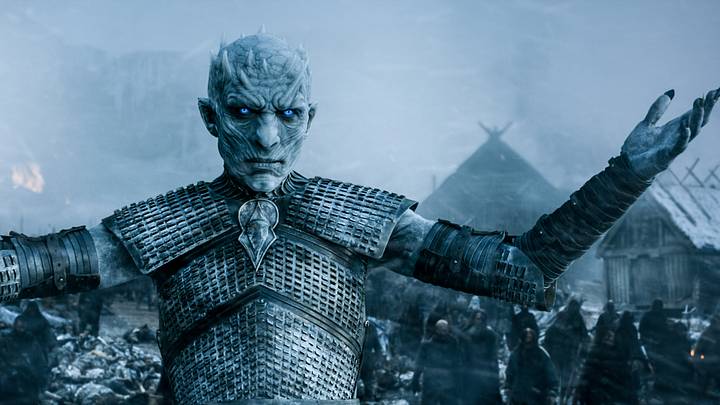
May 31 marks the 11th anniversary of Game of Thrones season 5 Episode 8, "Hardhome," one of the most spectacular — and confusing — installments of the series.
This showdown at the largest settlement north of the Wall was a shock at the time it aired, and it is often touted as a fan-favorite to this day. Still, "Hardhome" left some major mysteries unanswered in the show's canon, and raised some other questions about the version in George R.R. Martin's A Song of Ice and Fire novels. All these years later, fans are still concocting theories about it.
"Hardhome" primarily follows Jon Snow's (Kit Harington) largest ranging beyond the Wall after he becomes Lord Commander. He leads a force including Night's Watchmen and Free Folk northeast in the hopes of retrieving survivors of Mance Rayder's host. In the midst of the evacuation, the White Walkers descend on them, leading to one of the most chilling battles in the entire TV series.
The episode is also notable for bringing Tyrion (Peter Dinklage) and Daenerys (Emilia Clarke) together for the first time, and for Theon (Alfie Allen) finally revealing to Sansa (Sophie Turner) that her younger brothers are still alive. It was a massive success for HBO, with over seven million viewers watching live and six nominations at the Emmys the following year.
Hardhome's mysteries aren't solved in the show or the books

While the clash with the Others was a feast for the eyes and captivating to the imagination, "Hardhome" left viewers with a lot of questions — whether they had read the books or not. Despite getting this up-close look at the White Walkers and their wights, we still didn't learn much about the mechanics and limitations of their powers. Meanwhile, the show didn't explain how there was such an organized settlement north of the Wall, or why the Free Folk hadn't fortified it before.
Martin shed some more light on Hardhome in A Dance with Dragons, as well as The World of Ice and Fire. Hardhome was built alongside a natural harbor where the Free Folk could trade with merchants from Westeros and Essos. The town was controlled by four Wildling "chieftains," who maintained the peace. However, in the books' continuity, Hardhome was destroyed in a mysterious, fiery disaster about 600 years before the main story got started.
Fan theories about Hardhome have become particularly popular online recently, with many interesting new ideas about how and why the city was consigned to one of Old Nan's tall tales. There are compelling cases to be made about volcanic activity, caves with natural gas leaks, and conspiracies involving the maesters. Martin has clearly planted the seeds for a story here, but there's no telling if it will ever be told in books or on the screen. The Winds of Winter will need to tell us more about the current state of Hardhome, but that's no guarantee its mysteries will be solved.
“Dead things in the water”

"Hardhome" is one of the biggest changes between HBO's Game of Thrones and Martin's A Song of Ice and Fire. In the books, Jon Snow did not lead a ranging to Hardhome himself, though he desperately wanted to. Instead, he ordered the men of Eastwatch to sail north to Hardhome by sea, hopefully rescuing the Free Folk while minimizing the risk of encountering the Others.
Later in the book, he received a raven from Cotter Pyke, commander of Eastwatch, who asks for reinforcements as the battle is not going well. His cryptic note warns of "Dead things in the woods" and "Dead things in the water."
That line has led many fans to theorize about how the Others' powers may extend to the sea. We've seen them raise dead horses and bears as wights, so it's not unreasonable to imagine them raising dead sharks, whales, or other sea creatures to attack the Night's Watch ships. Some fans also wonder if the army of the dead itself may be able to walk across the bottom of the seafloor, since wights don't need to breath. It's possible that the wights are climbing the anchor chains and swarming over the Night's Watch ships, with no regard for how many they lose along the way.
Those are just fan theories at this point, but it's clear that the line "dead things in the water" is leading somewhere. Jon Snow and his allies were betting that the White Walkers couldn't attack them at see, and one way or another, this line indicates that they were wrong. That could have far-reaching implications for the rest of the story, as the Others could move across Westeros more quickly and perhaps even venture across the Narrow Sea, depending on what powers they display here.
On TV, Jon Snow and his allies narrowly escaped to sea, and the White Walkers weren't able to follow. The scene where he watched the Night King raise all of his fallen soldiers back on the shore is certainly haunting, but it also confirmed that they have no naval power.
Later, that made it logical for Euron Greyjoy (Pilou Asbæk) to retreat from Westeros and hide on the Iron Islands. Euron is very different in the books, and even if he could avoid this fight, he doesn't seem like the type who would want to. It seems inevitable that the events at Hardhome are setting up a major surprise for the war between the living and the dead.
The persistent mysteries around "Hardhome" are part of what makes this episode so unforgettable, even 11 years after its premiere. It's also one of the earliest major departures from the books in Game of Thrones, even if many fans don't realize it. Hopefully one day, we'll be able to compare this episode with The Winds of Winter and decide which is more terrifying.
 Add us as a preferred source on Google