

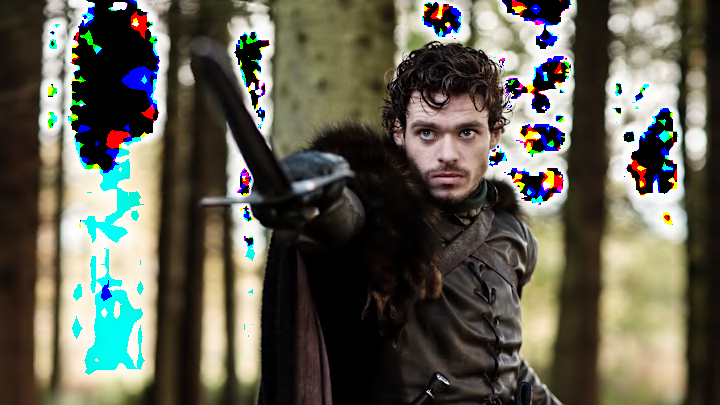
With Game of Thrones celebrating its 15th anniversary, many fans are revisiting the show's earliest days with a rewatch of season 1. The season that started it all adapted A Game of Thrones, the first book in George R. R. Martin's A Song of Ice and Fire series, to near perfection, setting Thrones on its path to becoming a cultural juggernaut.
Season 1 is filled to the brim with unforgettable episodes. The series' first episode, "Winter Is Coming," beautifully introduces the characters, world, power dynamics, and even the underlying threat of the undead. "Baelor," the ninth episode of the season, shocked TV audiences around the world by killing off Eddard "Ned" Stark (Sean Bean), who had essentially been serving as the show's main character up until that point. And the season finale, "Fire & Blood," ends the story on a high note as Daenerys Targaryen (Emilia Clarke) emerges from a pyre with the first dragons in over a century.
However, another season 1 outing is just as good as these three iconic episodes, but lacks their universal praise. Perhaps it became somewhat buried due to falling in the middle of the season, or came across as outclassed by the later episodes which raised the stakes. Regardless, this season 1 gem should be listed among the best episodes in all of Game of Thrones.

The hidden strengths of "A Golden Crown"
Season 1, Episode 6, "A Golden Crown," takes place in the aftermath of Ned's confrontation with Jaime Lannister (Nikolaj Coster-Waldau) and his men. As such, Ned spends much of the episode in recovery while ruling in King Robert Baratheon's (Mark Addy) place. Meanwhile, Tyrion (Peter Dinklage) stands trial in the Vale, Bran (Isaac Hempstead-Wright) survives a wildling attack, and, across the Narrow Sea, the Dothraki have begun to accept Daenerys as one of their own, much to the chagrin of her brother, Viserys (Harry Lloyd).
Each of these plot lines escalates quickly, and thematically ties into the rest of the series. For instance, Bran's sole surviving attacker, Osha (Natalia Tena), soon becomes one of his closest friends and allies, foreshadowing the ever-shifting alliances throughout the Seven Kingdoms. This is far from the only time an enemy becomes an ally in Game of Thrones.
Additionally, Tyrion's time in the Vale sets up an important theme throughout the show. Knowing Lysa Arryn (Kate Dickie) will stack the odds against him, Tyrion demands a trial by combat. When he can't get his brother Jaime to fight for him in time, Bronn (Jerome Flynn) volunteers to fight for Tyrion against Lysa's champion, Ser Vardis Egan (Brendan McCormack).
Vardis, being a knight, fights honorably, but falls to Bronn's sneak attacks and underhanded tactics. Lysa, livid at Tyrion's victory and the death of her man, shouts "You don't fight with honor!" Bronn simply points to the moon door, where Ser Vardis' corpse fell, and mutters, "He did." This sets up the themes of how honor can sometimes work against you in the world of Westeros, teasing the eventual death of Ned Stark.
Speaking of Ned, his storyline contains one of the early season's most iconic plot twists. When his daughter Sansa (Sophie Turner) mentions wanting to have "golden-haired babies" with her betrothed, Prince Joffrey Baratheon (Jack Gleason), Ned delves further into the research of his predecessor as Hand of the King, Jon Arryn (John Standing), and discovers the secret that got him killed: Every previous Baratheon has sported dark hair, meaning Joffrey and his siblings are not, in fact, the children of King Robert, but instead, bastards born of the incestuous union between Queen Cersei Lannister (Lena Headey) and her brother Jaime.
This secret has been staring both Ned and the audience right in the face. Viewers have known about Jaime and Cersei's affair since the first episode, and the casting, costuming, and hair and makeup teams took great care to ensure that Joffrey resembled Jaime far more than Robert. And yet, the reveal still comes across as a shock, despite how obvious it seems in retrospect, thanks to some pitch perfect filmmaking,
Finally, the episode's crown jewel is Daenerys' plotline in Vaes Dothrak. For the first time in her life, Daenerys finds a home among the Dothraki, as they fully embrace her as their Khaleesi despite her being an outsider. This further enrages Viserys, who becomes jealous of her love and attention, and he attempts to escape the city and steal Dany's dragon eggs on his way out. However, he is stopped in his tracks by Ser Jorah Mormont (Iain Glen). Shortly thereafter, a drunk Viserys stumbles into Khal Drogo's (Jason Momoa) tent and threatens Daenerys, an act which seals his death warrant. To avoid shedding blood in the scared city, Drogo melts down some gold and pours it over Viserys' head, giving him the "golden crown" he so desperately desired in his final moments.
This episode showcases huge character growth for Daenerys, who, despite Viserys' pleading, sides with her new people, and Jorah, who stands up to Viserys, finally realizing that following Dany would be a better way back to Westeros. Without these developments, Daenerys would not become the liberator of Astapor, Yunkai, and Meereen that audiences would universally come to love.

What "A Golden Crown" means for the rest of the show
Game of Thrones usually positions its penultimate episodes and season finales as the biggest episodes of each seasons. Most fans will list the likes of "Blackwater," "The Rains of Castamere," "Battle of the Bastards," or "The Winds of Winter," all the ninth or tenth episodes in a given season, as their favorites. However, as "A Golden Crown" proves, some of Game of Thrones' best outings aren't necessarily its flashiest, but instead, their subtle strengths help elevate an entire season, and by extension, the entire series.

Our Game of Thrones 15th anniversary celebration continues all month long, with more retrospectives, deep dives, and explorations of the iconic fantasy series that changed the face of television. Embarking on a rewatch and want some reading material to get the most out of it? We've got you covered!
More Game of Thrones:
 Add us as a preferred source on Google