

Here’s the thing about fantasy and sci-fi in recent years. It wasn't about spectacle for spectacle's sake. This was a year when worldbuilding slowed down, ideas were allowed to breathe, and directors trusted mood, texture, and performance again. Big swings existed, sure, but the films that lingered were the ones willing to sit with ambiguity instead of racing toward IP-friendly answers.
The following are nine fantasy and sci-fi films from 2025 (and a few from 2024) that mattered, and might just become your next favorite watch.

Dune: Part Two
Denis Villeneuve’s Dune: Part Two is the rare blockbuster sequel that narrows its focus while expanding its implications. Rather than escalating purely through volume or spectacle, the film sharpens its thematic blade, interrogating messianism, colonial power, and inevitability with an almost austere confidence.
Villeneuve understands that Arrakis is not just a setting but an ideological pressure cooker, one that transforms belief into weaponry. Timothée Chalamet portrayal of Paul Atreides is no longer a reluctant heir but an increasingly unsettling figure, and the film is wise enough to let that discomfort linger. The sandworms, the battles, the architecture of empire are all breathtaking, but the real achievement lies in how calmly the film lets destiny become menace. This is science fiction as cautionary epic, not power fantasy.

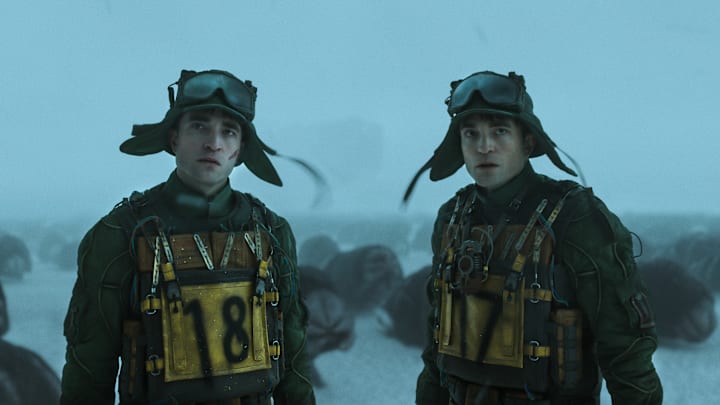
Mickey 17
Bong Joon-ho once again proves that no one working today is better at smuggling existential dread inside an accessible genre framework. Mickey 17 uses cloning not as a novelty but as a philosophical trapdoor, asking what happens when a human life becomes infinitely replaceable. The humor is dry, occasionally cruel, and deliberately destabilizing. Robert Pattinson gives a performance that is both precise and disarming, finding pathos in repetition and disposability.
Bong’s control is evident in how the film gradually shifts tone, from absurdist sci-fi comedy into something colder and more accusatory. It is a film about labor, being expendable, and of being necessary only insofar as you can be erased.

Furiosa: A Mad Max Saga
George Miller returns to the Wasteland not to outdo Fury Road, but to contextualize it. Furiosa is slower, harsher, and more mournful, concerned less with velocity than with accumulation. This is a story about what it costs to survive long enough to become myth.
The action, in true Mad Max fashion, remains ferocious, but it is framed as endurance rather than spectacle. Miller’s gift for visual storytelling is undiminished, but here it serves purpose in showing how trauma calcifies into identity.

The Substance
Coralie Fargeat’s The Substance is confrontational science fiction in the truest sense, using speculative technology to interrogate autonomy, self-worth, and bodily control. The film refuses subtlety because subtlety would dilute its point. Instead, it leans into exaggeration and discomfort, weaponizing genre aesthetics to expose the violence embedded in perfection culture.
What makes this film compelling is not shock value but intention. Every grotesque flourish is tethered to a coherent thesis. This is not science fiction meant to soothe or inspire. It is meant to provoke, to unsettle, and to leave residue.

Kingdom of the Planet of the Apes
This installment is worth mentioning because it understands that the strength of the franchise has always been its ability to reflect human behavior at a remove. Set generations after Caesar, Kingdom of the Planet of the Apes explores how ideology mutates when memory fades and symbols replace lived experience.
The film is patient, almost meditative at times, allowing its world to feel genuinely evolved rather than cosmetically altered. Power structures emerge not through villainy but through misinterpretation and fear. It is science fiction that respects intelligence and trusts its audience to sit with ambiguity. The result is one of the franchise’s most thoughtful chapters.
Civil War
Alex Garland’s Civil War operates as speculative fiction with a journalist’s eye. While its premise is incendiary, the film resists sensationalism, instead focusing on observation and consequence.
The near-future setting is deliberately under-explained, making the collapse feel disturbingly plausible. Garland frames conflict not as ideology but as atmosphere, something that corrodes daily life and perception. The film’s power lies in its restraint, in its refusal to provide comfort or catharsis.

Superman
James Gunn’s Superman takes a quietly radical approach by treating optimism as a narrative risk rather than a default. In a genre crowded with cynicism and deconstruction, the film embraces sincerity without irony. Gunn grounds Superman’s power in moral consistency rather than spectacle, presenting heroism as an act of choice rather than destiny.
The science fiction elements serve the character rather than overwhelming him, and the result is a film that feels confident in its simplicity. It is not revisionist, but it is thoughtful, suggesting that hope itself can be a disruptive force. Hope and kindness are the real punk rock, after all.

The Fantastic Four: First Steps
After years of misfires, The Fantastic Four: First Steps finally understands that this team works best as explorers, not icons. The film leans into scientific curiosity, cosmic wonder, and interpersonal tension, framing its science fiction through discovery rather than destruction.
The family dynamic is central, messy, and convincing. Rather than rushing toward universe-ending stakes, the film allows ideas to unfold, giving its speculative concepts room to breathe. It feels less like a corporate mandate and more like an actual attempt to honor the intellectual spirit of the source material of the comics.
The Gorge
The Gorge closes the list with a reminder that scale is not synonymous with impact. This tightly controlled science fiction narrative thrives on isolation, routine, and psychological pressure. Its speculative premise is deployed sparingly, allowing character and atmosphere to dominate.
The film trusts silence, trusts implication, and trusts the audience to engage without handholding. It is a disciplined piece of genre filmmaking that understands tension as an accumulation rather than a spike. Though the second half was panned as being predictable by critics, standout performances from both Teller and Taylor-Joy were a treat to see.
Together, these films suggest that 2024-2025 was a year when fantasy and science fiction matured into something more deliberate, and more adult. The genre’s strongest voices were not chasing novelty or spectacle, but consequence, authorship, and thematic cohesion. These are films that linger in your mind because they are confident enough to speak clearly and let the implications settle.
 Add us as a preferred source on Google