

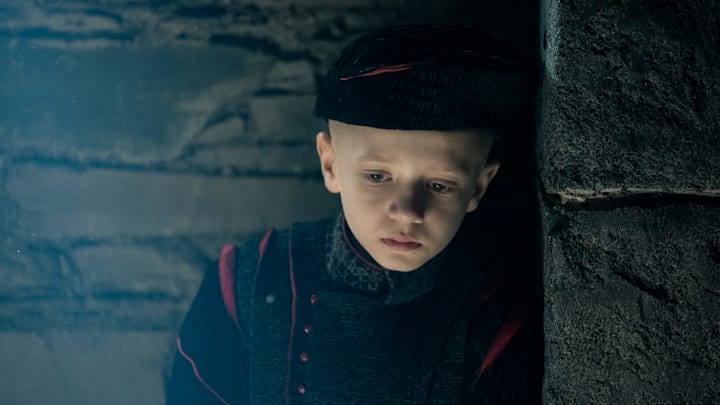
After five episodes, A Knight of the Seven Kingdoms finally killed off a major character. The fifth episode of the season, "In the Name of the Mother," proved to be the bloodiest of the series so far. The episode focused on the trial of seven, the climactic battle between Ser Duncan the Tall, aka Dunk (Peter Claffey), and Prince Aerion Targaryen (Finn Bennett). Both men have assembled teams of seven to fight for judgement of the gods, with six other knights joining the fight on either side.
The fourth episode of the series, "Seven," ends with Dunk finding his seventh and final knight when Prince Baelor Targaryen (Bertie Carvel), Aerion's uncle, rides in to fight alongside Dunk and his men at the last minute, allowing the trial to proceed. However, this proves to be fatal for Baelor, who suffers a head wound, causing him to collapse and die shortly after Dunk wins the trial.
Before his death, Baelor appeared in four episodes, playing a fairly large role in each. This makes him A Knight of the Seven Kingdoms' biggest character to die so far. The show's two predecessors, Game of Thrones and A Knight of the Seven Kingdoms, both kill huge cast members left and right, so A Knight of the Seven Kingdoms is now creeping closer to their level of bloodthirstiness with Baelor's demise.
The first major character to die in each of the three Westeros shows all have something subtle in common, and discussing their similarities can help highlight a key storytelling trend for George R.R. Martin.
Back before it developed a reputation as a killing machine, Game of Thrones featured its first major character death in its sixth episode, "A Golden Crown." In Vaes Dothrak, Daenerys Targaryen (Emilia Clarke) finally finds herself embraced by the Dothraki. This enrages her older brother Viserys (Harry Lloyd), who feels entitled to that respect and praise as the rightful heir to the Targaryen dynasty.
In a drunken stupor, Viserys attempts to steal his sister's dragon eggs, but is thwarted by Ser Jorah Mormont (Iain Glen). Then, the so-called Beggar King stumbles into a Dothraki celebration, demanding the respect he feels he deserves. After Khal Drogo (Jason Momoa) denies him, Viserys draws a sword, a forbidden act in the sacred city, and threatens Daenerys and her unborn son. Drogo responds by melting down some gold and pouring it over Viserys' head, killing him without weapons or drawing blood, and giving Viserys the "golden crown" he had spent his whole life fighting for.

The first major character to die in House of the Dragon is...also Viserys Targaryen. However, this Viserys, played by Paddy Considine, predates Lloyd's character by around 150 years.
Up until his death in the eight episode of the first season, "The Lord of the Tides," Viserys essentially acts as the main character of House of the Dragon. By this episode, Viserys' illnesses have made him decrepit and confused, and he's only able to slowly limp to the Iron Throne. He finally dies shorlty after telling his wife Alicent (Olivia Cooke) that he believes "Aegon Targaryen" will save Westeros from the "coming darkness."
While Game of Thrones fans know that this refers to Jon Snow (Kit Harrington), Alicent assumes Viserys is talking about her son, also named Aegon Targaryen (Tom Glynn-Carney), leading to the brutal Dance of Dragons, in which Aegon competes for the Iron Throne against his half-sister Rhaenyra (Emma D'Arcy).
In his dying breath, Viserys calls out to his deceased first wife, Aemma Arryn (Siân Brooke), without any idea of the carnage he unknowingly caused.

All three of these deaths change the order of succession. Baelor, who was the heir to the Iron Throne at the time of his death, leads to the eventual coronation of his younger brother, Maekar (Sam Spruell). Lloyd's Viserys' death means his younger sister Daenerys is the last Targaryen (or so she thinks). And Considine's Viserys' succession became so convoluted it led to one of the most devastating wars in Westerosi history.
George R.R. Martin's stories often use changes in succession as an inciting incident. In a world with such a strong emphasis on who the current king is, a deviation from the expected order of succession makes for a notable historical event, and places an unlikely character into the spotlight.
 Add us as a preferred source on Google