

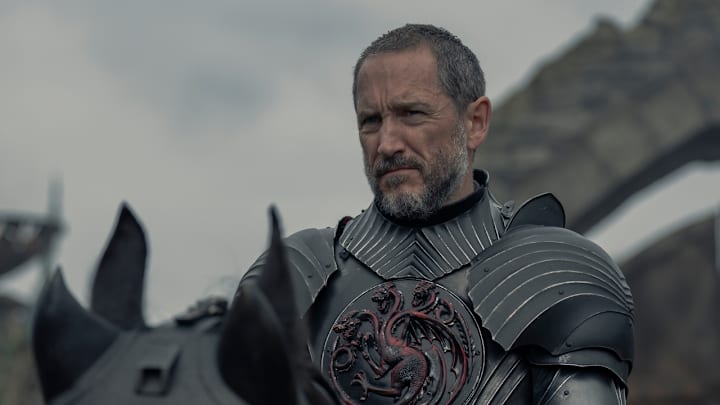
This past weekend, A Knight of the Seven Kingdoms delivered the most shocking Game of Thrones moment in years, and we're still reeling. "In the Name of the Mother" featured the trial of seven where Ser Duncan the Tall (Peter Claffey) secured his innocence by defeating the sadistic Aerion Targaryen (Finn Bennett), marking one of the bloodiest showdowns in the franchise. At the end of it all, Dunk is left with a mess of terrible wounds...yet it's not the hedge knight who succumbs from the battle, but the stalwart prince Baelor Targaryen (Bertie Carvel), who pledged to fight for him at the eleventh hour. Dunk can only watch on in horror as Baelor's helmet is removed and peels away the back of his head along with it, the result of a terrible mace blow from his own brother, Maekar (Sam Spruell).
Baelor's death is an insane twist right up there with the death of Ned Stark in George R.R. Martin's first A Song of Ice and Fire book, and it will send similar ripples throughout history as the noble heir to the Iron Throne is replaced with less ideal rulers in the years to come.
Yet while Baelor is indisputably a heroic figure in the lore of Westeros, and his coming to Dunk's side represents arguably the most triumphant moment of the show's first season, it's also a rare instance where the Targaryen prince besmirched his own honor. Because while it may have been the right thing for him to fight for Dunk even against his own family, Baelor's plan in the trial relied on a devious tactic that undermined the ability of his opponents to fight fairly.

The gods judged Baelor...and found him wanting
Before the trial begins, Baelor gives Dunk's team a pep talk, urging them not to die and revealing a key part of his strategy: the three Kingsguard knights fighting for Aerion are sworn to protect the royal family. That means all of the royal family, including Baelor. Even though he's fighting against them in a trial, their oath prevents them from harming him. Baelor plans to exploit this weakness to keep the Kingsguard knights at bay, hopefully giving Dunk enough time to defeat Aerion.
In the book, Lyonel Baratheon questions the honor of this tactic; in the show, it's the zealot knight Ser Robyn Rhysling (William Houston) who asks, "Is that honorable, Your Grace?" Baelor responds that "The gods will let us know."
This is a key reminder that the whole point of trial by combat as a tradition isn't just to allow people who are better at fighting to escape justice, but that in the view of the Andals, these trials let the gods shine favor on those they deemed innocent, while striking down those who are guilty. Yes, the tradition is twisted beyond recognition by the time Cersei Lannister employs the unbeatable Gregor Clegane into her service in Game of Thrones, but that doesn't change that at its heart this is a religious solution to legal matters. And while we can debate whether the Faith of the Seven gods are real or not in Westeros, divine justice has had a habit of rearing its head in unexpected ways during these contests.
For as heroic and typically honorable as he may be, in this one instance, Baelor did something underhanded. His actions undoubtedly saved Dunk's life, from warding off the Kingsguard to duking it out with his brother, Maekar. Yet as Maekar fought desperately to save his son, he accidentally struck a mortal blow to Baelor's helm. It's a terrible tragedy for House Targaryen and the realm at large. But if the gods, in their cold and clear way, looked down on this contest, it's hard to argue that Baelor is one of those whose actions tried to overcome the trial with tricks. The result speaks for itself; I'll leave it to the septons to decide whether the gods had a hand in it or not.

The gods showed their favor in other ways during the trial of seven
While Baelor's death is obviously the highlight of the trial, there are a few other ways it could be argued that the gods favored those who fought righteously. The clearest is Raymun Fossoway (Shaun Thomas), the young squire who steps up after his cousin Ser Steffon (Edward Ashley) betrays Dunk and defects to Aerion's team in hopes of winning a lordship. Raymun offers himself up in Steffon's stead, throwing himself head first into a deadly fight to the death in order to reclaim his family's honor and protect his friend.
Raymun makes it through this battle relatively unscathed, fighting admirably and matching his senior cousin blow-for-blow. This prevents the duplicitous Steffon from gaining that quick path to a lordship he coveted. And if you know the novellas, you know that Raymun will gain a bit more glory from this over time, as House Fossoway changes because of his actions.

Then of course, there's the clash at the heart of the trial between Dunk and Aerion. While both believe in their respective causes, Aerion was acting out cruelty to even call this trial in the first place, since Dunk was only honoring his oath as a knight to protect the innocent by saving Tanselle (Tanzyn Crawford) from the prince's wrath. Aerion fought well, but ultimately he fell to the hedge knight, who spared his life without a second thought once the trial was deemed over.
The fallout from this trial for Aerion is going to be severe. Not only did he bring immense dishonor to his house by instigating it in the first place, his antics also got the heir to the Iron Throne killed and made his father an accidental kinslayer. Dunk's star, on the other hand, is on the rise. Yes, he will be haunted by the specter of Baelor's death for years to come, but he's also at the beginning of a long, winding journey that will see him honorably serve the realm as one of its most storied knights.
So did the Seven have a hand in Baelor Targaryen's death, and the dishonor of Aerion Targaryen? I suppose it's all a matter of belief. But if you look at Baelor's actions, it's hard to argue that in this one instance, the honorable prince relied on a dishonorable tactic, and paid the ultimate price.
The season finale of A Knight of the Seven Kingdoms premieres February 22 on HBO and HBO Max.
 Add us as a preferred source on Google