

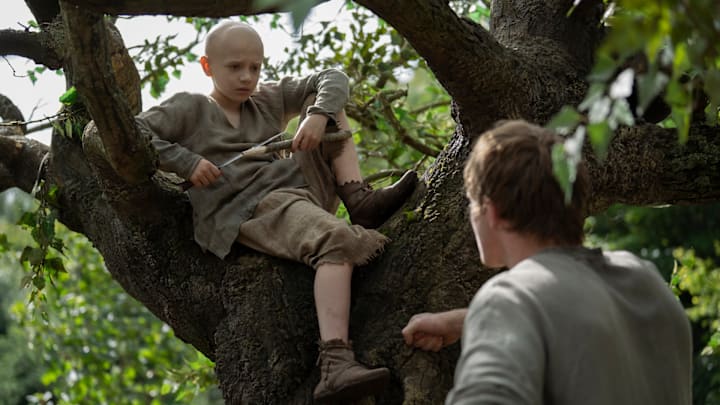
In Episode 3 of A Knight of the Seven Kingdoms, titled “The Squire," the young squire in question sings a funny ballad on the morning of the first day of jousting at the tourney of Ashford. To the untrained ear, it could initially sound like just another song, but fans of George R.R. Martin’s books will recognize that the ballad is a historical account of the battle of the Redgrass Field which put an end to the First Blackfyre Rebellion, a civil war that threatened to destroy Westeros in 196 AC.
In-word, the ballad is known as “The Hammer And The Anvil”. The one recited by Egg appears to be the censored version of a lewd song probably sung in the brothels of King’s Landing.
Let’s analyze the lyrics and unpack their meaning.
"The Hammer And The Anvil" lyrics
Prince Baelor was the firstborn
Baelor Targaryen, the gallant prince we met in Episode 2, was the first son and heir of King Daeron II The Good and his wife Queen Myriah Martell. Prince Baelor was born in 170 AC. When his father ascended the Iron Throne, Baelor inherited the title of Prince of Dragonstone.

Prince Maekar sprang out last
Maekar Targaryen, Prince of Summerhall, was the fourth son of King Daeron II and Queen Myriah, their last child. We also met him in Episode 2.
Daemon was a bastard so they kicked his bastard —
It’s clear to everyone that the verse should have continued with the word “ass,” right? Notice how the next verse starts with the word “grass”… I’m not making this up? But Egg being an adorable little prince, sings a court-friendly version.
Anyway, Ser Daemon was a bastard son of King Aegon IV, known as Aegon the Unworthy. Technically, as a bastard of the Crownlands, Daemon’s last name should be Waters, and when his father legitimized him, it could’ve become Targaryen. But Daemon also received Blackfyre, the sword of Targaryen kings, from his father, and decided to make that his entire brand and thus adopted Blackfyre as his last name. Targaryen kings… they name sons after Daemon Targaryen and expect them not to cause trouble?
Grass is green in summer, green grass I adore
But grass is red all over when you kill a rebel —
Okay, for the non PG-rated version, the obvious rhyme here would be “whore,” especially if you consider the assonance with the next word being “horse,” but don’t take my word for it.
These verses refer to the Redgrass Field, the plain outside King’s Landing where the two enemy armies fought the final battle of the Blackfyre Rebellion, and sealed the future of the Iron Throne and Westeros. Over 10,000 men died in the bloody battle, which gave the field its name.
Horses die in battle
This battle was the front
Blackfyre’s not a trueborn
He came from the wrong —
We all know that the next word is supposed to be “cunt” — the following word is “country," don’t try to deny it. Daemon’s father, King Aegon IV, sired way too many bastard children all over Westeros, many on highborn women. Those came to be known as the Great Bastards, and Daemon was the greatest of them all; his mother was Princess Daena Targaryen, the king’s own cousin, also known as Daena the Defiant.
Country was in peril
The Blackfyre rebellion bled the Seven Kingdoms dry. The open civil war may have lasted for only a year, but the unrest lasted much longer and had many dire consequences in the decades to come. The Targaryen victory was a close call; Daemon had many supporters in Westeros, even in the smallfolk. To Egg, a member of the royal family, the possibility of the bastard line prevailing is horrific.

The Anvil was a rock
Prince Maekar commanded his forces to crush the rebel host between them and the army commanded by his elder brother, Prince Baelor Breakspear. After the Battle of the Redgrass Field, he was nicknamed "the anvil" for his strategy.
The Hammer smashed the bastard with his giant veiny… host of Dornish spearmen.
Prince Baelor, in charge of an army of Stormland and Dornish men, broke the enemy lines from their rear and forced them towards the rest of the loyalist forces led by his brother Maekar and earned the nickname of "the hammer". The word that Egg spares us is obviously “cock” — sorry.

Egg’s redacted version of the song
Egg was born in 200 AC, four years after the battle had taken place, and we know that Westerosi bards are quick wits when it comes to composing hits. “The Hammer and the Anvil” must have been around for quite some time before Egg came to hear the lyrics and retain it.
One question haunts me: does Egg censor himself, or was he taught the PG-rated version of the song? I would have no trouble believing that Egg heard the original song from his brother Prince Daeron and chose to censor the bad words, but wouldn’t it be sweeter to imagine that someone sang him the kid-friendly version?
Not his father Prince Maekar, for sure, because that man has probably never known the joy of singing, never mind that the song is about his own heroic deeds. So was a Septa involved in teaching Egg the song of how his father smashed the rebellion? Or was it a maester? Wait, was it Egg’s older brother Prince Aemon, the sage Maester Aemon we know and love from Game of Thrones? That would be quite adorable. I will be busy picturing that until we are told otherwise.

What did you think of "The Hammer And The Anvil," and did you imagine different lyrics?
A Knight of the Seven Kingdoms Episode 3 is now streaming on HBO Max.
 Add us as a preferred source on Google