

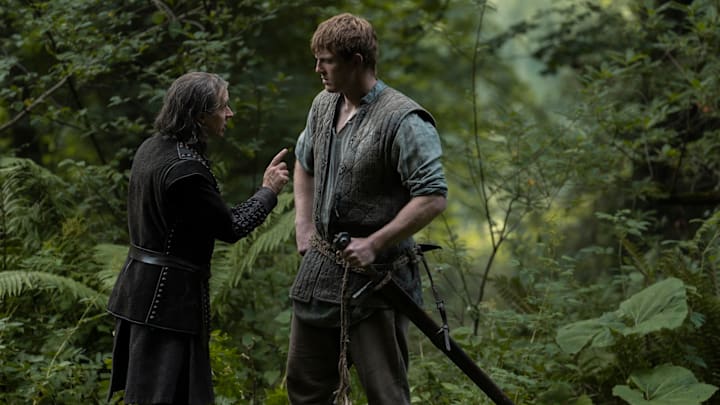
The third episode of A Knight of the Seven Kingdoms marks the turning point of the season and upends the scale. This is, possibly, the strongest episode of the entire first series.
There’s a before and an after in Dunk’s life, and the ending of this episode is the divide. In “The Squire,” Egg’s identity is revealed, and nothing will ever be the same. The course of the tourney of Ashford will change, as will the whole of Westeros.
Writers Hiram Martinez, Annie Julia Wyman, and Ira Parker did an admirable job adapting Episode 3 and finding the perfect balance between staying true to the novella (the unparalleled “The Hedge Knight” by George R.R. Martin) and adding new material that rendered the episode less straightforward and more captivating.
News scenes in Episode 3 of A Knight of the Seven Kingdoms
We explore the characters through a few show-original scenes. The first is an adorable montage of Egg waking up before dawn to train with Thunder. The young squire’s eager dedication to Dunk is admirable and the way he speaks to the horse is so delicate and sweet. “A horse doesn’t want to be ordered about any more than a man does. Ser Duncan only has us.”
We also get an introduction to Ser Robyn Rhysling when he interrupts Egg’s training. In the book, Ser Robyn is mentioned almost in passing, so this new scene works in two ways: first, it adds a layer of potential danger to the scene, and second, the audience is guaranteed to remember the character (“the maddest knight in the Seven Kingdoms”) for when the storyline needs him to matter later, as opposed to if he were introduced as just another knight during a joust.
Best quote of the episode: “I serve Ser Duncan the Tall. He’s large enough for the both of us.”

When Egg returns, Dunk is sewing a patch on a garment. It is clear from his expression that he was upset when he woke and didn’t see Egg and Thunder, although I’m willing to bet he was more concerned for his young squire’s safety than about him potentially making off with his warhorse (aka his most prized possession). After a few stern words, he resolves to teach Egg how to sew a patch, and we are gifted with Dunk’s excitement when Egg gets it right.
This episode, we hear a version of a famous in-world ballad titled “The Hammer and the Anvil” that tells the story of how Prince Baelor and Prince Maekar defeated the rebel host of Daemon Blackfyre, the pretender. We first got a brief mention of Daemon in Episode 2 (and we went into the history in our recap), and the audience is slowly being fed more information on who he was. The song Egg sings is so iconic that we are dedicating a separate article to it — there’s too much to unpack.
Another show addition is the foreboding scene where the fortune teller offers Dunk and Egg to tell their futures. The foreshadowing is strong. And we’re talking about a remote future, decades down the line, chronicled in The World of Ice and Fire, very far from the three currently published novellas.
Differences between AKOTSK and "The Hedge Knight"
The changes from the book are done so gracefully that you could re-read the novella and not notice the difference, or argue that the show’s version is way more hilarious. In the episode, Dunk spends the morning in anxiety with the expectation of entering the lists, until Egg informs him that he won’t be fighting that day. In the book, this conversation is covered with the line “His belly felt hard as a rock, even though he knew he would not ride today. The right of first challenge would go to knights of higher birth and greater renown, to lords and their sons and champions from other tourneys.” How could we trade this with the peak comedy that is Dunk asking Egg why he’s been vomiting all morning?
The funny moments just keep coming. If somebody only watched the first three episodes, they could probably walk away believing A Knight of the Seven Kingdoms is a comedy show. Where the novella gives us a simple “they were able to break their fast on goose eggs, fried bread, and bacon,” the episode regales us with Dunk trying to communicate with the farmer that he shouldn’t kill the bird by mimicking a goose laying eggs, only for Tanselle to witness it and Egg to tease him about it. The Robin Hood-esque music tops it off. Plus, those eggs looked beyond delicious. I bet goose eggs Google searches will spike after the episode.

Plummer’s offer to Dunk to stage a victory in the list is an addition of the show. In the novella, we see that both sons of Lord Ashford are doing quite well in the tourney, and when they are defeated, it’s after long fights with formidable foes, lords Lannister and Baratheon, and Dunk notices Lord Ashford looking quite proud of his sons. The show chose to go with a different, but no less plausible story: that despite how well Ser Androw Ashford is faring, he will need to lose to an unlikely foe, so that the household can win an unbelievable bet and get back some of what they’ve spent on this lavish tourney. Although this begs the question… how big is the betting pool? Quite large, if the Ashfords are content with Androw losing to an upstart knight no one’s heard of and bequeathing his horse, arms and armor to him.
This is another clever aspect that anchors A Knight of the Seven Kingdoms to reality and makes it so tethered and down to earth. Westeros feels more real if the characters are dealing with the same things the audience is, like worrying how much we can afford to spend on an eccentric birthday party. We’re hardly ever allowed to consider something as pedestrian as money in Game of Thrones, focused as we are on monarchs and great lords that are so far removed from us, but knights and lesser lords need to eat through winter just like we do.
Episode 3 has everything: suspense, comedy, action, a thickening plot and compelling characters. What more could we ask for?
Episode rating: A+
 Add us as a preferred source on Google