

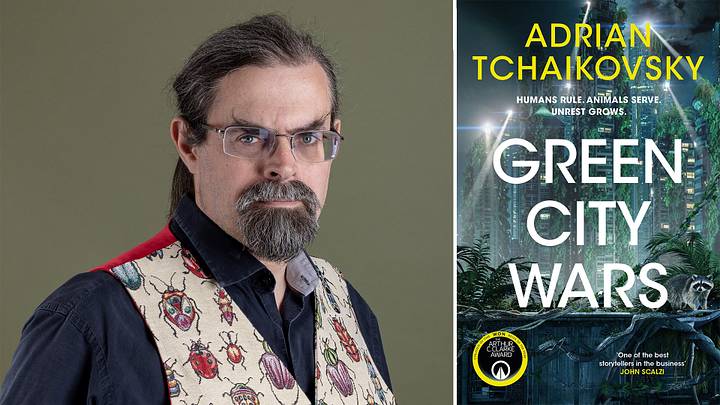
Adrian Tchaikovsky is one of the biggest and most beloved names in science fiction and fantasy right now. He's the British author behind the Arthur C. Clarke Award-winning Children of Time series, the Final Architecture space opera trilogy, the 10-book Shadows of the Apt fantasy saga and a string of fan-favorite standalones including The Doors of Eden, Elder Race and last year's Service Model. Before turning to full-time writing, he trained in zoology and psychology and spent years working in law in Leeds, and that scientific grounding shows up everywhere in his fiction, most obviously in his enduring genuine love for non-human minds, whether they belong to uplifted spiders, war dogs, or now, a raccoon detective.
That raccoon is Skotch, the hero of Green City Wars, out from Tor Books in the US on 23 June and in the UK on 25 June. Ahead of release, we got to ask Tchaikovsky some questions about the novel.
Tchaikovsky has described it as a fun book in the way his previous Tor title Service Model was a fun book, meaning the humour is doing a lot of work to make some fairly serious ideas go down easily. Under the genre pastiche and the daft pop-culture gags he says he included largely for his own amusement, Green City Wars is interested in pharmaceutical dependency and labour exploitation. It's also, notably, a standalone, though Tchaikovsky has left the door open for Skotch to return if the book finds an audience and the right idea comes along.
We asked Tchaikovsky to walk us through where the premise came from, how deep the raccoon research went, why Neuwien ended up so Germanic and what it's like balancing the laughs against the darker machinery running underneath them. Here's what he had to say.

ASH ANJUM for WINTER IS COMING: A raccoon PI navigating a solar-punk animal underworld is such a wonderfully specific premise. It feels like it could only have come from you. What was the actual spark that made this click into a real book you knew you had to write?
ADRIAN TCHAIKOVSKY: So I tend to wander around the animal kingdom in my writing and I hadn't really done urban animals yet. I feel a lot of animals that share human spaces have a very bad rep – people resent them despite the fact that it's usually us who've moved into their habitat. I have also been thinking about solar futures, sustainability, and from that somehow came the idea that people could get urban animals to work for people as a carbon neutral form of infrastructure. How I got from there to a noir detective story with Skotch the raccoon I couldn't rightly say.
WIC: The drug plangent, the thing keeping animals intelligent, ends up being the entire power structure of Neuwien in a single mechanic. It's so elegant. Did that come early in the worldbuilding, or did it reveal itself as you were writing?
AT: Definitely part of the worldbuilding – that's the usual way with me. It's a narrative driver, but it also feels like the way people would set up a "system" that they rely on, even if that system is also a biosphere.
WIC: There's such obvious affection for raccoon biology baked into Skotch – the "waschbar," "Herr Bandit," the hand dexterity, all of it. How deep did the research rabbit hole go for this one, and did you discover anything that genuinely surprised you?
AT: There's a lot of fun stuff with raccoons – they're perfect uplift candidates, and also ideal little helpers if you're looking for a servitor species. I was surprised that they win fights with cats in the wild – I had to beef up the cat in the book to be a plausible threat to Skotch. I also found that raccoons really are bears, or at least evolutionarily they split off from bears relatively recently.
WIC: The red vs. gray squirrel turf war is such a cool specific real-world thing to drop into a sci-fi noir. Was that always the plan, or did it start as a throwaway detail that kept growing?
AT: That is the titular Green City War, and it's a very UK thing – we have native red squirrels that are endangered because introduced US grey squirrels are beefier and have pushed them out of much of their habitat. Growing up in a rural UK area, it was something you heard a lot about.
WIC: Every classic noir archetype is here – the femme fatale stoat, the corrupt snapping turtle chief, the cat assassin. Were you consciously playing with the genre's cliches, or did casting animals in those roles naturally twist them into something new?
AT: I think if you set out to write a Noir then you really have to include a nod to all the traditions of the genre. I read quite a few of the classics to get a handle on the structure, pacing and trappings, and then had a lot of fun working out the equivalents for my little critters.
WIC: Neuwien has such a vivid and specific Germanic flavour with the language, the setting, the cultural references. What drew you to central Europe as the home for this world?
AT: Partly my main research source is based out there, so it's a nod to her. Also, between the Third Man, and Gibsonesque Cyberpunk, an American visiting an unfriendly European city is quite a common trope in this sort of story. It felt that I was tapping quite a rich tradition.
WIC: Green City Wars sits in a fascinating spot in your catalogue. The tone is lighter and funnier than something like Children of Time, but the underlying horror of pharmaceutical dependency and labour exploitation runs pretty deep. How do you think of it yourself – as a fun book, a dark book, or something that refuses to be either?
AT: It is a fun book – much like its predecessor at the same publisher, Service Model. Except that it's also a very serious book because those are the books I cram the jokes into, to make them palatable. On the other hand it really is a fun book, or at least for me, because I have so many daft pop culture references in there, mostly just for my own amusement.
WIC: It's apparently a standalone, which feels almost cruel given how rich this world is and how much we've grown to love Skotch. Is that truly final, or is there a version of the future where he gets another case?
AT: Most of my books are standalone until I write a sequel – that's usually how it goes for me. If the book does well and an idea occurs, there might be another!
WIC: Last one – You've conquered epic fantasy, hard sci-fi, horror and noir. Is there a genre you haven't cracked yet that you're already quietly plotting?
AT: Yes, but it's a bit early to talk about it. Watch this space!
Green City Wars is available now from Tor wherever books are sold. To learn more, visit Adrian Tchaikovsky's website.
 Add us as a preferred source on Google