

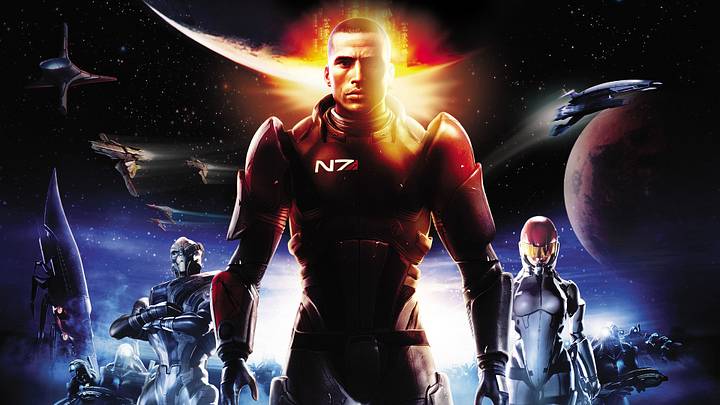
It's been a difficult time for fans of Mass Effect, the beloved sci-fi RPG video game series from legendary studio Bioware. On October 21, the news broke that Bioware's parent company, Electronic Arts, was shuttering the studio and canceling its long in-development fifth Mass Effect game. While it has been a turbulent time in general for the video games industry, the loss of Bioware hit differently. Fans have rallied to start a petition to #SaveMassEffect. One of the developers working on Mass Effect 5 leaked a trailer which had been circulating internally at the studio, giving fans a glimpse at the vibe and tone of the forthcoming game, which we learned was titled Mass Effect: Universe. Other game studios have come out of the woodwork to lament the loss of BioWare and reflect on how influential its works were, from CD Projekt Red to Larian Studios and far too many others to list here. It's been...a lot.
As we all continue to process this huge change in the video game landscape, it's a good time to look back on Mass Effect as a whole. We've journeyed around the Milky Way and to Andromeda, and need to look back on those travels now that we know the chances are all but set that we'll never get more. Unless of course that fan effort wins out, but even then, it's hard to know what a revived Mass Effect would look like without the BioWare teams that breathed life into the series in the first place.
Board the Normandy or Tempest, and let's go once more into the great beyond.
4. Mass Effect: Andromeda
Look, is anyone actually surprised that Mass Effect: Andromeda places last on this list? The highly divisive follow-up to the Mass Effect trilogy was always going to have a nigh-impossible bar to clear, so it didn't help that Andromeda launched with tons of glitches and gaps where it was clear the game developers had more planned, but were forced to pare things back for a variety of reasons.
All that said, I'll be straight with you: I absolutely love Mass Effect: Andromeda. Its story of a massive, daring space migration into a new star system, with all the exploration and adventure that implies, was a breath of fresh air after the often brooding intensity of the first three games. Andromeda often shined most when it leaned into those ideas, such as its systems designed around improving planet viability for colonists and the gradual construction of its central hub, the Nexus.
Despite its flaws, Mass Effect: Andromeda is an exceptional game, with memorable companions, slick combat that actually exceeds its predecessors, and vast explorable worlds that were filled with secrets to uncover. It's unfortunate that the game's reception was muted enough that EA and BioWare abandoned their plans for expansions and sequels, which could have improved the overall Andromeda arc dramatically in the same way that they did for the original games.
3. Mass Effect
The original Mass Effect came out back in 2007, so it's no surprise that from a gameplay perspective, it's the least fluid of the lot. The remastered version in 2021's Mass Effect Legendary Edition went a long way toward evening out that experience, but really, gameplay was never the first Mass Effect's greatest strength. That was all in the storytelling, which launched the series with an insanely high bar for both narrative detail and player choice.
Mass Effect had the daunting task of introducing players to a whole galaxy full of aliens, where humans were the new kids on the block amidst a complex political climate they were just starting to understand. Into that morass steps Commander Shepherd, the first human promoted to the elite rank of Spectre — a special operative with carte blanche to pursue the most sensitive and important missions needed for galactic safety.
It's a testament to how strong the first Mass Effect was that all of its companions became series mainstays, returning for later installments to varying degrees. (If they survived, at least — because make no mistake, this game made you decide which of your friends you were going to send to the grave.) Mass Effect has a shorter, tighter main campaign than any of its sequels, but its focus on optional exploration and story moments that got players invested laid the groundwork for what was to come.
2. Mass Effect 3
In many ways, Mass Effect 3 is a perfect example of what fans lost out on with Andromeda when BioWare was forced to abandon their long-term plans. The end of the trilogy was originally the most divisive entry in the franchise, both for its brutal ending choices as well as several key plot threads that were left hanging. However, with the release of several subsequent DLCs, including the fan-favorite Citadel expansion, Shepherd and their friends finally got the ending they deserved.
Mass Effect 3 picks up at the height of the Reaper War, when the main threat of the series that Shepherd has been trying to stop since the trilogy's opening minutes finally arrives in the Milky Way. While its companions aren't quite as beloved as those in some of the other titles, Mass Effect 3 has improved gameplay mechanics and a sense of tension in its story that's only rivaled by the late-game of Mass Effect 2, where it feels like every choice you make and mission you fulfill is a race against the clock before the big finish. It's also an extremely cinematic entry, with some of the most breathtaking and emotional sequences of the entire series.
Whatever issues it may have had at launch, as it stands now, Mass Effect 3 serves as a perfect conclusion to an incredible story. Without it, it's unlikely that the trilogy as a whole would have stood the test of time as well as it has.
1. Mass Effect 2
Just like you probably weren't surprised to see Andromeda at the bottom of this list, is there anyone who's really shocked that Mass Effect 2 comes in first? This game is the one that truly cemented the series an all-time great, and 16 years after it first launched, it's still just as amazing as ever.
Mass Effect 2 flips the script, taking Shepherd from their honorable service for the Citadel and dropping them into the viper's nest of Cerberus, a shadowy organization run by the mysterious Illusive Man with extensive resources and a drive to do the things no one else is willing to for the galaxy. At least, that's how it seems at first; over time, the organization's paper-thin morals become ever harder to ignore.
The second game in the trilogy sees Shepherd assemble a crack team of operatives to get to the bottom of a string of attacks far from Citadel-controlled space, where colonists are being abducted by an alien species called the Collectors. The group of companions is the largest and by far the best out of any of the Mass Effect titles, with plenty of clashing personalities and memorable interactions aboard the Normandy. It should go without saying that this game has far more romance options as well, always a staple of the Mass Effect series.
Yet while its gameplay is an overall improvement on the first game and its storytelling reaches new heights, the place where Mass Effect 2 truly becomes legend is in its final act, where Shepherd leads their elite team on a rescue mission into the heart of Collector space. That journey forces Shepherd to choose which tasks their various companions undertake, and depending on the choices made throughout the game as well as in this sequence, the result can vary from everyone making it out alive, to literally no one, not even Shepherd themself.
The "Suicide Mission," as it's called in the fandom, isn't just the best part of any Mass Effect game; it's one of the best video game endings, period. When we look back on the series, there's no doubt that Mass Effect 2 and its jaw-dropping end gauntlet deserve their flowers as the pinnacle of the franchise.
 Add us as a preferred source on Google