

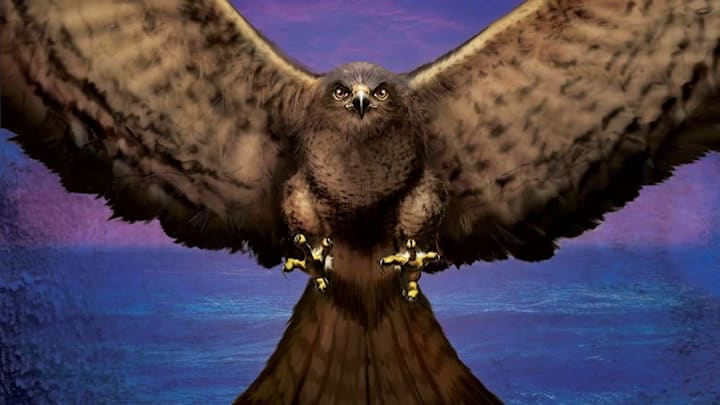
Ursula K. Le Guin's Earthsea Cycle stands as one of the most acclaimed fantasy series ever written. Le Guin crafted a world of philosophical depth and elegant prose across six relatively short books published between 1968 and 2001. Each volume explores big themes of identity, power, gender, and mortality while subverting traditional fantasy tropes.
The series divides into two trilogies. The original three books (1968-1972) follow young protagonists in coming-of-age tales, while the later trilogy (1990-2001) adopts a more mature perspective exploring gender dynamics and the nature of power through middle-aged characters.
What makes ranking these books difficult is that each excels in different ways. Some are tighter narratives, others more ambitious in scope and a few challenged the very foundations Le Guin had built. Here's how all six Earthsea books rank, from the one that resonates least to the masterpiece that crowns them all.

6. Tales from Earthsea (2001)
Tales from Earthsea is a collection of five stories spanning Earthsea's history, from the founding of the wizard school on Roke hundreds of years before Ged's time to glimpses of different characters across various eras.
The stories include "The Finder" (about the establishment of Roke during dark times), "Darkrose and Diamond" (a love story between a witch's daughter and a merchant's son), "The Bones of the Earth" (young Ogion preventing an earthquake), "On the High Marsh" (a broken mage finding redemption in a remote village) and "Dragonfly" (a woman disguised as a man seeking admission to Roke).
Landing at number six doesn't mean Tales from Earthsea is bad. It simply suffers from being a short story collection in a series of powerful novels. While some stories are exquisite (particularly "The Finder" and "On the High Marsh"), others feel slight. The collection serves more as worldbuilding supplement filling gaps between Tehanu and The Other Wind. It's surely valuable context for devoted fans but the weakest entry for newcomers.

5. The Farthest Shore (1972)
The Farthest Shore follows a mysterious malaise spreading across Earthsea where magic is fading, songs are forgotten, people and animals sicken. The now-mature Ged, serving as Archmage of Roke, sets off on a quest with Prince Arren of Enlad to discover the source of this unraveling. Their journey takes them to the edge of the known world and beyond, even into the realm of death itself where they confront a wizard who has opened a breach between life and death in his desperate quest for immortality.
The Farthest Shore won the 1973 National Book Award and is a powerful meditation on mortality and what makes life meaningful. Seeing Ged as a mature, wise mentor adds gravitas and the philosophical explorations of death's necessity are profound.
The journey to lands beyond maps again goes on to show the mythic quality Le Guin excels at. However, it ranks fifth because Arren is a less compelling protagonist than Ged or Tenar, and the villain Cob feels somewhat one-dimensional compared to the nuanced antagonists (or lack thereof) in other books. The pacing also lags in the middle sections. Still, it's a worthy conclusion to the original trilogy, with Le Guin's signature elegant prose and Taoist philosophy about balance and acceptance.

4. The Other Wind (2001)
The Other Wind follows the sorcerer Alder, who is tormented by dreams of the dead calling to him from beyond the wall of stones that separates life from the Dry Land of death. Seeking help, he visits Ged (now stripped of his magic) and is directed to King Lebannen at Havnor. There, Alder joins an unlikely alliance including Tenar, Tehanu (revealed to have dragon nature) and a dragon in woman's form to confront a fundamental truth that the Dry Land was stolen from dragons by ancient mages and the boundary between life and death must be unmade to restore balance.
The Other Wind brings the series full circle, tying together threads from all previous books in surprising ways. It won the 2002 World Fantasy Award for its mature exploration of aging, loss and acceptance. Le Guin's willingness to fundamentally reimagine Earthsea's cosmology shines bright, with the revelation about the Dry Land's origins recontextualizing everything that came before.
The reunion scenes between Ged and Tenar as an elderly couple are genuinely moving. It ranks fourth because it requires reading most other books to fully appreciate, feeling more like an essential epilogue. The shifting away from Ged and Tenar to newer characters (Alder, Irian) is slightly disappointing, though this choice comes from Le Guin's commitment to showing how the great must step aside for new generations.

3. Tehanu (1990)
Tehanu takes place nearly 20 years after The Farthest Shore and we find Tenar living as a widow on Gont, her children grown. She adopts Therru, a young girl brutally burned and abused, just as Ged returns from his quest stripped of his magic and vulnerable. As Tenar navigates caring for both Ged and Therru while confronting societal constraints on women, threats from Therru's abusers emerge. The novel reveals Therru's true nature and questions the male-dominated power structures of Earthsea's magic.
Tehanu is easily Le Guin's most radical Earthsea book. Written after she'd begun seriously engaging with feminist criticism of her earlier male-centric stories, it deliberately challenges the original trilogy's assumptions. This won the 1990 Nebula Award and 1991 Locus Award. What makes Tehanu remarkable is its intimate domestic scale after world-spanning quests, Le Guin focuses on the daily reality of women's lives, abuse, trauma and healing.
It's unflinching about violence and gender inequality in ways young adult fantasy rarely is. For those who connect with it, Tehanu is a devastatingly powerful exploring women's "invisible" power and the cost of traditional heroism.

2. The Tombs of Atuan (1970)
The Tombs of Atuan follows young Tenar, who is taken from her family at age five to become the high priestess of the Nameless Ones, ancient dark powers worshipped in the Kargish Empire. Renamed Arha ("the Eaten One"), she grows up serving these gods in isolation guarding the labyrinthine Tombs of Atuan. Her lonely existence is shattered when Ged arrives to steal the Ring of Erreth-Akbe from the tombs' treasury. Tenar must choose between her lifelong duty and the freedom Ged represents, between darkness and light.
The Tombs of Atuan earned a Newbery Honor in 1972 and is many readers' favorite Earthsea book. Le Guin's decision to shift protagonists from Ged to Tenar was revolutionary for 1970s fantasy. The claustrophobic atmosphere of the lightless labyrinth is masterfully rendered and Tenar's psychological journey from imprisoned priestess to free individual resonates powerfully.
She has been called a more revolutionary protagonist than Ged precisely because she rebels against her prescribed role rather than growing into it. The exploration of faith and the courage to question everything you've been taught gives the book surprising depth. It's tightly plotted with genuine suspense and a moving central relationship. The only reason it doesn't claim the top spot is that A Wizard of Earthsea's originality and influence slightly edge it out.

1. A Wizard of Earthsea (1968)
A Wizard of Earthsea follows a proud, talented boy named Duny who grows up on the island of Gont learning magic from his aunt. After defending his village from invaders, he's apprenticed to the wise mage Ogion, but his impatience leads him to the wizard school on Roke. There, rivalry and pride cause Duny/Ged to unleash a shadow creature during a magical duel. The shadow hunts him relentlessly and Ged must transform from hunted to hunter, journeying across Earthsea to confront what he's released, which turns out to be his own darkness.
A Wizard of Earthsea is one of the greatest fantasy novels ever written. Winner of the 1969 Boston Globe-Horn Book Award and 1979 Lewis Carroll Shelf Award, it influenced generations of fantasy writers. Margaret Atwood called it one of the "wellsprings" of fantasy literature. What makes it remarkable is how Le Guin took the wizard's apprentice trope and transformed it into a profound psychological journey.
Le Guin's prose is spare but lyrical, the worldbuilding elegant (names have power, magic requires balance), and the pacing impeccable. She subverted genre conventions by making her hero dark-skinned when fantasy protagonists were uniformly white. At barely 200 pages, it accomplishes more than most thousand-page epics. It's simply a perfect book, taut, wise, and timeless.
A Wizard of Earthsea's combination of accessibility, depth, influence, and sheer craft makes it the essential starting point and the crown jewel of one of fantasy literature's most important series.
What's remarkable about The Earthsea Cycle is that every single book contains gorgeous writing and valuable insights. Le Guin's willingness to evolve, to question her own earlier assumptions, and to write books that challenged rather than comforted her audience makes the series as a whole greater than any individual entry.
 Add us as a preferred source on Google