

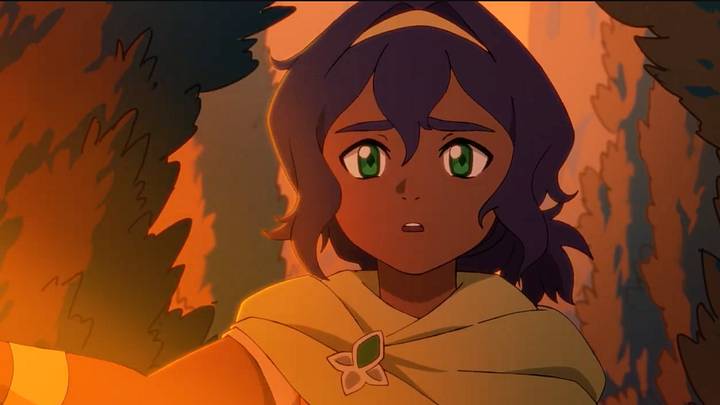
With the rise in popularity of Avatar: The Last Airbender, it was only a matter of time before we got another sequel series, titled Seven Havens. Now, one of the creators revealed just how far in the future it's set.
In an email interview with Polygon, Michael Dante DiMartino, along with two of his producers for the new series, Ethan Spaulding and Sehaj Sethi, discussed the timeframe. Sethi specifically said that Seven Havens takes place many, many, many years after The Legend of Korra.
“Avatar: Seven Havens takes place about 225 years after Legend of Korra ends," Sethi said.
My goodness! Spaulding said that because of that time jump, there will be certain influences on the style, the setting, and more, which honestly explains why the animation looks a little different than previously.
“Viewers will notice Seven Havens has more of a fantasy look to the overall look of the Havens and clothing; there has been a blending of cultures during the time span since the previous series. The real-world elements are still there in a less obvious way.”
That’s honestly a major time jump — more so than the first series, Avatar: The Last Airbender, which took place 100 years after Aang froze himself in the iceberg. The Legend of Korra jumped forward about seventy years after the events of the previous show. But this is even crazier. Two centuries? How did the cycle of the Avatar vanish? Did Korra somehow stay alive for that long?
For a refresher, the new Seven Havens series paints Korra as the villain. The series revolves around Pavi, a young Earthbender who finds out that she’s the next Avatar. But in this world, everything has been destroyed, and the Earth is scattered across “settlements” that she has to navigate through. The Avatar, once a symbol of peace, is no longer seen as humanity's savior.
What the heck did Korra do? Now, I’m just even more curious.
How The Legend of Korra sets up Seven Havens
DiMartino said that a big reason that he and co-creator Bryan Konietzko decided to make such a drastic time jump was based on the fact that they really wanted to put the Avatar in a world that wasn’t just focused on surviving a war or something else: they wanted something world-ending.
“This idea started with the setting and the desire to drop the viewer into a world that had experienced a cataclysmic event. Then we threw around ideas for what kind of Avatar would make the most sense in this world. We settled on Pavi, a girl who lives in hiding and who is younger than both Aang and Korra. We thought it would be interesting to place this kind-hearted character into a world that was not only on the brink of collapse, but whose citizens reviled the Avatar.”
So, like, I have questions, because how? How did Korra become the Avatar and do all of this? This feels like I’m not going to like where any of this is going, and I don't know how much Korra lovers are going to be able to defend her now.
In The Legend of Korra, she went through a lot of scary stuff, to the point where, as she grew into the role of Avatar, it felt like everyone was out to get her. Korra also dealt with much more of the spiritual side of things than physical war forces like Aang did, which could have also played a role in the world's destruction.
In the finale, it felt like she and the Spirit World were on good terms. After this — and several hundred years in between — now I’m just curious as to what the heck happened. Did the sub-bendings go awry? Did someone mess up timelines? How did this happen?
Only time will tell. But I’m interested to see how this affects Pavi and what this story becomes. They’d better have a good reason for putting Korra under the bus.
Avatar: Seven Havens premieres on Oct. 9, 2026, on Paramount Plus.
 Add us as a preferred source on Google