

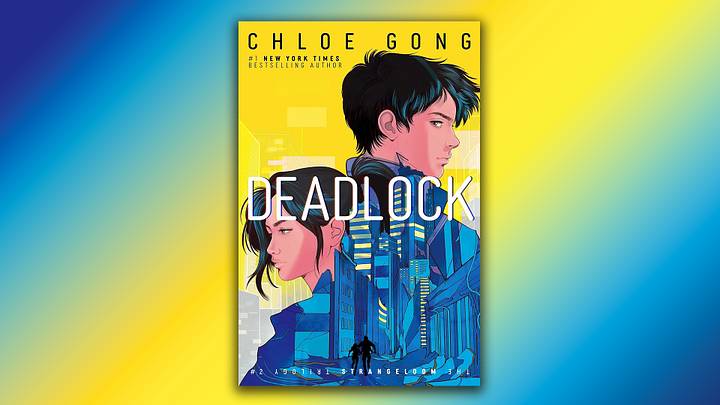
Coldwire’s structure is a card Eyes of Kings author Chloe Gong could only really play once, so I worried the sequel would ultimately feel lacking with a more straightforward timeline. But Deadlock proves to be a rich follow-up with multiple POVs and an expansion of the worldbuilding, even if the previous gimmick is spent.
The StrangeLoom trilogy follows a group of young people whose lives are defined by both a cold war and the existence of “upcountry,” a virtual reality copy of the real world. Now, the characters have become sharper, and the stakes higher, leading to a setup for the finale (slated for fall 2027) to perhaps be another unconventionally narrated piece.
In Deadlock, the main crew aims to expose the crimes of NileCorp (the company that controls upcountry), but they clash over how to go about this while being plagued by technology’s worst capabilities. Thankfully, this cyberpunk dystopian saga has prose that isn’t too flashy for the story it is telling, but with certain descriptions that strike at the heart of the main issues and galvanize the reader.
Deadlock takes StrangeLoom’s worldbuilding to the next level
"In my mind's eye, blood drips down Brooks's office walls. Gallons and gallons and gallons, pouring from the restless bodies on the streets, the abandoned wards who can't work back their debt.” Our protagonist narrates this as she stands in the vice-president’s office, graphically illustrating the truth of “world peace.”
Lia and Eirale narrate Coldwire, while Miz and Kieren become additional POV characters in Deadlock, forcing the reader to reevaluate their narrative roles. Following its predecessor's heartbreaking ending, they have all become involved in some capacity with the Coalition, a covert movement working to take down NileCorp.
Gong’s worldbuilding shines in Coldwire (see my review on Fantasy Hive), and I’m pleased to say that this aspect only gets more detailed in the second book. Gong builds upon her exploration of capitalism, cold war, and AI, with concerns about controlling the narrative in the media, government seizure of children, and competing theories of resistance.
Something fairly unique about Deadlock is the involvement of the main characters’ parents. The young adult genre trends towards absentee or villainous parents, so the plot's outcome is in the young heroes’ hands. Gong, however, uses these figures to explore other facets of slipping but tangible power in this world, as Miz’s mother is the heir to one of the last indie media organizations, while Lia’s father is a senator.
Like in the first book, Gong treats us to drive-by descriptions of places and off-hand comments about everything from airports to social media that continue to flesh out this already blinding world, filled with casual atrocities. But what is illustrated through a few supporting characters is that even the wealthiest are not safe from the destruction they have wrought.
Yet this only fuels the quest for the perfect virtual reality rather than a reckoning with systemic problems, hence Lia’s willingness to bet on the Coalition, even if her friends aren’t. “What happens when NileCorp stops being a corporation and becomes a god?”

Deadlock has messy conversations about resistance and AI
The main characters ponder how much they should trust the Coalition when their handlers provide little to no information but emphasize that collective resistance is essential. It’s interesting to see how they all respond to orders; it is a valid interpretation that they are being naive in thinking they can take on NileCorp by themselves.
Kieran’s particular resentment is at odds with his anarchist alter ego, a symbol that the Coalition occasionally leverages, but who also represents a different take on rebellion: “[...] is not a freedom fighter; he is a vigilante. [...] This persona is capable of doing wide-scale damage, and that’s why NileCorp is afraid of me, that’s why this nation believes in me.”
It’s also not as if these kids, who all went to a military academy, were schooled in rebellion theory, so their gaps are understandable and organically add to the conflict. Moreover, underlying all their problems is an existential anxiety about the nature of reality.
Lia argues, “Grief is the only way I know my father loved his wife [...] she would have loved me too. It is the only marker I have been afforded, because I don’t have any of that data in front of me otherwise.” NileCorp CEO James Moore’s ambitions become more destructive because of his inability to reckon with grief or responsibility, both immutable facts of life.
Despite desperate circumstances and betrayals, there is a warmth between Lia, Kieran, Miz, and others; they assure each other of their own humanity. This series illustrates the power of common decency while governments and corporations battle for absolute control — now all that is left is to see if Gong will deliver a satisfying, poetic ending next year.
Deadlock is available now from Margaret K. McElderry Books, wherever books are sold.
 Add us as a preferred source on Google