

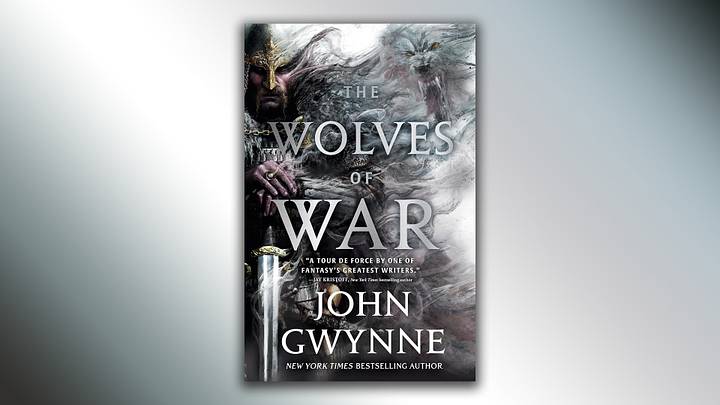
Over the past decade and change, John Gwynne has staked his claim as one of the most prominent authors in the modern fantasy space. Starting with his acclaimed debut tetralogy The Faithful and the Fallen, Gwynne has gone on to write banger after banger, following up that first series with the Of Blood and Bone trilogy and the Norse-inspired saga The Bloodsworn.
Now, Gwynne is back with his next novel: The Wolves of War, which is the first volume of a duology called The Wolfheart Chronicles. And while longtime readers of Gwynne's work might think they know what to expect in this story, there are some notable surprises in store. The Wolves of War has all the hallmarks of Gwynne's previous work, like heroic deeds, epic battles, a dash of Viking culture permeating the worldbuilding, and deadly creatures that make even the most battle-hardened warriors quake. But this is also a far more vulnerable book than Gwynne has ever written, and it brings a level of emotional honesty to the work that makes it far stronger than just the sum of its parts.
The Wolves of War review: The set up
Just like the worldbuilding for The Bloodsworn was primarily drawn from Viking culture and Norse myth, The Wolves of War takes inspiration from Slavic mythology and history. At the same time, Gwynne keeps his love of Vikings in the mix by exploring in a fantasy analog of the historical period where Swedish Vikings, known as "Rus," left their mark on several Eastern European countries, including modern day Ukraine, all while Christians from some of the neighboring empires they contended with tried to convert them from their northern pagan ways. The result is a fascinating melting pot, where northmen and the native peoples of the areas they're in the process of conquering come together in often unpredictable ways, sometimes clashing, others finding common ground.
If you've read The Bloodsworn, you no doubt remember that one of the shining aspects of its worldbuilding was the authenticity of Gwynne's fantastical Viking culture. When not writing, he is a Viking re-enactor, and his knowledge on the topic is clearly vast. He brings a similar sensibility to The Wolves of War, painting an engrossing and somewhat unique milieu that has shades of stories like Vikings as well as The Witcher. For anyone who enjoys Andrzej Sapkowski's monster-hunting fantasy saga or CD Projekt Red's video game series, you will absolutely find some recognizable elements at play here, like leshen, the tree-like monsters which haunt the forests of Eastern European folklore.
But what makes this melting pot setting work as well as it does is the fact that Gwynne has characters spread across the various cultures at play. Ingvar is the Lord of the Rus, who is just returning to his fortress in Kyiv after winning a vast campaign against the neighboring superpower of Tsargrad (Constantinople). Dagmar is a northman mercenary who is part of a warband tasked with a dangerous mission to the mythical resting place of one of the Slavic gods.
Then there's Ivan, his family, and his daughter, Halia. They belong to one of the forest clans of the region, which has been subjugated by the Rus and forced to pay tribute. Ivan could care less about that; he simply wants to protect his family and keep them safe. And it's this family which drives the book forward, and truly sets it apart from any of Gwynne's previous works.
The characters of The Wolves of War are brilliantly realized
A good setting is nothing without excellent characters to inhabit it, and it's in this aspect that The Wolves of War shines the most. Yes, it has the sort of action you can pretty much always expect from a John Gwynne novel, albeit a little less than The Bloodsworn. Yet while there may be clashes of both a brutal mortal nature as well as those on a more deific scale, it's the quiet parts of this book that set it apart.
At its heart, The Wolves of War is a story about families. Ivan's entire storyline centers around his family, but both Dagmar and Ingvar also represent different kinds of family units. The former is a mercenary who swore an oath to protect two children, and now has to reorient himself around that oath as they become adults capable of fighting in a shield-wall beside him or making grievous mistakes that get people killed. The latter is bound by his conqueror father's own vision to create a vast empire for the Rus, which he desperately wants to leave solidified for his own son.
The reason for this focus on the family unit as the heart of The Wolves of War is rooted in the real-world story of how this book was made, which ties into the most notable and beautifully written character of the novel: Halia, Ivan's daughter who suffers from an immense physical disability that leaves her unable to speak, feed herself, or move easily on her own. Halia's mind remains sharp however, and in her very first chapter we discover that she has supernatural abilities, which she's only initially able to access when sleeping. By day, Halia's parents care for her every need, warmed by the light she brings into their home and doing their best to keep her safe. By night, Halia runs with wolves, earning their respect with her wolfish heart and willingness to understand their ways.
Halia is Gwynne's tribute to his own real-life daughter, Harriett, who was also severely disabled and tragically passed away in 2021. Gwynne took a break from writing before returning to finish off The Bloodsworn with The Fury of the Gods, yet that was the culmination of an already established series, with characters whose payoffs had been years in the making. With The Wolves of War, Gwynne had a fresh starting place where he could take the terrible ordeal that he and his family went through in losing a treasured child and sibling, and process it through his art.
The Wolves of War is an excellent book on its own merits, and Halia herself is a vividly realized character who is simultaneously the hero of the book as well as its most interesting character. Gwynne has written many a legendary warrior in his career, but he has never written a character quite like Halia, whose smile brightens rooms, winning over anyone who spends time in her orbit — outside of those in the village who would brand her a witch, since their ancestral customs dictate that anyone with conditions similar to Halia's be left out to die as babies, claimed by the elements and gods.
These accusations begin as the blustering of scared men, who are looking for someone to blame for a wave of difficulties their village comes under. But it becomes more complicated by the fact that Halia is, in fact, a witch. Yet she is not evil; quite the opposite, and it is never in doubt for a single second she's on the page.
Without getting into the spoilers, the ways in which John Gwynne utilizes Halia as a character, and her overall arc in the story, hit like a warhammer blow by the end of the book. It's beautiful as well as heartwrenching; tragic as well as hopeful. The Wolves of War is a confident book that shows Gwynne not only knows when to write a great action scene, but when not to write one, instead drawing readers into Ivan and Halia's home in ways that make it easy to understand their deep bond — which just makes it all the more powerful when that bond is tested.
As Gwynne told Screen Rant, "This book is written as a tribute and celebration of my daughter. It is not a book that is all about grief, although grief is in it.” Both the grief and the celebration are on full display here, as this master fantasist uses everything he's gained in his craft so far to spin yet another epic saga-tale, with undertones that will stick with readers long after the final page. It may not have quite as much scale and scope as The Bloodsworn or The Faithful and the Fallen, but I have no doubt that The Wolfheart Chronicles is destined to become a favorite among Gwynne's fans.

Verdict
In short, The Wolves of War is a triumph. John Gwynne could write 100 more books in his career, and I doubt he'd ever turn out one quite like this, with its particular alchemy of personal real-world trials mixed with artistic vision, and how vulnerable he was to essentially create a fictional analog of his own family to explore it all. The book is bigger than just Halia, Ivan, and their family, but it is they who keep the tale on track, in spite of the monsters and power-hungry lords swarming about their periphery. I'm beyond eager to see how things wrap up in the second book of the duology.
The Wolves of War is available now from Orbit, wherever books are sold.
 Add us as a preferred source on Google