

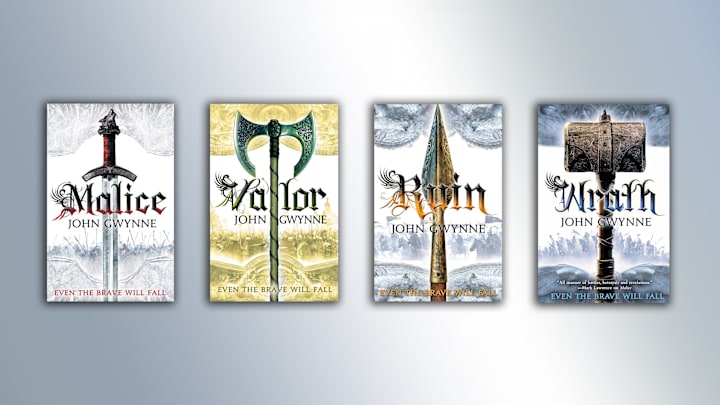
John Gwynne made his literary debut in 2012 when his first fantasy novel, Malice, was published. He followed that up with three more excellent works with Valour, Ruin, and Wrath. Together, they comprise the series, The Faithful and the Fallen.
Each book and the series as a whole are fantastic. Gwynne has a distinct writing style that is both fast-paced and detailed. His worldbuilding and character development skills make it difficult to believe this series was the first he'd had published.
The Faithful and the Fallen offers plenty for everyone. Battles, political intrigue, good versus evil, love, loyalty, redemption, and even some romance are all elements well represented in these books. And that's just within the story itself. The writing style is also brilliant and will keep readers flipping pages until the final page of the final book has been finished.
Ranking them is a bit like picking your favorite ice cream. All were terrific, but for various reasons, some are slightly better than others. Those margins of difference are slim.

4. Ruin (Book 3)
One of the biggest positives with Gwynne's pacing is he eliminates the minutiae of travel. During this series, there are long journeys throughout. Instead of just following one character or a group of characters as they make their way toward a goal, Gwynne skips around to another character.
Instead of boring readers with the slow, day-to-day details of the journey, he gives you points of view of other characters as they deal with whatever it is that is going on in their part of the story. This helps speed the story along at a pace that keeps the pages turning.
In Ruin, this writing methodology almost works against Gwynne. Some characters get to the end line faster than expected. While most likely purposeful, Gwynne had to throw up a rather large hurdle toward the end of this book.
This unexpected twist was skillfully worked out by Gwynne and gave readers pause, so they understood there was still another book left and nothing was going to be this easy for the favorite characters.
Ruin is still terrific, but it felt slightly more rushed than some others. The surprising twist toward the end helps develop the cliffhanger ending that builds up the anticipation for the final book.

3. Valour (Book 2)
Valour certainly includes more action than the series' opening volume. It doesn't cover nearly as much time as Malice did, and there are more battles, and more intrigue. This installment also builds up important relationships that will carry through to the end of the series. It establishes unexpected loyalties and friendships that impact the characters forever.
This book also draws the lines as to who is on what side. Some characters are taken aback by the truth, as things are not what they thought. Some are still blind to what is happening. Gwynne, however, makes it clear to the readers what is going on.
That decision helps build up tension with some characters and anticipation with readers. When will this character realize the truth, and what will they do about it? It's a nice trick, and it works brilliantly.
In this book, Gwynne extends his featured list of characters with significant points of view. Readers get to know characters from each side of the conflict and develop sympathy for them, even if they are villains.
A lot of ground is covered in the volume, figuratively and literally. Some characters travel quite a bit in Valour, and the story itself is moved ahead in leaps and bounds.
Of course, there are battles. On nearly every front in the story, battles are taking place, and the heroes don't always win. In most instances, Gwynne's battles are intense, yet not dragged out overly long. He also doesn't get bogged down in the grim details of each skirmish.
So much happens in this book and at a breakneck pace. You'll hardly want to set the book down.

2. Wrath (Book 4)
While Valour is marked by numerous battles, Wrath comes down to one gigantic battle that takes up nearly a quarter of the book. The battle at Drassil holds its own with other fantasy classics like Helm's Deep and Pelennor Fields in The Lord of the Rings series.
The main reason this book doesn't rank first is that much of the early part of this volume is spent moving away from the climactic scene instead of toward it. It almost feels like Gwynne painted himself into a corner on one particular thread of the story, and he had to find a way to fix it.
Part of the result of that detour also led to an anticipation of something specific happening. That thing did occur, but very late in the book and almost as an afterthought.
The battle itself was spectacular. Gwynne doesn't allow readers to get stuck with one character in one place for very long. As with the rest of the series, he jumps from one perspective to another, giving readers looks at different parts of the battle and from both sides.
While the battle itself is long, so much is happening to so many of the people readers have come to know that it doesn't feel drawn out. Unfortunately, many beloved characters do not survive.
This nod to the realism of battle makes sure the series doesn't end on a “happily ever after” feeling. While this battle (and all the others that preceded it) do not have the grimness and starkness of a Joe Abercrombie battle, it is still a fight to the death for many.
Gwynne does an outstanding job of portraying the necessity of this war and the ramifications. Sacrifices are made, and they seldom will be pleasant.
Wrath didn't disappoint in its scope or storytelling, which matched the earlier installments. The climactic battle was well-orchestrated and described, and the ending was believable according to how the story was developed.

1. Malice (Book 1)
As anyone who reads fantasy knows, it often takes 100-200 pages for readers to settle into the world the writer is laying out. In The Fallen and the Faithful, it doesn't take nearly that long. Gwynne jumps in quickly, setting up the seed of the story, and then he jumps ahead immediately to where that seed begins to bear fruit. He develops a quick pace, using the perspective of several characters to build his world and to develop those characters and the others around the central figures.
For much of the first book, readers aren't sure who the villains and heroes are, though there are hints for those astute enough to catch them. By the end of the book, readers know more about the main characters than the characters realize about themselves.
Gwynne's pacing is masterful, even while being patient with this overall story development. He's not rushing, but because of how often he switches viewpoints, the story never lags.
In a genre where worldbuilding and character development are so important, the way Gwynne handles both is superb. It doesn't take long for readers to feel something for the people in the story. Plus, after a while, when readers know there is both a good side and an evil side, Gwynne doesn't reveal too much too early. He also doesn't drag out the process of trusting the readers with what is going on.
In an unusual twist, a featured character dies in the first book, letting readers know that anything can happen in this series. It gives later books an edge, never knowing who will survive to the end. It is a brilliant move that isn't used commonly in the genre.
Because of the way readers are drawn into the story so quickly, and because of the pacing and character development, this book sets the standard for the rest of the series. The fact that the other books are so well-written and not far off in quality from the first is what makes this series so special.
 Add us as a preferred source on Google