

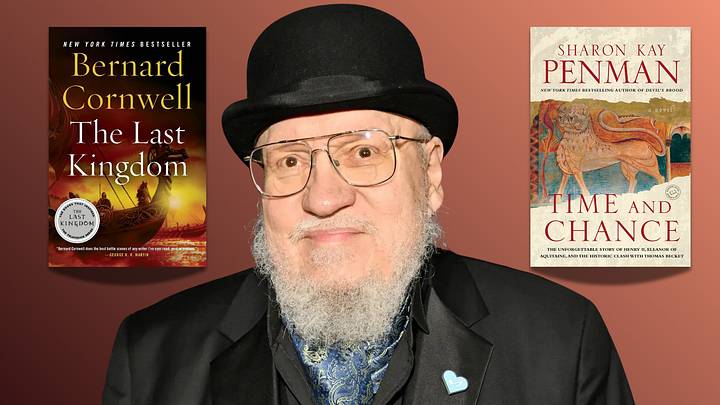
While immersing themselves in the world of Westeros, many fans have wondered how George R.R. Martin was able to create places and characters that feel so real. Putting aside his obvious writing and storytelling skills, where could he have gotten his ideas?
Martin's work wasn't written in a vacuum, and it's fascinating to see which books had an influence on the battle for the Iron Throne. Martin consulted both fantasy and historical fiction novels in his quest to write an epic historical fantasy series, and they didn't just provide inspiration for plot points, but tone and writing style. These books helped Martin decide what he wanted to write and how he wanted to write it, thus giving us A Song of Ice and Fire.
- The Plantagenets by Thomas B. Costain
- The Lord of the Rings by J.R.R. Tolkien
- The Accursed Kings by Maurice Druon
- Memory, Sorrow, and Thorn by Tad Williams
- Time and Chance by Sharon Kay Penman
- The Last Kingdom by Bernard Cornwell
The Plantagenets by Thomas B. Costain
Thomas B. Costain wrote both historical fiction and non-fiction, and it was the non-fiction that inspired Martin. The author has mentioned that he was very interested in the Wars of the Roses, and Costain's The Plantagenets covers that event in intricate detail.
The thing that Martin liked the most about Costain's books was that the history was story-driven rather than just dry facts. In an interview with The Guardian, Martin talked about Costain's works: "He’s not interested in analysing socioeconomic trends or cultural shifts so much as the wars and the assignations and the murders and the plots and the betrayals, all the juicy stuff."
When writing the history of Westeros, Martin kept Costain's style in mind to keep his story from dragging.

The Lord of the Rings by J.R.R. Tolkien
It seems rather obvious to anyone reading Martin's epic fantasy that one of his inspirations is J.R.R. Tolkien. Martin had loved The Lord of the Rings since he was a child, and he wanted to emulate not just a fantasy epic, but the creation of an entire world with its own history, language, and culture.
Tolkien's writings include millennia of in-world history and lore, and Martin modeled the vast history of Westeros on that of Middle-Earth. Take his 2018 book Fire & Blood, for instance. What started as just filling in some holes in the history curated by his fans turned into 350,000 words explaining the different reigns and genealogy of the Targaryens.
What others might have called overkill for a fantasy story, Martin and Tolkien saw as necessary to build believable worlds.

The Accursed Kings by Maurice Druon
Martin has said of the first book in Maurice Druon's The Accursed Kings series, The Iron King, “This is the original game of thrones." Readers can see that in each scheme, intrigue, and machination by Philip the Fair, his family members, and his enemies during the Hundred Years' War.
“The Accursed Kings has it all,” Martin added. “Iron kings and strangled queens, battles and betrayals, lies and lust, deception, family rivalries... and all of it (well, most of it) straight from the pages of history.”
The majority of Druon's work is historical fiction, but it does add a bit of fantasy when the Grand Master of the Knights Templar is burned at the stake and vows a curse upon the king's bloodline. Druon spends the rest of his series showing just how real that curse was. Martin's A Song of Ice and Fire was directly drawn from Druon's historical fantasy.

Memory, Sorrow, and Thorn by Tad Williams
Martin had high praise for Tad Williams' series, Memory, Sorrow, and Thorn, after reading the first book in the series, The Dragonbone Chair. In Martin's view, many fantasy works have become predictable and unoriginal, but this book defied his expectations and helped him realize how he wanted to write his own fantasy series.
Williams’ books feature alternating points of view from protagonists and antagonists alike, and Martin loved that format enough to adopt it. The story of Simon, a kitchen boy caught up in two princes' magical fight for the throne, also has many parallels to A Song of Ice and Fire. Similarities in Simon's character arc can be found in Jon Snow: both came from lowly origins to become great leaders and survived harsh, icy environments.

Time and Chance by Sharon Kay Penman
Sharon Kay Penman is, in Martin's words, "the strongest historical novelist working the medieval period" in recent history. Her Plantagenets series is a favorite of Martin's, specifically the first and second novels, When Christ and His Saints Slept and Time and Chance. Penman covers the Wars of the Roses and always "brings history vividly to life."
Penman has a way of bringing the emotions and personalities out of what seem just names in old history books. Time and Chance tells the story of Henry II and Eleanor of Aquitaine, with all the love, lust, and scandal that filled their relationship. Martin wanted his characters to feel as real and as flawed as Penman's characters to bring his tale to life as well.

The Last Kingdom by Bernard Cornwell
Martin has been in awe of Bernard Cornwell's battle scenes for years. In an interview between the two authors, Martin told Cornwell that he does "the best battle scenes of any writer I’ve ever read, past or present." He admitted that battles are difficult to write, but when he does, he tries to emulate Cornwell's style to give just the right balance between action and exposition.
Martin also loved how Cornwell's characters, both protagonists and antagonists, are so human. The heroes are flawed, and the villains have redeeming qualities. Cornwell's The Last Kingdom series inspired Martin to make his characters feel historical while also having complete identities. And he enjoyed knowing that Cornwell studied his own genealogy to create his historical fantasy.
 Add us as a preferred source on Google