

HBO Max's A Knight of the Seven Kingdoms is an adaptation of George R.R. Martin’s Tales of Dunk and Egg novellas. Season 1 follows the events of the first novella, titled “The Hedge Knight." Television adaptations of Martin’s work have a history of starting faithfully and straying farther from the source material as seasons progress, as seen with Game of Thrones and House of the Dragon. How is this new series faring in relation to the books?
Season 1 of A Knight of the Seven Kingdoms is as loyal an adaptation as one could get, a fact that will undoubtedly make fans of Martin’s work rejoice. In fact, the very first episode of the new series, also titled “The Hedge Knight," makes it a point to establish, very clearly from the beginning, that this show is nothing like its predecessors. When the Game of Thrones theme starts playing, suggesting that a foreboding moment is coming, the audience’s pregnant expectation is met with Dunk… defecating behind a tree. A comedic moment that serves the episode well.
Before we start discussing book to show changes, have you seen the gorgeous tie-in edition of A Knight of the Seven Kingdoms? It has the same 160 stunning illustration by Gary Gianni as the 2015 edition, and features show Dunk and Egg on the cover.

How does episode 1 of A Knight of the Seven Kingdoms compare to the books?
The first episode of AKOTSK follows the beginning of the novella closely. It starts in the same exact way, with Dunk burying his mentor Ser Arlan of Pennytree and with a feeling of inadequacy. In the novella, readers are welcomed in Dunk’s own mind and privy to his thoughts. On the show, most of Dunk’s internal doubts and considerations are vocalized, often spoken to the horses, which achieves the double goal of comedy and establishing how fond Dunk is of the animals.
The next few scenes, of Dunk meeting Egg at the inn and going into Ashford where he talks to Plummer, Lord Ashford’s steward and master of the games, are almost identical to the book. After Plummer assures Dunk that, if a great knight or lord vouches for him, he will be allowed to enter the tourney, he resorts to looking for Ser Manfred Dondarrion, since Ser Arlan worked for his father. In the episode, Dunk goes to the Dondarrion pavilion right away, earlier than in the novella. However, Dunk doesn’t find Ser Manfred and instead makes two acquaintances.
It's tough out here for hedge knights. #AKnightOfTheSevenKingdoms premieres January 18 on @HBOMax. pic.twitter.com/MKYjPisYkB
— Game of Thrones (@GameOfThrones) January 9, 2026
The show adds more female characters (on the sidelines, but we’ll take all the progress we can get!)
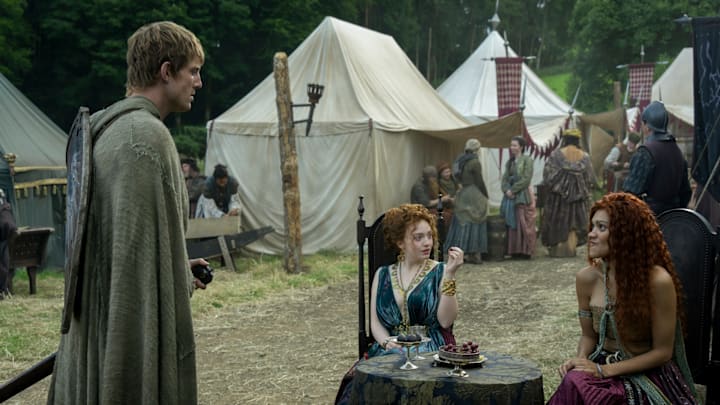
The novella certainly lacked female characters (one significant role and counting), so the show creating two original female characters with witty lines of dialogue is certainly a welcome change. Red and Beony are two camp followers (read: factotum and sex workers) and a true delight. Like the chorus in a Greek tragedy, the women provide an unsolicited external commentary to the situation, returning to the stage every time Dunk seeks out Ser Manfred.
This episode, Red and Beony draw an apt parallelism, comparing knighthood to sex work, in the way that both professions entail using one’s body and putting it at risk for the entertainment of others. The comments help Dunk — and the audience — see knighthood from a bleaker perspective, beyond the glory, which is particularly fitting of hedge knights like Dunk himself. Rowan offers a good piece of advice: "Be kind to your body, knight. Last one you're like to have." These words will stay with Dunk throughout the next episodes.

Lyonel Baratheon’s role is expanded (and he and Dunk get much closer)
One character whose role is afforded significantly more screen time is Lyonel Baratheon of Storm’s End, nicknamed The Laughing Storm for his habit of laughing at his enemies during tourneys. Here, we see him laugh a great deal, not only during fights. And yes, he is an ancestor of Robert Baratheon’s (most likely his great-grandfather) and displays the standard Baratheon trifecta of traits: loving a good wine, a good banquet, and a good fight.
In Episode 1, Dunk sneaks into a party in Lyonel’s pavilion and gains his attention. Lyonel quickly begins to take a liking to Dunk, and even allows him to wear his antler headpiece. The two drink together, converse, and dance. Fun-loving Lyonel seems to be genuinely flirting with Dunk, who innocently beams at the attention of a great lord.
It’s Lyonel who encourages Dunk to be more self-confident and to own his nature. “You’re tall,” he tells Dunk. “Be tall.” It’s advice that Dunk internalizes, because later when he finds young Egg at his camp and he asks his name, Dunk finally utters the name he chose for himself: “Ser Duncan the Tall.” This deeper connection with Lyonel is an invention of the show, but a fitting one, given that Lyonel and Dunk's fates will be linked for long after Ashford.
Spoilers for A World of Ice and Fire incoming: Decades after the events of their first meeting, when Lyonel declares himself Storm King in an act of open rebellion against King Aegon V (dramatic much, but not exactly without reason), it's Ser Duncan the Tall who defeats the Laughing Storm during a trial by combat, putting an end to the rebellion and bringing Lyonel back into the King's graces.

Other book to show differences in A Knight of the Seven Kingdoms Episode 1
Most scenes in the episode are taken straight out of the novella, with dialogues transposed verbatim with only small changes, if any. It’s clear that showrunner Ira Parker and everyone in the writers’ room has a tremendous amount of respect and love for George R.R. Martin’s work.
One visual difference to be mentioned has to do with Tanselle and the puppet shows: in the novella, the puppets are described to be normal-sized dolls whose strings Tanselle masterfully pulls with her quick fingers. The series makes the shows more spectacular, with human-sized puppets that certainly achieve maximal entertainment, both for the Westerosi enjoying them from within the puppeteers' tent and for us watching from our screens.
A tiny change in dialogue I appreciated immensely is at the end of the episode, when the falling star crosses the night sky above our heroes. In the book, Egg is said to be asleep, so Dunk thinks “A falling star brings luck to those who see it. But the rest of them are all in their pavilions by now, staring up at silk instead of sky. So the luck is mine alone.” On the show, it’s Egg who says the first part, in that odd wisdom of his, and Dunk incredulously asks him, “So the luck is ours alone?” then the camera shows us a smiling Egg and a pensive Dunk, before the credits start rolling.
The first episode has managed to establish much and to end on such a hopeful note, all the while staying true to the spirit of the novella. Dunk and Egg are taken straight out of the pages of the book, as are most characters. Bonus points for Raymun Fossoway, perfect to his book courterpart, who deserves all the love.
Episode rating: A+. This is how it’s done!
A Knight of the Seven Kingdoms airs every Sunday at 10:00pm ET/PT on HBO and is available to stream on HBO Max.
 Add us as a preferred source on Google