

George R.R. Martin has a story that he likes to tell about television adaptations of books, and his philosophy about changes in those adaptations. Martin's very first screenwriting gig all the way back in 1986 was penning an episode of The Twilight Zone based on Roger Zelazny's story “The Last Defender of Camelot," which culminates with a horseback duel at an otherworldly Stonehenge. But when Martin went to write that climactic scene, the production realities made it impossible to match it to Zelazny's book. So out of respect, Martin called his fellow author up and told him the dilemma he'd been given from the studio: "You can have Stonehenge or you can have horses, but you cannot have horses and Stonehenge." Zelazny chose Stonehenge, and the horses were struck from the episode in favor of a duel on foot on a soundstage to create the proper effect.
This analogy depicts what Martin once described as a "legitimate" change from a written source material, of the type that he as an author of such works can fully support, as opposed to arbitrary changes made to fit a different creative vision than intended.
The point is not just which changes will nettle an author or not; this story also says something important about the compromises needed for film adaptations. Books and film are two different mediums, and the demands of those mediums necessitate changes by their very nature. Even beloved works have to meet budget quotas, or face realities of production that can preclude elements dreamt up in a novel where imagination was the only boundary. Sometimes the team behind a show just has to choose: the horses or Stonehenge. Hopefully whatever path creates an equally memorable experience to the book, bolstered by its differences rather than weighed down by them.
But once in a rare while, a show comes along that manages to have it all: amorous adherence to its source material, with its own shining qualities such as the charisma and skill of its actors, the detail of its sets and costumes, the power of its music, and a critical eye for visuals and storytelling. And, just maybe, room to add in some new material as well that rounds out the endeavor.
A Knight of the Seven Kingdoms is such a series. After two adaptations in Game of Thrones and House of the Dragon that were never shy about deviating from Martin's written works, at long last, we have a Westeros show that fully embraces its roots while blossoming into its own towering achievement. With A Knight of the Seven Kingdoms, George R.R. Martin and co-creater/showrunner Ira Parker have managed to have the horses, Stonehenge, and some of the most thrilling joust sequences ever put to film beside. I think longtime fans of Martin's books and new viewers alike will love the result.

A Knight of the Seven Kingdoms spoiler-free review
But let's back up a minute. Maybe you are the sort of viewer who could care less about how A Knight of the Seven Kingdoms stands in conversation with its source material. Let's get basic: what is this show, and why should you care about it?
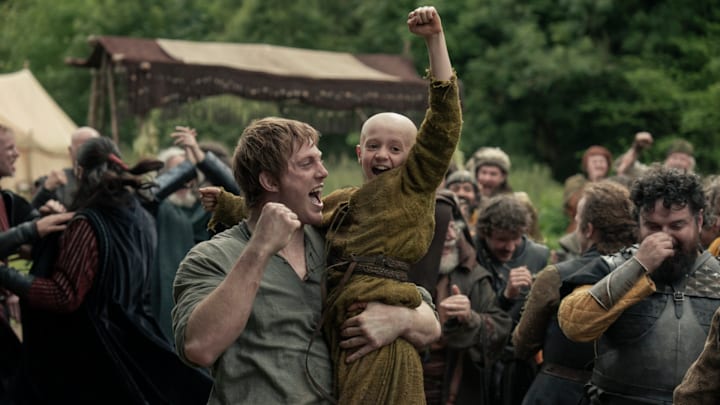
Set around a century before the start of Game of Thrones, this latest spinoff is a ground-level dramedy about a peasant-born knight named Ser Duncan the Tall and his diminutive squire, Egg. Together, Dunk and Egg go around Westeros having adventures, while the young knight teaches his fledgeling squire about the ways of honor and service. Martin has written three Dunk and Egg stories to date, and the first season of A Knight of the Seven Kingdoms adapts the first of them, "The Hedge Knight," which shows our leading pair meet for the first time as they head to a tournament at Ashford Meadow in the Reach.
In the HBO series, Dunk is played by Peter Claffey, while Egg is portrayed by Dexter Sol Ansell. There are many different facets to this series, but the one thing the show absolutely had to get right to have any hope of success is the dynamic between its leads. I'm so happy to say that not only do Claffey and Ansell nail the good-natured banter between Dunk and Egg, but if anything, their chemistry sings even more on screen than it did for their book counterparts. They are simply a joy to watch any time they have scenes together, bringing extra emotion and humor to scenes that I never expected from the novellas.
That emotional expansion is a big throughline of A Knight of the Seven Kingdoms, which wrangles with what it means to be a knight in a morally compromised land like Westeros. Over the course of its six episode season, A Knight of the Seven Kingdoms does a wonderful job at pulling the heartstrings of viewers, from joyous moments to heartwrenching ones, uplifting monologues to edge-of-your-seat action, and of course, a few of those shocker twists that the franchise is known for.
At the same time, this is a much more endearing Westeros than we've ever seen before. During the lead up to the show, there were plenty of rumbles about its more comedic tone, promising a very different experience from the dark political drama of Game of Thrones or the sheer tragedy of House of the Dragon. A Knight of the Seven Kingdoms lives up to that hype and then some. This show has so many funny moments, often hinging on the comedic timing of its cast, exceptional writing, and lingering camerawork of its crew. But it takes things a step further: A Knight of the Seven Kingdoms isn't just funny, it's so funny and heartwarming that it will make you want to hang out with these characters time and again, longing for new episodes when you're not watching. I haven't truly felt that way about Westeros since the early seasons of Game of Thrones. It's nice to be back.

The tourney at Ashford Meadow feels like a real place
Another element that elevates this series is its dedication to practical sets, period-appropriate costuming, and the immersiveness of its world. Both previous Game of Thrones shows had a heavy reliance on visual effects to bring their stories to life, from magical creatures like dragons to digitally created castles in the distance and more. A Knight of the Seven Kingdoms certainly has some special effects wizardry, but by and large, most of what you see on screen is really there. Ashford Meadow is a much smaller setting than King's Landing, and the series made it a point to make it feel real and lived in, populated by people who feel just as authentic.
The music also adds to this. A Knight of the Seven Kingdoms is the first show in the franchise to stray away from previous composer Ramin Djawadi. This time, it's Dan Romer creating the sonic landscape for the show, and it sounds different enough to truly stand out from its predecessors in that regard. From lilting strings to hopeful orchestration and even some truly unexpected choices like campfire-style whistling, the score of A Knight of the Seven Kingdoms is like a breath of fresh air for the franchise that perfectly matches the more whimsical tone of the show.

A Knight of the Seven Kingdoms balances comedy and deadly drama on a knife's edge
Despite how fun I've made this series sound, I do want to be clear: we are still in Westeros here, and that means the potential for events to turn devastating still lurks behind every plot twist. Ahead of the season, Martin revealed that he had challenged the creative team behind the series to create "the best jousting sequences that have ever been put on film." I haven't watched enough film jousting to be an expert in that regard, but I will say that the jousting and action in A Knight of the Seven Kingdoms is as spectacular as it brutal. This show isn't filled with wall-to-wall fight scenes, but when it puts on the suit of armor and spurs its horse into a charge, it hits with all the force of an expertly directed lance to the chest.
It also has the full sort of range of characters you'd hope for from a Game of Thrones show, each played wonderfully. From Finn Bennett's villainous prince Aerion Targaryen; to the noble heir to the Iron Throne, Baelor Targaryen (Bertie Carvel); to the boisterous Lord Lyonel "The Laughing Storm" Baratheon (Daniel Ings) and more, the cast of A Knight of the Seven Kingdoms is perfect. Each plays their part, and there isn't a single weak link to be found.
In short, A Knight of the Seven Kingdoms is a show which I fully expect people to be able to enjoy, from its sense of levity to its moving moments and epic sequences. This may be a smaller scale Westeros story, but I imagine its impact will be felt long after the credits roll on its final episode next month.

A Knight of the Seven Kingdoms is beautifully faithful, but not afraid to take risks
Now, let's circle back around and end with some adaptation talk. After all, Winter Is Coming has its roots as a Game of Thrones site, and so I'm going to take off the gloves here and assume you're probably better acquainted with Westeros than the average reader.
Both Game of Thrones and House of the Dragon made changes from their source material, for better and worse. The reasons for that are myriad, but at the end of the day, it's hard to argue that either show is a completely faithful adaptation of Martin's stories. I give Thrones a lot more grace on that front than House of the Dragon, because it at least had the excuse of running out of source material before it truly took some of its biggest swings on original storylines. But let's stay on track.
How does A Knight of the Seven Kingdoms stand up? Does it do justice by Martin's excellent novella, "The Hedge Knight"?
The answer, I am so relieved to say, is a firm, resounding yes. A Knight of the Seven Kingdoms doesn't just do a good job of adapting Martin's work; it might just be the most faithful book-to-screen adaptation I've ever seen. At the same time, it isn't a slavish adaptation, either. A Knight of the Seven Kingdoms does make changes here and there, and adds a few elements that weren't present in Martin's story. Often, those add extra humor — or in two especially notable cases, extra drama and character development.
But rest assured, the show isn't just off in the weeds doing its own thing. Any additional material A Knight of the Seven Kingdoms adds mainly serves to support what's already there in Martin's book. Practically every single beat and nearly every line of dialogue from Martin's story remains in tact. There's a strong feeling that the team behind A Knight of the Seven Kingdoms loved the story they were adapting, and did their absolute best to do right by it. Ironically, that gave the series more room to flesh out certain things, add its own twist or its own flair to the interpretation of the reading of a scene, or even develop a few entirely new moments that I have no doubt fans will come to love. The most recent TV show I can think to compare it to is Apple's Murderbot series, which similarly expanded Martha Wells' beloved novella while staying true to the heart and events of it.
A Knight of the Seven Kingdoms is the story of an honorable young knight doing his best to uphold his vows in the grim world of Westeros. And in its own way, the television series similarly forged its own path of honor through adaptation, finding freedom where it made sense while never losing sight of the story it was telling.
I think longtime fans of Game of Thrones will thoroughly enjoy this show. I think new watchers will enjoy this show. And I'm extremely grateful (and unsurprised) that HBO made the smart move to already renew it and begin production on season 2 before this first installment even premiered.
Verdict
A Knight of the Seven Kingdoms is a breath of fresh air amidst the war-torn haze of Westeros, offering a lighter, funnier, and all-around more heartfelt journey to George R.R. Martin's medieval fantasy world. With a spectacular cast led by two exceptional main actors and enough bravery to break away from the original Game of Thrones series more than House of the Dragon did, this new spinoff sets itself up as a memorable experience that I'm fully confident will win people over. Add in the fact that it's also one of the most faithful page-to-screen adaptations yet in the fantasy space, and diehard fans will no doubt be exceptionally pleased as they settle in for their first wholesome adventure with Dunk and Egg.
Series grade: A+
We'll be reviewing every episode of A Knight of the Seven Kingdoms, along with extensive deep dives and breakdowns, here at Winter Is Coming. Check back each week and enjoy this next journey into Westeros with us!
 Add us as a preferred source on Google