

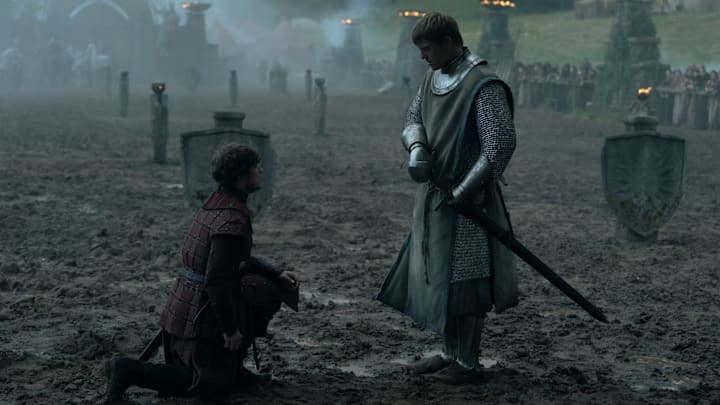
Episode 4 of A Knight of the Seven Kingdoms is a lesson in building expectation and paying off that suspense at the right time. Titled “Seven,” it covers, almost to the letter, pages 78-100 of “The Hedge Knight” by George R.R. Martin.
Most of the dialogue and descriptions from the book are adapted verbatim, but that is not why “Seven” achieves perfection. I would argue that the tiny changes sprinkled here and there make the episode even more captivating. The unparalleled writing is, of course, complemented by exceptional directing and Emmy-worthy acting.
The initial shot seems to be of the night sky, but when the camera pans, we realize it is the ceiling of Dunk’s cell. The knight’s solitude is interrupted by Egg, now a princeling in his Targaryen livery. They share a shorter conversation than in the book, with the episode sadly cutting the mention of Egg’s other siblings:
“Short for Aegon. My brother Aemon named me Egg, he’s off at the Citadel now, learning to be a maester. And Daeron sometimes calls me Egg as well, and so do my sisters.”
Dunk is harsher on Egg in the episode, to the point where he has to tell the prince to dry his eyes. Later too, Dunk is also less apologetic, challenging Baelor with questions, “wouldn’t you have done the same?” and “don’t all knights make the same oath?” — the dilemma that might just be the basis for this very story, questioning the true nature of chivalry.

Dunk and all his Targaryen princes
It’s clear on the show that Prince Baelor gave Dunk the idea to invoke a trial by combat; Aerion declines and Baelor suggests that he withdraw his accusation, but Aerion refuses to relent and requests a trial of seven. In the book, this happened slightly differently.
I love the sonorous detail in this scene of Aerion chewing nuts loudly, irreverently, almost to show Dunk that he is being trialed for an innocuous offense — after all, Aerion’s teeth are clearly just fine. This element certainly does not add much to the overall plot, but it shows how much care has gone into every single detail of the show and how much care the showrunner, writers, and directors have put into its creation.
On the other hand, the episode erases Daeron from this scene; in the book, Maekar’s heir provides some comedy in an otherwise grim situation. On the show, the comedy is replaced by the bit of Maekar claiming ignorance of a trial of seven. This offers the audience another chance to see how Baelor and Maekar complement each other by being opposites; where one is composed, put together, knowledgeble and rule-abiding, while the other is bitter, cheeky, and profane. Maekar also loses his temper with Aerion on the show, going as far as forcefully dragging him away and calling him an idiot while still in front of others.
When Daeron does appear on the show, it is in a scene almost identical to the book, however I can’t help but overanalyze the deliberate changes to his speech: we hear him say that his prophetic dreams are “an impressive talent for an unimpressive man. Another one of life’s little ironies. But I have seen you, ser. And a fire. And a dead dragon.” The novella lacks the mention of a fire; my theory is that this prophetic dream could refer also to another fire, the tragedy at Summerhall, which we covered extensively in another article. In the book, Daeron remarks of how frightened he is by his dreams and the idea of dying, although the episode has already done a great job at expressing Daeron’s cowardice and that he is not even remotely ashamed of it.

Dunk and his other friends
In book, Dunk finds that Raymun has taken Thunder and Chestnut outside the Fossoway tent, while on the show we watch Dunk walk all the way to his elm tree in the rain. This regales us with another endearing moment of Dunk talking to his horses, so I can’t complain, and Raymun was waiting for Dunk at his camp and taking care of the horses anyway, so the spirit stays the same.
When the hedge knight goes to retrieve his shield, Tanselle’s voice echoes in Dunk’s mind, mocking him, “you are no knight” (please hold on to this line for a moment) from her Jonquil and Florian the Fool show. Dunk finds himself staring into the eyes of Florian’s puppet, a character he clearly believes represents him.
In the book, the smallfolk show Dunk their support for he is “a knight who remembers his vows,” as explained by Steely Pate. I’m surprised this wasn’t translated on screen, given how fierce the commonfolk were when Aerion killed Ser Humfrey’s horse in Episode 3. But the episode is only 34 minutes long and we can’t break the perfect, heartbeat-like pace, and sadly the smallfolk interactions had to go.
As in every episode, Lyonel Baratheon is given more lines, a fact that everyone is happy about. In the novella, he only says he’s there “to fight the Kingsguard knights and tweak Prince Maekar’s nose” while the show adds a clear sexual connotation, an innuendo about taking the chaste knights’ virginity. Oh, Lyonel, our bisexual king.
The tension has built and built all episode, leading to these last few minutes. As Lyonel recites the sacred words that will make Raymun a knight (after our protagonist silently refuses to), Dunk sees Ser Arlan in his mind, the old man making a face at him, almost derisive… for never speaking those words to him, is my theory, because he never truly made Dunk a knight with the ritual. That is the “monstrous lie” that Dunk mentions in the book, the fact that he was never officially knighted. Yet, he is the truest knight in Ashford. Dunk didn’t need a knight to lay a sword on his shoulders and charge him to be just, brave, to protect the innocents; he took the mantle on his own. This is further proven by the careful words Dunk uses when enticing someone, anyone, in the audience to join his cause: “[Ser Arlan] taught me how to be a knight” as opposed to the literal “he made me a knight” and “[taught me] not just sword and lance, but honor.”
When you think this can’t get any better, there is a perfectly orchestrated moment which seems to be the episode’s climax, when the Brute of Bracken stands up as if to answer Dunk’s call, and instead farts loudly for everyone to hear, in open mockery of Dunk’s speech. A red herring for the turning point, fooling both us and Dunk, until the real climax of the episode, or the whole season, arrives.
When an angered and frustrated Dunk screams the iconic line “Are there no true knights among you?”, silence follows, only to be broken by none other than Baelor Breakspear, Prince of Dragonstone, heir to the Iron Throne, answering his call, truly earning his title of Lord Protector of the Realm through actions and not blood or words. The Game of Thrones theme starts playing (for real, this time), and everyone watching — both in Ashford and at home — erupts in cheer.
This, right here, is the only intentionally epic moment of the season, and I fear that it will be impossible to match in seasons to come, for no other moment can ever hit as true and as close to A Song of Ice and Fire. This, to me, is the biggest homage to George R.R. Martin that can ever be achieved on television.
Episode rating: A+++
 Add us as a preferred source on Google