

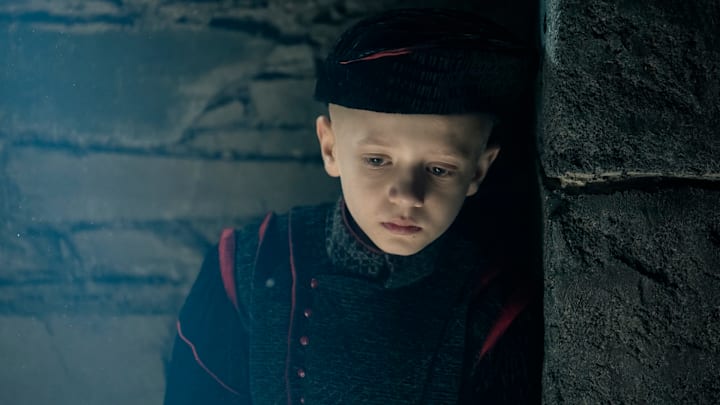
“The Morrow” is the title of the season finale of A Knight of the Seven Kingdoms. The sixth chapter in the story is certainly bittersweet, and It’s odd to think that the journey is already at an end, but comforting to know that filming for season 2 is well underway.
The episode adapts the final pages of George R.R. Martin’s novella "The Hedge Knight," precisely, pages 113 to 118. The source material may feel scarce for a full episode, but the writers did a splendid job integrating a few new scenes to the existing content, creating a well-balanced tapestry that wants for nothing.
The opening scene of the episode is original to the show, expanding Lyonel Baratheon’s role further. The lord brought his maester to tend to Dunk’s wounds and he spends some time with the hedge knight to cheer him up. He also has a generous proposition for Dunk, to go home with him and join his household. As a little easter egg, we get a mention of Tarth, where one of Dunk’s adventures might take him later in life, since we know from canon that Brienne of Tarth descends from him.

“Come with me to Storm’s End and I will love you like a brother,” Lyonel offers Dunk, sincerely, generously. “If you don’t… well, f*ck you, I will hate you like a brother.” I want to appreciate the fact that this may be the most Baratheon statement of all time. Robert, Stannis and Renly, somehow you all have so much in common with your ancestor Lyonel. You can tell just from the all-original characterization of this character how much the show writers care about the source material and creating parallels with it.
Giving in to his easy Baratheon temper, Lyonel speaks ill of late Prince Baelor, which angers Dunk. His point is that Baelor may have fought for Dunk, but he did so facing his family and men sworn to protect him, therefore risking nothing… oh, the irony. A fraud is what Lyonel calls Baelor, and the term upsets Dunk for more reasons than defending Baelor’s honor. Lyonel propositions Dunk again, sure that he will accept. Dunk’s face suggests otherwise, and it’s heartbreaking because to serve a great lord was all that Dunk wanted for himself at the beginning of the novella:
“I must earn my place in that company. If I fight well, some lord may take me into his household. I will ride in noble company then, and eat fresh meat every night in a castle hall, and raise my own pavilion at tourneys. But first I must do well.”

Next, we see the small affair that is Prince Baelor’s funeral. His closest family is there: his heir Prince Valarr and Valarr’s wife Kiera of Tyrosh; Manfred Dondarrion, as Baelor was married to Lady Jena Dondarrion, likely his sister. The credits don’t help us much in identifying the other characters, but it’s probable that the old man dressed in fine livery next to Egg could be King Daeron II, Baelor’s father, while the dark-haired man could be Prince Rhaegel, and the blonde girls are clearly Targaryen princesses, perhaps Maekar’s and Rhaegel’s daughters. While the novella does not specify who attended Baelor’s funeral pyre, it’s not unlikely that so many relatives — including the King — came all the way to Ashford to pay their respects to their beloved Prince. In the book, Dunk muses on the fact that King Daeron had the last word on how Baelor should be dressed for the pyre, which suggests that he did show up for the funeral. Travel distances are not too big of an issue here; many days must have passed for Dunk to be able to walk around, giving the royal party time to travel to Ashford and say farewell to Baelor.
In the wake of his father’s death, Valarr Targaryen, now the crown prince, finally gets his moment to shine with a few sentences taken straight from the pages of the book. “Why would the gods take him, and leave you?” [Prince Valarr] shook his head. “Begone with you, Ser Duncan. Begone.” I mean, can you really blame him?

The following scene, an addition of the show, is much more cheerful. Sweet Raymun Fossoway had gone looking for Dunk and is relieved to see him well. He comforts and hugs the hedge knight and shares the happy news that he married Rowan, the original character we initially met as a camp follower and sex worker who quickly became a fan favorite this season. Raymun’s cousin Steffon renounced him, a fact that doesn’t bother Raymun much. In fact, he finally changed his seal to a green apple to distinguish himself from Steffon… in his words, “Better green than wormy.”
The episode’s writers chose to divide Dunk’s conversation with Prince Maekar into two separate scenes. In the book, Maekar visits Dunk at his elm tree, while on the show Maekar summons him to Ashford castle. The dialogue is similar to the book; full of contempt for what has befallen his brother, almost as if to make up for his fatal error, Maekar swallows his pride and offers Dunk to join his retinue at Summerhall where he will be able to continue his training and take Egg to squire. Against his deepest wishes, Dunk refuses.

This is followed by a brief show-only scene of Egg and Dunk sitting together in melancholy companionship. Egg heard Dunk say he was done with princes and he feels rejected. “Maybe you’re not the knight I thought you were,” he says as he leaves.
Next we are in Dunk’s head, imagining a conversation with Ser Arlan, where the old knight recounts the story behind his name, and how the boys in his village would nail a penny in an oak in the middle of the square when called to war, and take it down if they came back. Dunk interrupts the tale, one he’s heard many times, and gathers his courage to asking the question that has haunted him since the season began, one he never had the courage to ask until now, the question that unlocks Pandora’s box: “Why did you never knight me?” With this sentence, the show has confirmed a theory that many readers share: Ser Arlan did not actually knight Dunk. Therefore, Dunk’s quest at Ashford, his entire chivalric future, is based on an original sin, this cosmic lie. One that Dunk feels the gods have punished him for by damning three good men who fought for him. Yet, Dunk is possibly the truest knight in Westeros. “Did you think I I’d leave you? I wouldn’t have. Or was it something else?” Even now, after everything, Dunk thinks he doesn’t have it in him to be a good knight. That his deception will mark him forever. Perhaps this is why he refused to take Egg to squire, even if it meant disappointing the boy.
Lord Beesbury’s funeral is also an original scene. We see Raymun and Rowan again, and Dunk shares a few words with Prince Daeron, who also begs the hedge knight to take Egg to squire. He muses on the fact that his brother wasn’t always a monster, lending to the misunderstanding that he is speaking of Egg instead of Aerion, which Dunk corrects… but perhaps, Daeron thinks, madness truly is the way for all of them, and there is time for Egg yet. The next scene, poetically, sees Egg picking up a knife to presumably kill Aerion in cold blood for having caused all this devastation, only for Egg to be stopped by his father’s embrace.

Perhaps Daeron’s words ring true, and Dunk understands how he can be of service. Perhaps trying will be enough. Perhaps this is how he can honor the memory of the fallen, by training a young prince with honor and good principles, as Ser Arlan taught him, and raising him so he turns out better than his mad brothers. Dunk goes back to Prince Maekar and asks for his permission to take Egg to squire for him as the hedge knight he is, sure that it will do the boy good to grow up away from castles and luxury. His elder brothers certainly did not turn out chivalrous, after all. Maekar doesn’t consent but he also doesn’t explicitly deny the request, leaving the audience with only an ambiguous “He’s my last son,” which could also be interpreted as a plea to take good care of Egg.
In the end, Dunk prepares to leave Ashford alone, talking to his horses as in the pilot and wondering where Ser Arlan would have steered them, were he still alive. In another, lovely, show addition, Raymun finds Dunk again to impart one last gift and token of his sincere friendship: he bought back Sweetfoot for Dunk. But the hedge knight wants her to go with Raymun; after all, she was always fond of apples.
In honor of all the fallen, from Ser Arlan to Prince Baelor to the Humfreys, Dunk nails a penny in the tree as Ser Arlan taught him. As Dunk makes to leave Ashford, one lasts surprise befalls the hedge knight, and Egg reaches Dunk to go squire for him. As they decide to head to Dorne, where they have good puppet shows after all, Egg brings up the funniest canon incongruence ever: they may be called the Seven Kingdoms, but there are actually nine of them: Crownlands, Westerlands, Stormlands, Riverlands, the Iron Islands, the North, the Reach, the Vale of Arryn, and Dorne. The title card at the end of the episode reflects the correction, spelling out A KNIGHT OF THE NINE KINGDOMS.
The very end of the episode comes after the title card change and it is rather comedic. To end with a bang, it is revealed to us that Maekar did not, in fact, give Egg leave to go with Dunk. With this quirky addition, the season comes full circle, with Egg running away from his family to squire for Dunk.

What a ride! The season finale turned out to be a great episode. The writers aptly diluted the events, creating more tension in an episode that is, after all, the aftermath to a tragedy, where not much else can happen. Still, “The Morrow” was entertaining and meaningful, making room for Dunk to truly face his insecurities and grow from them. By the end of it, the sense of doom is replaced by one of hope. “I wonder what the morrow will bring?” would ask Ser Arlan every evening. Well, we just have to wait and see. A Knight of the Seven Kingdoms will return for season 2.
This season was an absolute masterpiece and a perfect adaptation of “The Hedge Knight.” Bows to showrunner Ira Parker and to writers Hiram Martinez, Annie Julia Wyman, Aziza Barnes, and Ti Mikkel. Thank you and keep up the good work, you legendary bards!
 Add us as a preferred source on Google