

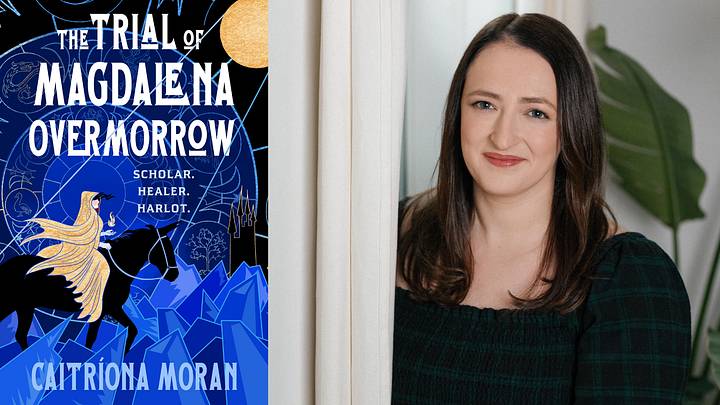
Caitríona Moran introduces readers to a wonderfully unconventional heroine in her debut, The Trial of Magdalena Overmorrow. At the heart of the novel is Magdalena Overmorrow, known as Magda, a scholar and healer whose work helping women access abortions lands her in serious trouble. She is also a heroine who knows her own mind, is entirely comfortable with her choices and has little interest in apologizing for them.
It is a rather refreshing starting point for a fantasy protagonist and one that sets the tone for a story about women's autonomy, institutional power and the people willing to fight against both. Moran was so kind to answer our questions and tell us more about the book and the characters who brought it to life.
The story takes Magda to the northern settlement of Cair Gramora to await her trial. There, she finds herself under the supervision of Morgan Mallander, the settlement's young and deeply religious Lord Proctor. He is supposed to oversee her confinement, and potentially her fate, but their relationship soon becomes considerably more complicated.
Magda is irreverent, curious and rather difficult to intimidate, while Morgan is restrained, courteous and governed by a faith that leaves little room for the feelings he begins to develop. What follows is an exceptionally slow-burn romance built on intellectual curiosity, mutual respect and two people trying to understand a world through different, yet not entirely different eyes.
There's also plenty to love beyond the central romance. Magda's friendship with Jula is another emotional highlight, while the novel's exploration of women's freedoms and the systems that seek to restrict them gives its fantasy setting a particularly contemporary resonance. Magda herself is a refreshing change of pace, too. In her early thirties, she brings a confidence and lived experience to the story that readers will absolutely love.
We asked Moran about the story's origins, the relationship between Magda and Morgan, that devastating ending and what readers can expect when Magda's story continues in the second book.
ASH ANJUM for WINTER IS COMING: We have to start at the very beginning. Where did this story come from? Was there one image, one idea that started it all?
CAITRÍONA MORAN: I can tell you the first scene I wrote, which was the reaping dance. So much of Magda and Morgan’s personalities and the shape of their relationship is in that scene: Magda’s impishness, their banter, Morgan having a good time in spite of himself. But what I started with really was the feeling of two people who are extremely attuned to one another and have a deep curiosity about how the other sees and experiences the world. That, to me, is the basis of love.
WIC: The world feels so urgently alive and so heartbreakingly relevant to right now. Was that always intentional, or did the contemporary resonance grow deeper the longer you spent with the story?
CM: Ugh, yes, wouldn’t it be great if it didn’t feel quite so relevant right now! When I started writing the story, in late 2016 or early 2017, I wanted it to be pure escapism. I was just trying to distract myself from doomscrolling for eighteen hours a day, and I thought at the beginning I was just going to write something kind of frothy and fun. I knew when I started that Magda was going to be accused of a crime, and that whatever it was she definitely did it, but I was imagining a more sexy crime, like that she was an assassin or poisoned evil husbands or something.
But I think some part of me knew all along that this was going to be an abortion story, even when I was writing the froth. When I got to the point of the process where I had to decide definitively what she had been arrested for, I realized that Magda being an abortion provider slotted in perfectly to the story I had already written–a story about physical autonomy and systems of power and control.
WIC: Magda felt like someone who has always existed. She’s guilty and she doesn’t apologize for it, not even once – which is so rare and so thrilling in a heroine. Was that unapologetic quality always hers?
CM: I think a big part of Magda’s unapologetic approach to life (and her own guilt) is her age. From the very beginning of the drafting process, I knew I wanted her to be in her early-to-mid 30s.
Obviously I love an 18-year-old fantasy ingenue as much as the next person, but it worked better in the story for Magda to have a more adult confidence–she is in a totally new situation but she has seen some things and it take a lot to faze her. And I think if I had written her as a teenager or even as someone in her early twenties, her character would have felt a lot different.
WIC: The friendship between Magda and Jula made us cry more than the romance, honestly.
It felt so completely real. Can you tell us a bit more about how it felt writing them?
CM: Magda and Jula are opposites in so many ways, but they complement each other so well. It was important to me to feature a strong friendship in a book where the main relationship is a romance–my friendships have been so life-sustaining, and I already know exactly which friends I would call if I was on trial for my life. Magda and Jula are an especially interesting case because they’re technically friends but were raised more like cousins by Jula’s aunt, who is no longer alive. So they don’t actually have to have anything to do with each other anymore–they are not, legally speaking, family–but they choose each other again and again, which to me is just as important as romantic love.
WIC: Morgan. We need to talk about Morgan. He holds so much power over her and yet somehow the book makes that feel like the most aching, complicated, beautiful thing. How did you hold that balance so carefully?
CM: I loved writing Morgan! The contrast between the restraint with which he lives his life and the muchness with which Magda lives hers was such fertile ground for me to play around in. I think what was most important about Morgan is that because of his background, he understands even more than Magda in some ways what it’s like to be completely powerless, and takes his position over her seriously, in a way that almost no one else would.
WIC: The slow-burn is one of the best we’ve ever read. Every tiny moment between them felt electric. Is there a particular Magda-Morgan moment that you loved best? (We have too many!)
CM: Oh man, it’s so hard to pick one moment because I loved writing them so much. I had to cut about 25,000 words off of the manuscript when I started querying because it was just too long, and most of that was just Magda and Morgan talking while drinking wine. I just could not stop writing scenes of them talking and drinking wine. I think my favorite moment between them, which comes fairly early in the book, is when they very first meet and he addresses her with her scholar’s title, which to that point no one else in the book has.
It’s a small moment, and not as flashy as some of their other scenes in the book, but it’s so representative of their relationship–Morgan first and foremost respects her as a person and a scholar, and that is so sexy to me (and also to Magda!).
WIC: The book is so openly and lovingly about women’s freedoms and bodily autonomy. There’s no metaphor but Magda doing what she does without apology. What gave you the courage to be that clear?
CM: I don’t think it’s courage, actually! I think it’s just that at this political moment, there is nothing to be gained by playing coy. We’re in a period of time when prominent politicians are advocating for the death penalty for women who get abortions. The reproductive rights Doomsday Clock is at midnight, so we’re kind of out of time for talking around the importance of reproductive autonomy.
I didn’t want the book to be ambiguous about that, which I think sometimes came at the cost of subtlety. That’s always the danger of writing a political book, but I was comfortable with that trade-off. I’m not afraid to push the big red button that says ABORTION IS GOOD, ACTUALLY in a scene.
WIC: Was there a scene that surprised you emotionally while writing it? Perhaps, one that hit harder than you expected, that maybe made you stop and just feel it for a while?
CM: This might not be a surprise but I found the trial scene incredibly hard to write. In the original drafts, it was extremely spare and short. I thought I was doing that on purpose, but in line edits my editor basically sat me down and said, this isn’t working and I don’t think this is how you want this scene to go. And she was right! I was struggling with it because I don’t like it when Magda suffers, and was sort of writing my way around that discomfort.
WIC: That ending. That absolutely devastating, diabolical, gorgeous ending. Was it always
going to end that way? Without giving too much away, how much of book two was already living in your head while you were writing book one?
CM: I knew pretty early on that Magda was going to go to trial, be found guilty, and make a
miraculous escape from the fire, and that Morgan, when his need for reserve and control turned into self-effacement, would sacrifice himself for her. The exact shape of it changed a lot in the drafting, but the main plot points were there. Which is also how I approached book two–I knew a couple major landmarks I wanted to hit related to the ending of book one, but the path to get to them was pretty opaque.
I’m a terrible outliner, so a lot of the writing process for me is also a discovery process. And I’m not just saying this because I’m a terrible outliner, but I think that’s where a lot of the magic happens!
WIC: Can you give us anything, literally anything, about book two? Will it be picking up the pieces or does it take the story somewhere we genuinely won’t see coming?
CM: I don’t want to say too much, because I am very much still in the drafting process, but book two picks up about a year after the first book. Magda isn’t having a great time. She is trying her hardest not to be named as an official living saint and failing. And however bad Magda’s time is, Morgan’s is worse.
 Add us as a preferred source on Google