

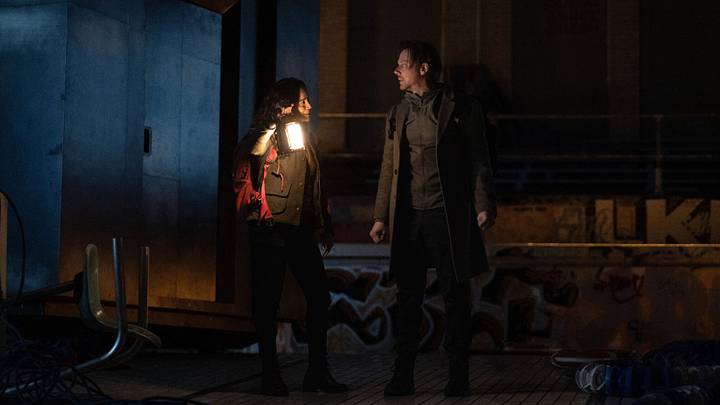
Blake Crouch's 2016 sci-fi novel, Dark Matter, took readers through an array of realities that formed a surprisingly grounded multiverse. Naturally, season 1 of the Apple TV series adapted these same worlds for the small screen. Also now serving as the project's showrunner, Crouch has introduced several new alternate realities to make Dark Matter's multiverse feel even more vast. However, I still have a strong affinity for the worlds that originated in the pages of the source material.
As such, I was especially pleased when season 2's "The Pyramid" combined these two worlds. The creative decision immediately highlighted how different the two worlds were, almost as if they exist at opposite ends of the spectrum when it comes to how disparate Dark Matter allows its numerous realities to be. Furthermore, the twist sets up a macabre-but-thrilling future for the Apple TV' series.
FULL SPOILERS for Dark Matter season 2, Episode 7, "The Pyramid."

Dark Matter's book universe mash-up in "The Pyramid," explained
Crouch doesn't name the universes in the book, and the Apple TV series has only recently started to address that quirk. For instance, we hear about a world uncreatively called "HB-24" in "The Pyramid." So, Dark Matter readers/viewers are largely left to their own devices in this respect. On that note, I'll need to describe the universes that have just been combined, and then assign them both an unofficial designation.
The first of the two universes involved in the inter-Dark Matter crossover in "The Pyramid" is the one where a lethal virus has taken hold. Everyone is either confined to their houses or else trying and failing to stop the spread by working for organizations like the CDC. The name of the virus isn't revealed in the book or in season 1, but it did take the lives of the Daniela (Jennifer Connelly), Charlie (Oakes Fegley), and Jason (Joel Edgerton) in that world. Let's call it the Virus Universe.
The reality that collides with the Virus Universe is what I've long been calling the Futuristic Chicago Universe. The technology here is more advanced than most other realities, and the enlightened society exists as a sort of near-utopia. Unfortunately, the contagion from the Virus Universe, which we learn in "The Pyramid" is called Hema Aetho 26, or the Black Iris Plague, has made the jump to Futuristic Chicago.
Although the Virus Universe has been devastated by Black Iris already, an earlier season 2 episode did at least reveal that Leighton (Dayo Okeniyi) had hunted down a cure and a vaccine from another reality that had already put in the legwork. Sadly, Futuristic Chicago has been caught completely off-guard by the rampant virus, with a version of Ryan (Jimmi Simpson) showing up there as a carrier — presumably after he and Amanda (Alice Braga) stumbled into the Virus Universe and made a quick escape.

I doubt we've seen the last of the Black Iris Plague in Dark Matter season 2
The idea of Black Iris leaving its native reality (if it is even is from that reality) and spreading to other universes isn't something I ever considered when I first read Dark Matter. It also didn't occur to me as a possibility when it appeared on screen in season 1. Now that Crouch and company have pointed out how easily it could happen, it retroactively feels like an inevitability. For all the good that can come from multiversal travel in Dark Matter, the story tends to focus on the negative fallout. It doesn't get much more negative than the multiverse crumbling under the weight of a terrifyingly contagious lethal virus.
Conversely, it seems very unlikely that this subplot of Black Iris' spread to other realities is going to just quietly come to an end. Instead, I expect it to become even more dominant as season 2 progresses. It may even spread into season 3, if Dark Matter continues beyond the current run of episodes. All of this is to say that Pandora's Box has been opened, and closing it again will be a near-impossible task for Dark Matter season 2 to achieve with just three episodes remaining.
Dark Matter season 2 is streaming now on Apple TV.
 Add us as a preferred source on Google