

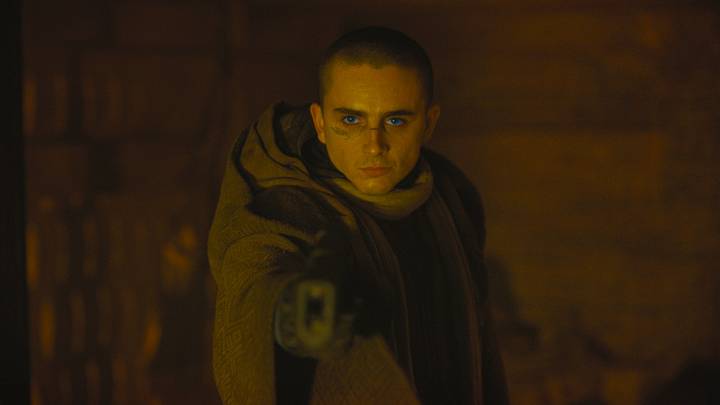
All good things must come to an end, and so it is for Denis Villeneuve's Dune trilogy. Advance IMAX tickets for the Dune: Part Three went on sale yesterday, and already it's becoming clear that it's going to be a major moviegoing event when it releases on December 18. If you're lucky enough to see it in the 70mm format, it promises to be an experience that few other films can match.
However, in a somewhat surprising move, this ticket presale also unveiled the official runtime for the film — and it's shorter than expected. According to IMAX's website, Dune: Part Three only runs 2 hours and 20 minutes. That's around 25 minutes shorter than Part Two, and 15 minutes shorter than Part One. Did Villeneuve run out of things to say with this one?
Not likely! From where I'm sitting, Dune: Part Three's runtime is just right. The first two films split Frank Herbert's seminal 1965 Dune novel in half, with the first primarily covering the Harkonnen coup to oust House Atreides from rule over Arrakis, and the second following Paul Atreides (Timothée Chalamet) as he leads the planet's native Fremen people on a war to reclaim their home, which in turn spills over into a galaxy-wide holy war by the time the credits roll.
Why is Dune: Part Three shorter than the first two movies?
Dune is a notoriously dense and difficult work to adapt. But the same can't be said for its sequel, Dune Messiah, which is a much smaller, more contemplative book. Ace's beautiful recent paperback run of the series put the difference in perspective: Dune clocks in at 704 pages, while Dune Messiah is only 352. That's exactly half the size; in other words, the split narrative of the first two movies had around the same amount of source material to go on for each installment as Part Three, and that's before you factor in how many more large-scale, cinematic action sequences there are in the first book to eat up screentime.
Essentially, Dune Messiah feels almost more like an epilogue to Dune rather than another sprawling adventure in its own right. It skips Paul's holy war entirely, picking up 12 years later when he's firmly entrenched as emperor of the known galaxy. The sobering fallout of the holy war — or jihad, as it's called in the book — haunts Paul in the twilight days of his reign. That's exacerbated by the appearance of a face from his past: the resurrected shade of his former sword master Duncan Idaho, now known as a genetically engineered "ghola" called Hayt.
Despite all this, don't expect Dune: Part Three to be a snooze fest. From the trailers, it looks like we'll see more of the holy war on screen than we ever did in the pages of Herbert's book, which is probably a good call for a visual medium. This will be a more focused film than its predecessors, which should allow Villeneuve's trilogy to reach a poignant and powerful ending that does justice to this incredible sci-fi film saga he's created.

How much of Dune: Part Three was filmed in IMAX?
In addition to finding out the runtime, we also got a few other details about the movie's specs this week. Denis Villeneuve and cinematographer Linus Sandgren filmed a substantial part of the movie for IMAX, meaning they utilized technologies like IMAX cameras to get the biggest, most immersive picture possible for these premium format screenings.
According to IMAX's press release for the early "Dune Insider" screenings, 71 minutes of Dune: Part Three's 140 minute runtime were filmed for IMAX (via Gizmodo). That means more than half the movie is optimized for these enormous screens. It's not quite the same brag as The Odyssey filming the entire movie in IMAX, but it's still far more than the average film.
Suffice to say, Dune: Part Three is probably going to be the IMAX movie event of the fall and winter this year. Watch it in 70mm, if you can still get tickets!
Dune: Part Three premieres December 18, 2026.
 Add us as a preferred source on Google