

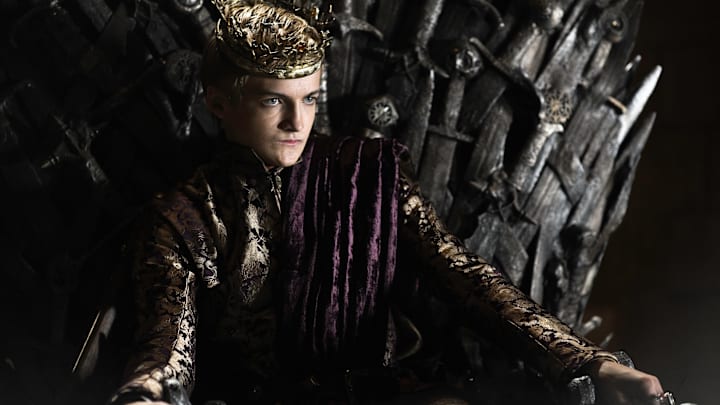
Mark Addy's King Robert Baratheon only appears in the first seven episodes of Game of Thrones before his death. However, the end of his reign is one of the show's biggest narrative catalysts. After Robert's passing was successfully orchestrated via a hunting accident set in motion by Cersei Lannister (Lena Headey), the mad scramble for who would take the Iron Throne next begins. However, not all the would-be monarchs of Westeros have an equally legitimate claim — which is sort of the point of the entire show.
Before we begin the list proper, I feel it's important to point out why I haven't included certain characters in the official line of succession. While they are on the Iron Throne throughout most of Game of Thrones, Cersei and her children got there through subterfuge and manipulation. If the line of succession had been followed properly, Joffrey (Jack Gleeson), Tommen (Dean-Charles Chapman), and Cersei would have been ineligible to rule due to their lineage as Lannisters rather than being genetic Baratheons. Similarly, although Robert's dying wish was for Sean Bean's Lord Eddard "Ned" Stark to take the throne, he'd only have been keeping it warm until a true successor was identified. So, let's take a look at who had an actual claim to the Iron Throne.

7. Daenerys Targaryen
Played by: Emilia Clarke
It should be clarified at this point that Daenerys' claim to the Iron Throne is only legitimate when viewed through a certain lens. While she would once have been inarguably part of the line of succession when the Targaryens were in power, Robert's rebellion overthrew the centuries-long dynasty and violently supplanted the Mad King before the core events of Game of Thrones. The rebellion may have been carried out under false pretenses, but it was undeniably successful at removing the Targaryens from power and slaughtering almost every member of the silver-haired family.
So, Daenerys' belief throughout most of Game of Thrones that the Iron Throne is her birthright is technically incorrect, but easy to understand and accept when it's considered how recently Robert took it for himself and House Baratheon. Plus, with how closely Daenerys' movements are monitored by those in King's Landing as she draws closer to taking the throne, it's probably fair to say that Cersei and the others are fully aware that Daenerys' claim is, at least, sort of legitimate. Still, there are several other characters ahead of her at that time.
6. Viserys Targaryen
Played by: Harry Lloyd
Viserys is in fewer episodes than Robert ever was, but only by a total of one. For the first six episodes of Game of Thrones, Lloyd's character tries to position himself as the rightful King of Westeros after being in exile over the Narrow Sea since Robert violently took the throne from Viserys' father, the Mad King. When considering only Targaryen characters, Viserys does have a more legitimate claim to the Iron Throne than Daenerys as her older male sibling. However, since Jon Snow is the trueborn child of Viserys' elder brother, Rhaegar, the laws of Westeros and how succession works in Game of Thrones mean Viserys would have had less right to rule than his nephew....if he hadn't died.

5. Jon Snow (Born Aegon Targaryen)
Played by: Kit Harington
The biggest Jon Snow twist in Game of Thrones concerns his lineage, when it's discovered deep into the show's run that he's not only a Stark, but a Targaryen too. As the last surviving male heir of the Targaryen family, he exists further ahead in the line of succession that Daenerys believes she's still a part of. Born Aegon Targaryen, Jon consistently refuses to press his claim for the Iron Throne when he discovers the truth. When Robert dies, Jon is still years away from finding out his status as a Targaryen. As such, the matter of Jon's claim doesn't become a known factor until much later.
4. Most of King Robert's Bastards
Played by: N/A
This is where the Baratheon bloodline really starts to kick into gear. Although born out of wedlock and to various lowborn women, the bastards whom Joffrey ordered slaughtered to solidify his own (illegitimate) claim to the Iron Throne had a more solid place in the line of succession than Gleeson's character ever did. Secretly born of incest, Joffrey was a full-blooded Lannister, and so should never have followed Robert into the Iron Throne. Most of these bastards are shown only briefly, and never reach anywhere near an age where they could have ruled. Still, they did exist as part of the chain for a time.

3. Gendry Baratheon
Played by: Joe Dempsie
Referred to incorrectly in the show as Gendry Rivers, Dempsie's character should have been born Gendry Waters. If, that is, he was ever an acknowledged bastard. He wasn't, though. As such, he was known only as Gendry (or at least should have been) until Daenerys legitimized him as Gendry Baratheon in season 8 and made him Lord of Storm's End. Like Jon, Gendry doesn't find out he's descended from royalty until quite deep into Game of Thrones, and even when he finds out, he has no interest in pushing any kind of claim. Still, as the oldest living child of Robert in the show, Gendry did have a pretty valid claim — especially once Daenerys legitimized him. At least he got Storm's End.
2. Renly Baratheon
Played by: Gethin Anthony
As the youngest of the two brothers left behind by the late King Robert, Renly's claim to the Iron Throne is one of the strongest. While not a son of Robert, like Gendry, Renly is a legitimate Baratheon from the start. This is why his claim is stronger than that of Dempsie's character. There is someone with a stronger claim (we'll get to him in a moment), but Renly's belief that he himself is the one best suited to rule over Westeros is bolstered by the immense support from countless other houses with a great deal of power, wealth, and influence, House Tyrell being the most important. With a Queen, a Hand of the King, and the support of the people, it's no wonder that he meets his end via something as specific and dishonorable as targeted witchcraft.

1. Stannis Baratheon
Played by: Stephen Dillane
If the line of succession had been followed to the letter, then Stannis, as Robert's oldest living brother, would have been the next King of Westeros after Robert's death. It was only Cersei's deceptive plan to place her and Jaime's children into the line of succession that prevented this from happening. Robert had no biological heirs who weren't bastards, and most of them would have been too young to take the throne even if they were legitimate. Ned's attempt to out Joffrey's true lineage would have put Stannis on the throne, but all that happened was that Robert's former Hand lost his head while trying to pull this off.
Instead of a seamless transition from Robert to Stannis, Stephen Dillane's character was left with no choice but to rally his own forces in an attempt to take the Iron Throne by force, just like Renly was trying to do. While Renly did gain significant support before Stannis sank to dark magic, the older of the two Baratheon brothers was forced to resort to sellswords and lesser houses when it came to who would fight for him. Even his rejected offer to legitimize Jon Snow wasn't enough for Stannis to gain the support of the North, and the would-be successor to his King Robert Baratheon fell after a near-successful sack of King's Landing and a follow-up, limp, second attempt to rule while trying to capture Winterfell.
Game of Thrones is streaming now on HBO Max.

Game of Thrones turns 15 this month, and we're celebrating by looking back on the series with editorials, deep dives, lists, and retrospectives exploring the impact of Westeros and the characters we all grew to love (or love to hate). Embarking on a rewatch? We've got you covered to get the most out of it.
More Game of Thrones:
 Add us as a preferred source on Google