

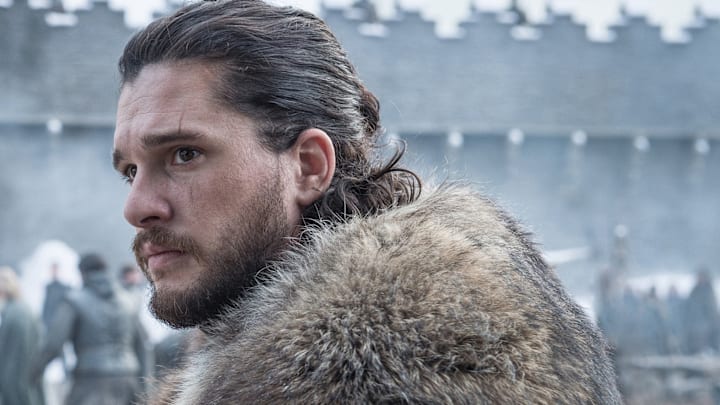
Game of Thrones is filled with turning points that, if another choice had been made, would have taken the story in a wildly different direction. Of these scenarios, one of them often eludes discussion, despite it being one of the most important decisions in the entire show. In Game of Thrones season 5 Episode 2, "The House of Black and White," Stephen Dillane's King Stannis Baratheon makes Jon Snow (Kit Harington) an offer that he can barely refuse. Still, the Bastard of Winterfell did find the strength to turn Stannis down.
With Stannis looking to secure support in the North ahead of his attempt to take Winterfell back from the Boltons on the way to King's Landing, his offer to legitimize Jon and make him a Stark is little more than political manipulation. While the would-be king does see the value in having a Stark loyal to the crown as the Warden of the North, and the immensely positive way the Northerners respond to Jon, he's trying to use what Harrington's character has always wanted to meet his own needs. On a weaker day, perhaps Jon would have accepted Stannis' proposal. Let's explore where that would have headed.

The immediate fallout of Jon accepting Stannis' offer
It's done, Jon has bent the knee to Stannis and agreed to swear fealty to the rightful King of the Seven Kingdoms. What that immediately means is that Jon wouldn't then become the Night's Watch's new Lord Commander, which is what actually happened shortly after he turned Stannis down in "The House of Black and White." Instead, the position would almost definitely go to Owen Teale's Ser Alliser Thorne. He was, after all, the favorite — until Samwell Tarly (John Bradley) convinced many of his brothers to vote for Jon instead.
"Kneel before me. Lay your sword at my feet. Pledge me your service and you'll rise again as Jon Stark, Lord of Winterfell."Stannis Baratheon to Jon Snow
Although there was an outside chance that the Free Folk imprisoned at Castle Black would have followed Jon as he marched on Winterfell, it's just not something that would have happened with Alliser in charge. The Lord Commander would surely have executed the Free Folk, which would have meant fewer men to try and take Winterfell from the Boltons. Still, the Northern houses who previously had refused to bolster Stannis' army would have been far more likely to join the fight if they knew Jon Stark, one of their own, would be holding Winterfell at the end of it.

The Battle in the Ice would have been Jon's end (the books prove it)
In the show, Stannis' march on Winterfell is a slow and painstaking affair. With winter rapidly coming, many of his forces abandon their king. By the time they reach Winterfell, his army is minimal, not to mention starving from the food shortage and exhausted from the journey. While the Battle in the Ice hasn't actually happened yet in George R. R. Martin's source material, things are set up to be equally grim for Stannis at this point in the original story. The thing is, in the books, he even begins the march with the support of the Northern houses. Jon, who is the Lord Commander of the Night's Watch, doesn't go with Stannis, but he does offer advice on how to recruit more men. Men whom Stannis wouldn't have been able to convince without Jon's wisdom.
Regardless, against the well-fed, well-rested army occupying Winterfell, Stannis' men don't look to have a chance, even in the books. This is paid off in the Game of Thrones season 5 finale, "Mother's Mercy," where the Boltons make quick work of Stannis' depleted army. So, the larger franchise has already pretty much proven that even with Jon present to make Stannis' victory more likely, it's not enough. The support of the North is not enough to take back Winterfell. As such, Jon would die in a battle he was foolish enough to involve himself in. He's too honor-bound to abandon his arrangement with Stannis, and so he would fall outside the walls of where he grew up. Strangely, "Mother's Mercy" is also the episode where Jon (temporarily) dies in the show, adding a depressing level of parity to things. RIP Jon Stark, in both timelines. He never even found out he was a Targaryen.
While there is an argument that Lady Melisandre (Carice van Houten) could also have resurrected Jon in this alternative timeline, that wouldn't line up with how she operates. She believed fully in Stannis, but she didn't bring him back to life after he fell in battle. So, it stands to reason that she also wouldn't do it for Jon in this version of events either. Plus, how would she get to the body? Jon's remains were still at Castle Black in the show, so they were easily accessible, and Melisandre was basically forced into the resurrection by Ser Davos (Liam Cunningham). That wouldn't happen here. She'd probably just head back east.

Jon's death at the Battle in the Ice sends Game of Thrones wildly off-course
Without Jon, the Battle of the Bastards doesn't happen. While there might be similar attempts from Sansa (Sophie Turner) to take back Winterfell from his abusive husband, they'd all lack the rallying leadership of Jon Snow. Or, as he might have been called in this timeline, Jon Stark. That said, Ramsay (Iwan Rheon) wouldn't have held Winterfell forever. When Daenerys (Emilia Clarke) lands in Westeros, her initial plan of violently taking King's Landing by surprise could easily have gone ahead had she not been softened by her romance with Jon.
What ultimately happened in season 8's penultimate episode, with Daenerys torching King's Landing with Drogon, would have been brought forward and made even more fearsome by the presence of two additional beasts. After all, Clarke's character would never have needed to head north of the wall to save Jon, and therefore wouldn't have lost her first dragon. King's Landing also wouldn't have been prepared for dragons, lacking sufficient defenses to take down the one it did in the show.
Meanwhile, Ramsay, sitting comfortably within the walls of Winterfell, would undoubtedly bend the knee to Daenerys upon her uncontested rise to power as she takes her place on the Iron Throne. This would cement Ramsay as Warden of the North. Without the dragon that the Night King raises from the dead in the show, he lacks the advantage necessary to march his Army of the Dead south. Plus, let's remember that Allister is still Lord Commander by this point, and while he's severe, he's dedicated to his post at Castle Black. The Dead stay held at bay for longer.
Still, with a tireless Army of the Dead at his command, the Night King would inevitably find a way to breach the wall eventually, especially with the largely unaddressed mark on Bran (Isaac Hempstead Wright). When that happened, the Unsullied, the Dothraki, and the other fighters who ultimately helped stop the Dead in season 8 would be in King's Landing, or elsewhere and unprepared. It would take a march through most of Westeros before the Dead were thinned significantly to the point that Daenerys' forces would stand a chance of finishing the job outside the walls of the capital. But would it be too late by then?

Queen Daenerys Targaryen watches King's Landing fall, and the Night King wins
Daenerys' reign has barely begun in the show by the time Jon betrays his love/aunt by sliding a knife into her heart and killing her. But their relationship was still vital to beating the Night King. Jon was the reason Daenerys saw the Dead with her own eyes, and she permitted the dragonglass to be mined at Dragonstone. Without ever knowing Jon, she would still have doubted the Dead even existed until it was too late. Westeros would lack the dragonglass weapons needed to take down the undead soldiers, and with Valyrian steel at such a premium, that wouldn't have been a realistic alternative.
While it was proven in "The Long Night" that dragonfire was a formidable weapon against the Dead, and remember that Daenerys would still have three of them in this timeline, the episode also revealed the Night King wasn't affected by the blaze. Furthermore, it's already been established that he's one of the rare few capable of killing a dragon. They'd hold off his forces for a while, but the dragons would inevitably fall and be taken by the Night King. If any resistance remained from the living after that, it wouldn't last long. In short, Jon Snow definitely made the right choice to turn down Stannis, as Game of Thrones would have had an incredibly dark conclusion if he had wanted to be a Stark too badly.
Watch Jon not set any of this in motion in Game of Thrones, streaming now on HBO Max.

April marks Game of Thrones 15th anniversary, and we're celebrating all month long with deep dives, retrospectives, think-pieces and more to look back on the iconic HBO series. Are you as excited for Game of Thrones anniversary month as we are? You're in the right place! Stay tuned for more, and get to rewatching!
More Game of Thrones:
 Add us as a preferred source on Google