

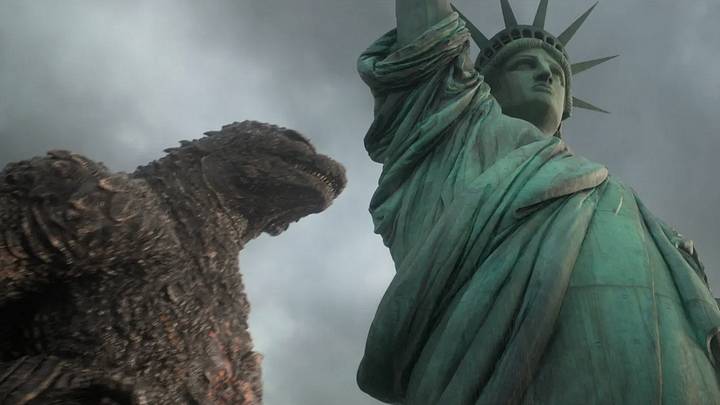
When I go to see a movie for the purposes of reviewing it or writing about it in-depth, I keep things professional. While there are absolutely occasions where I cut loose and see something solely for my own sake (shoutout to Sun-Ray Cinema, whose 35MM print of Creepshow ruled), if I am seeing a film, I want to remain as objective as possible about the work so that I can ultimately evaluate the film in an honest way. But when I went to see Takashi Yamazaki’s Godzilla Minus Zero in IMAX, I couldn’t help but get swept up in it.
There were numerous contributors to this immersive and captivating effect. For one, on the IMAX screen, the frame was literally so large that it filled even my peripheral vision at times. Furthermore, the film itself was incredibly thrilling from its very opening moments and engaged with a whole lot of the themes, ideas, and genre hallmarks from across the Godzilla canon that I personally love the most, so that also lent itself to a much more subjective kind of viewing experience.
But perhaps the film’s strongest tool of immersion is one that doesn’t get talked about nearly enough: the sound of it all.

Godzilla Minus Zero is the kind of movie IMAX was made for
When you go to see a movie, the film’s audio has been tested and re-tested time and again, to ensure that it is adequate and applicable for theatrical distribution. This is an inherently good thing and necessary, but it has also led to a kind of sanding-off-the-edges in terms of a lot of mainstream films’ sound. Godzilla Minus Zero, partially because it’s a Japanese production and partially just because it felt creatively right to the team, foregoes a lot of these conventions and cranks the volume up to insane degrees.
In the IMAX theater, the sounds of Godzilla and Ghidora fighting were bone-rattling at times, which made the whole viewing that much more of an experience to be had.
The only mainstream release that this is comparable to from across the past year would be Christopher Nolan’s The Odyssey, which similarly cranked the volume all the way up to achieve a unique kind of invasive immersion. Nolan has famously experimented with sound over the course of his career (the Bane voice from The Dark Knight Rises or the reverbed organs from Interstellar remain talking points for a reason), and it’s no coincidence that such big swings do really seem to resonate with viewers in the theater.

As someone who strives for objective viewing, the great thing about really loud sound is how alive it can make a film feel. In a strange way, it bursts through your preconceived notions of the established guardrails of the movie, and blurs the line between what’s on the screen and what isn’t. At that aforementioned showing of Creepshow for instance, the volume was cranked all the way up, and I was able to watch this 1982 film in a wholly new and far more vital kind of way.
There are many lessons that I hope blockbuster films can take from the success of Godzilla Minus Zero, but chief among them is its willingness to make its sound a key component of its means of artistic expression. This isn’t necessarily to say that every film needs to be deafening in its volume, but rather that a willingness to think outside of the pre-established sonic box could reap untold benefits.
I am going to go see Godzilla Minus Zero in the IMAX again for a repeat viewing, simply because I can’t imagine the sound ever being that thunderous or immersive at-home, and I want to experience it once more before it’s gone.
 Add us as a preferred source on Google