

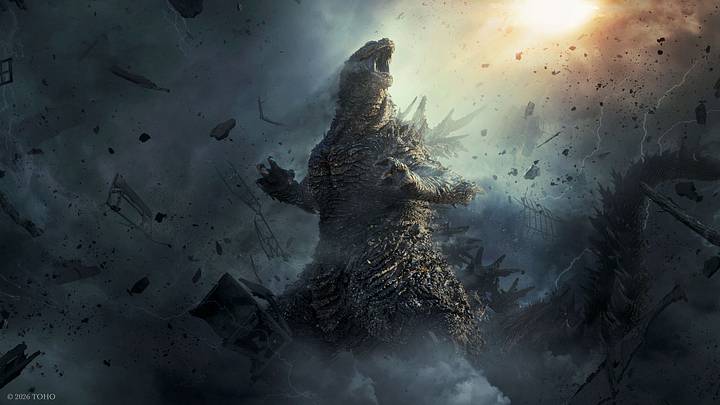
Ever since the dawn of the monster movie, there has been a deep connection forged between the misbegotten creatures of the silver screen and children. A contributing factor to this is often the tragic nature of such monsters; characters ranging from Frankenstein’s monster to King Kong exist as these misunderstood entities to be empathized with, and that kind of a character can leave an indelible impression on young viewers.
Such is very much the case for Godzilla both as a character and a franchise. Over the course of decades, the Godzilla movies have ebbed and flowed from more mature and serious entries to far more joyous and semi-kid-friendly takes on the character and his monstrous cohorts.
The new film, Takashi Yamazaki’s Godzilla Minus Zero, is predominantly the former of these two options: it is an R-rated film dealing with tons of heavy adult content, including nuclear destruction and the resulting fallout, emotionally and physically, of such devastation.
Godzilla Minus Zero understands the importance of its child character
However, in the midst of all of this, Yamazaki’s script also interweaves the tale of Akiko, as played by the young Sae Nagatani. She is the adopted daughter of primary characters Noriko and Kōichi, and she becomes an unexpected centerpiece of the film. And you know what? It absolutely rules.
There’s a lot to be said about the potential pitfalls of introducing child characters into long-running horror-tinged franchises. It feels like somewhere along the way, everything from Halloween to Friday the 13th has tried its hand at focusing more explicitly on a child protagonist, often to varying results. However, Godzilla as a series has a much deeper and more nuanced relationship to children than practically any other such franchise does.
Godzilla has not only had films explicitly geared towards children (looking at you All Monsters Attack and Son of Godzilla), but the character has also been featured in his own animated series. Neither Michael Myers nor Jason Voorhees can boast such things.
What makes Godzilla Minus Zero so fascinating though is in how it incorporates these more kid-focused elements into the adult-skewing tone and story of this film. When the film focuses on Akiko, it isn’t just to utilize this younger character and her potential fate within these harsh conditions as a way to cheaply ratchet up the stakes.
Instead, Akiko is treated genuinely and interacted with by the film on her own terms. Her scenes, especially those in the orphanage, play out like scenes from a children’s film, in the best of ways. This gives Sae Nagatani incredible performance room to breathe and resonate, but it also allows the character’s arc throughout the film to tie that much more directly into the primary themes of the film.
If Yamazaki’s previous entry, Godzilla Minus One, was primarily about characters learning the value of life and beauty of surviving such disaster to prosper anew, then Godzilla Minus Zero is about many of those same characters grappling with the idea of paving the way forward for the next generation, attempting to give them a better world for tomorrow than the one they have today.
To this end, children are something of a focal point within the story, with Yamazaki’s writing continuously looping back around to them for punctuation. At the heart of all of this is Akiko and her relationship with her adopted parents.
Godzilla Minus Zero isn’t a film hampered by its kid-focused story elements, but rather enhanced by them. The film manages to respect and incorporate influences from across the larger Godzilla canon, and in blending the more kid-friendly elements of latter-day sequels with the deadly-serious tone of the 1954 original, it creates something truly special.
 Add us as a preferred source on Google