

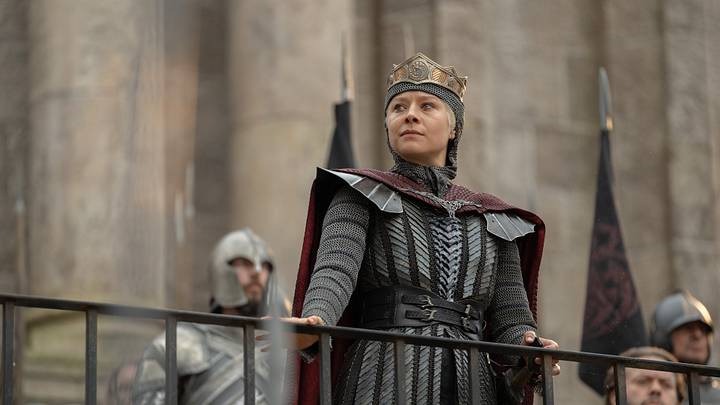
With House of the Dragon season 3 behind us, it's fun to look back and analyze the parallels between Game of Thrones. In the season 3 finale, there were plenty.
One thing everyone is talking about coming out of the finale is similarities in the decline of Rhaenyra (Emma D’Arcy) in House of the Dragon and Daenerys (Emilia Clarke) in Game of Thrones. However, House of the Dragon's showrunner Ryan Condal acknowledged those similarities in a press conference he did after the finale (via TV Insider):
“I think that’s wonderful if people draw parallels between this and the original series," Condal said. "For sure there’s going to be mirroring and echoes and reflections across the two series, and people will see things that are either intentional or subliminal, and I will just say that I think this is one of those existential themes that goes across this entire universe, which is the draw of the Iron Throne: what it does to a person in its thrall or the people that are trying to get to it."
More interestingly, Condal also noted a big difference between Rhaenyra's arc and Daenerys' rise to power.
“The big difference between Rhaenyra and Daenerys is that Daenerys only got to the Iron Throne at the very end after she had destroyed the city,” Condal said. “Rhaenyra goes through this experience of having the throne, trying to hold it, and being, in a way, turned and changed by it, altered by the experience. So, I think they’re very different things, but the parallels do call to the greater themes of the A Song of Ice and Fire universe, which is pride and power, how power corrupts, how far it corrupts, and it can change good people into corrupted people. It can take corrupted people and make them real villains, and other people, like Viserys [Paddy Considine], that [it] can simply just destroy. And that is, to me, is where [the parallel] exists. Those reflections exist on a thematic level.”

How Daenerys' journey is different than Rhaenyra's
I do think that this parallel is important, and it does show the difference between the two characters. Even if Daenerys had already destroyed the city before she had taken the throne, there's no denying that grief, with her, and power imbalances also played a heavy role in her journey. Those things happened before she even got to King's Landing.
With Daenerys, at least to me, it felt as if her descent was much slower. While Rhaenyra did lose a lot in a small amount of time (which, for anyone, would be impossibly hard to deal with), Daenerys had that sort of slow downward spiral, one that most didn't really recognize until the very end. Plus, everything she did, and the mistakes she made, was in pursuit of the Iron Throne, aside from one key death.
The one death I would say in her life that didn't directly occur because of her desire for power was her son's death early in the story. He had to die in order for Khal Drogo (Jason Momoa) to live, but that turned out only to be a farce. Drogo was basically just breathing; he was not himself anymore. That, in itself, led to Daenerys having to kill her first husband.
Over time, however, Dany consistently began to lose the support of her people. As we see with Rhaenyra, people would constantly question her rule because she was a woman, but it was much harder for Dany because her family were outcasts. Dany saw betrayal after betrayal, including from one of her biggest supporters, Jorah Mormont (Iain Glen). Then, when she finally arrived in Westeros, she was treated pretty poorly by almost everyone, including those in the North, when she arrived to help with her dragons, only for her to lose one.
Then, she lost the support of Jon Snow (Kit Harington), the one person who should have understood her, and then Missandei (Nathalie Emmanuel). It all began so slowly and then fell apart so fast. It's easy to see why she burned down the city. Quite frankly, I think that if Rhaenyra were in the same position, she'd do the same.
In that way, I think Condal is right to a certain degree, but if you switched Daenerys and Rhaenyra and let them experience the same circumstances, the outcome of each situation would probably be the same or similar because these characters are so similar.

The Iron Throne changes everyone
The power of the Iron Throne, whether you're sitting on it or you're around it, alters everyone, as Condal noted. He also mentioned the great example of how it could destroy others, as it did for Viserys in season 1 of House of the Dragon. We've seen this with basically all of the Targaryens in these stories, Rhaenyra, Daenerys, Aegon (Tom Glynn-Carney), Aemond (Ewan Mitchell), and others.
Of course, it doesn't stop with the Targaryens. Even when Joffrey (Jack Gleeson) was on the throne, as well as Cersei (Lena Headey) in Game of Thrones, they became crueler and bolder in their attempts to keep power. They used that power to harm others. Cersei was more strategic, while Joffrey was just sadistic. As for Tommen (Dean-Charles Chapman), well, he was destroyed as Viserys was, not physically, but mentally. Remember, he threw himself out the window, which is clearly a parallel to Helaena’s death in the season 3 finale.
Anyone who gets close to the Iron Throne is never the same, and that's true of Rhaenyra, Daenerys, and the many other characters who have been in its proximity for too long. The season 3 finale is just further proof of that. Honestly, with more deaths likely to happen in season 4 since it is the final season, I can only imagine who the Iron Throne will corrupt next, whether that be a ruler or a follower.
 Add us as a preferred source on Google