

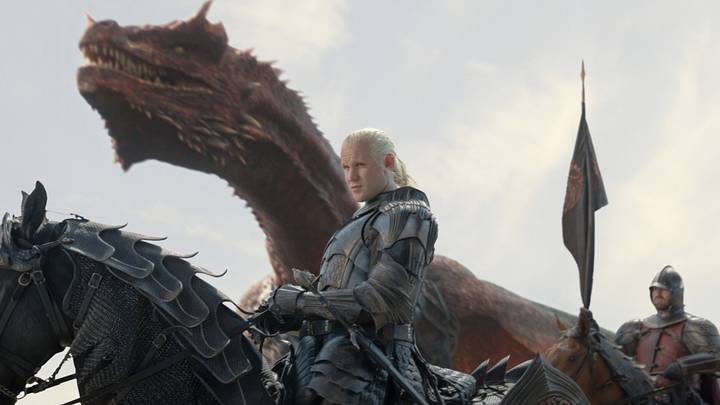
It's been quite a ride, but at long last, the House of the Dragon season 3 finale has arrived. Over the course of eight episodes, the Game of Thrones prequel has delivered fire and blood, with the most epic battles of the series, more dragons than ever before, and character payoffs that left our jaws on the floor. It's all led to this moment, with Queen Rhaenyra Targaryen plunging to her most villainous depths yet while the Battle of Tumbleton unfolds a few days' ride from King's Landing.
The Thrones franchise has a grand tradition of the most cinematic fantasy battles on television. The Battle of the Blackwater. The Battle at the Wall. Hardhome. The Battle of the Bastards, Battle of the Gold Road, The Long Night, and the Battle of King's Landing. These sequences are the stuff of TV legend.
House of the Dragon's Battle of Tumbleton more than earns its place among them. But the season finale is so much more than just its centerpiece battle, which just makes it all the better.
At 70 minutes long, the House of the Dragon season 3 finale is one of the longest episodes of the entire series to date. That mammoth runtime is well-warranted, given that this is easily the most ambitious installment of the Dance of the Dragons the show has produced so far, both in terms of production values as well as its sweeping story.
We have so much to discuss, so let's waste no more time with the wind-up. FULL SPOILERS for House of the Dragon season 3 episode 8, "The Treasons at Tumbleton," beyond this point.

The return of the king
The finale begins with Grand Maester Orwyle (Kurt Egyiawan) racing toward Rhaenyra's room in the dead of night, bearing an urgent message delivered via raven. Aegon II Targaryen lives, arisen with his wounded dragon Sunfyre at his side. This news predictably sends Rhaenyra (Emma D'Arcy) into a full-blown panic attack. She barges into Daemon's (Matt Smith) room as he prepares for the looming battle at Tumbleton, raving about how her subjects have been waiting for this sort of news about Aegon and they're already gathered outside the Great Sept to celebrate the good omen of his rebirth.
Daemon meets the queen's fears with unflappable calm. He is older, more seasoned, and more used to life and station-threatening challenges than his niece/wife. "This is your test," he insists in High Valyrian, when she gripes about how one challenge after another has been pushed on her. And he's not wrong. This is the crucial moment where Rhaenyra Targaryen either rises to the occasion or folds.
Unfortunately for her and the realm at large, it goes even worse than anyone could have anticipated. The season finale marks Rhaenyra's full descent into tyranny. Before season 3, I worried that House of the Dragon didn't have the guts to fully embrace her villain arc from the book, since it's made a habit of letting characters off the hook for their monstrous actions in the past. That fear has now been laid firmly to rest. Not only does the season 3 finale give us Rhaenyra at her darkest, it takes her even further than I expected, all while Emma D'Arcy delivers the performance of a lifetime. There is no doubt in my mind that they deserve an Emmy nod for their work in this season, and this finale exemplifies why.

Rhaenyra's atrocities mount swiftly after her meeting with Daemon, who remains her one safe harbor in all the chaos. The moment he leaves for Tumbleton, Rhaenyra begins to go off the rails. First she's confronted by her stepdaughter Baela (Bethany Antonia), who finally unloads on Rhaenyra with full clarity about how she uses and discards those who serve her. This incites Rhaenyra's cold, dispassionate fury as she abruptly grabs Baela's face, slipping back into using the formal majestic plural to call attention to their difference in station as she berates the young dragonrider for her insolence. It's a harbinger of much worse to come.
We find out later that the queen grounds Baela and orders her confined to her chambers. Addam of Hull (Clinton Liberty) and Hugh the Hammer (Kieran Bew) are ordered to guard King's Landing and the Dragonpit with their dragons, in case Aegon or Aemond attack the city. It's yet another sign of Rhaenyra's growing paranoia, and one that will backfire on her by the end of the episode when Hugh makes a fateful decision that will remove him from Team Black for good.
The next person to suffer Rhaenyra's ire is Mysaria (Sonoya Mizuno), her Mistress of Whisperers who used her past skills as a whore to seduce Rhaenyra at the end of the previous episode. If you thought that was going to lead to a deeper connection between the two, think again. Rhaenyra sends her lady-in-waiting Elinda Massey (Jordan Stevens) to evict Mysaria from the Red Keep; the queen has booked her former spy mistress passage on a ship to Pentos, and wants her gone without even saying goodbye. It's a good touch that Elinda is as distraught and confused as Mysaria here. No one knows what Rhaenyra is going to do next in this episode, and it's fascinating watching how everyone shrinks or stands their ground in response.
If there's one silver lining to Rhaenyra's descent, it's that it gives more than just Baela the chance to finally tell the queen what they think of how badly rule has twisted her. The next is Helaena (Phia Saban), Rhaenyra's half-sister. As Helaena is led back inside from her brief hour in the Godswood, she passes Mysaria, who is being similarly escorted by guards from the castle. Mysaria uses this opportunity to throw a vindictive wrench in Rhaenyra's plotting by informing Helaena that her brother/husband Aegon lives, and that the queen will never allow their unborn child to be anything other than a hostage to keep Aegon at a disadvantage. And of course, Helaena sees the gray mare and wagon from her dream in the courtyard of the Red Keep just before she encounters Mysaria, which sent a shiver down my spine as it confirmed what we'd all dreaded: this episode is Helaena's last.

As an aside, I can't help but wonder if House of the Dragon added this bit with Mysaria into the show after George R.R. Martin's scorched-earth blog post back in 2024, where he reflected on how Helaena was planned to end her life in the show "for no particular reason," before confirming that Mysaria imparting Helaena with devastating knowledge to push her over the edge was his own canon version of events from the notoriously opaque book, Fire & Blood. I imagine if the show had planned to go that route to start in the outline as presented to Martin, he wouldn't have said what he did. Combined with Helaena's pregnancy, it all smells a bit like damage control.
Rhaenyra meets with Helaena in the room where she's been confined, trying to make small talk as a way of lulling her sister into eating. Helaena, meanwhile, is finally ready to tell Rhaenyra how she sees her ugly actions. I loved how Helaena describes a beetle she thinks is beautiful, which is unique to King's Landing thanks to its propensity for living off the copious amounts of feces in the city, only to turn things on Rhaenyra by saying she doesn't care about this feature of the city's ecosystem, just as she doesn't care about anything that doesn't serve her interests.
We then get the biggest red flag of Rhaenyra's story yet, when she orders her guards to force-feed Helaena. Alicent Hightower's greatest fears for her daughter have come to pass; Rhaenyra is committed to keeping both Helaena and the child alive as leverage over Aegon, by any means necessary. Having her commit such a horrific action against one of the show's few completely sympathetic character is a good way to drive home just far gone she's become. The direction by Andrij Parekh deserves a special nod here; the way the camera lingers on Rhaenyra from behind after Helaena refuses to eat, showing the quiet moment where the queen decides to embrace to this latest abuse of power, is masterful.
Rhaenyra has yet more horrors to commit this episode, but let's leave King's Landing for now to touch on a few of the other plotlines going on in this supersized finale. Don't worry, we'll return to the Black Queen later, when she fully embraces her new identity as Visenya reborn — or "Maegor with teats," as she'll infamously come to be known by the histories of Westeros.

The truth of Alys Rivers' origin
For all Rhaenyra's paranoia about Aemond (Ewan Mitchell) and Aegon (Tom Glynn-Carney) raiding the capital with their dragons Vhagar and Sunfyre, the truth is that there's no real threat of that happening at this juncture. Rhaenyra sent Alicent (Olivia Cooke) to poison her son at Harrenhal last episode, so she knew that Aemond and Vhagar were not there together. But Rhaenyra didn't know the full picture of Aemond's situation; if she had, perhaps she might have reacted differently.
Aemond awakens from Alicent's poison to find himself under the watchful eye of Alys Rivers (Gayle Rankin), the woods witch who is making a habit of saving his life. Aemond immediately rues the fact that his own mother poisoned him, how he's cursed to be truly alone in the world for how he tried to kill his brother. In response, Alys claims to know a few things about curses and loneliness. She bears her soul to Aemond, revealing a shocking truth: she was once the wife of Harren the Black, the dreaded warlord who built Harrenhal more than 100 years ago. Her son was burned by dragonfire when Aegon the Conqueror destroyed the castle, and after turning to old magics to try and save him, Alys accidentally cursed herself to be immortal and forever tied to the Riverlands.
Yes, it is a lot. This is new lore that has never been revealed in George R.R. Martin's writings. It's not clear whether it came from Martin — his long-time writing assistant Ti Mikkel is a co-writer on this episode — or whether House of the Dragon made it up, but either way I thought it worked incredibly well for Alys. If you want to dig deep into the full implications of this reveal, I've broken it all down in detail here.
Alys' heartwrenching confession is played beautifully by Gayle Rankin, who delivers perhaps her strongest acting of the season here. This is a turning point for Aemond and Alys' relationship, where he fully embraces her as his partner and shows her a tenderness we'd never have assumed the one-eyed prince was capable of at the start of the season. It really does show how far he's come, both as an individual and in his relationship with Alys.

The Targaryen brothers, together again
Romance isn't all that awaits Aemond in the House of the Dragon season 3 finale. He later awakens from his medicinal slumber to the sound of wings in the castle: a dragon has arrived. Just like the viewer, Aemond assumes it's his wayward mount Vhagar and races through the castle to its gargantuan main hall — the very same one where Daemon proclaimed Rhaenyra queen to his host of Rivermen in the season 2 finale. This time, however, it's not Syrax who has descended on Harrenhal or even Vhagar, but Sunfyre. The show makes the cool decision to leave the maimed dragon mostly concealed by the shadows, as Aegon limps forward to confront his brother.
Fire & Blood never gives us an inkling that Aemond and Aegon met again after Rhaenyra took King's Landing, but for the show's version of these characters I think we desperately needed this scene. Aemond collapses to his knees in front of his brother, fully consigned to face whatever judgment comes. This, ironically, is the exact opposite of what Aegon wants. He came to Harrenhal intending to kill his younger brother for burning him with dragonfire and trying to usurp his throne; instead, he finds Aemond's defiance completely gone, and even worse, he's remorseful.
Tom Glynn-Carney has consistently delivered one of the best performances on House of the Dragon, and that's true as ever in his final scene of season 3. He gives the funniest line reads of the episode, calling Aemond an imbecile and chaotically declaring "I'm alive" like he's the Joker from Batman. It's just a joy to watch Glynn-Carney in this role.
Aemond wants his brother's forgiveness and is willing to work for it. Aegon never expected this, but he could use his brother's help so he begrudingly leaves that door open for now, declaring that they'll leave Harrenhal together to find Vhagar, so that they can go to Tumbleton and bring their "twat" of a younger brother Daeron into line, since Ormund Hightower declared him king in Aegon and Aemond's absence. Aegon also meets Alys Rivers, who Aemond calls his betrothed for the first time. Talk about a way to propose!
The reunion is everything I'd hope it might be, and it leaves Aegon and Aemond in a compelling place. Of course, they never reach Tumbleton by the time the credits roll, and it's doubtful they could have made a difference in the tragedy there even if they had. For now, we leave our Targaryen brothers with their relationship surprisingly on the mend. I'm very eager to see what happens next for them in season 4 — especially considering that this episode made the surprising decision to leave Vhagar off the board. We haven't seen Aemond's dragon since episode 302, and won't again until sometime in 2028 when season 4 airs. Don't worry though, Vhagar will have a huge role to play in the show's fourth and final season.

Arise, Ser Daeron the Daring
We turn our eyes at last to Tumbleton, which gets the lion's share of the finale's screentime for good reason. As with many of the best Game of Thrones battle episodes, there's a long build-up to the start of the actual fighting. Several characters need this time to hit key turning points, others to move about the political chess board until the arrows start flying, the axes start swinging, and the dragons start breathing fire on anything caught in their path.
We follow the lead-up to the battle from both sides. In Tumbleton, Ormund Hightower (James Norton) decides that he'd like to knight his ward, Daeron Targaryen (Benjamin Evan Ainsworth), so that he can go into battle with a proper knightly title: Ser Daeron the Daring. This scene felt fairly random to me; typically in Westeros, people are knighted after they commit acts of heroism in a battle, not before. That's the case for Daeron in the book, where he's knighted after saving the day at the Battle of the Honeywine. Here it kind of just feels tacked on for no particular reason, like Ormund coincidentally remembered in this moment that Daeron can't be king without first being a knight — something which I'm not even sure is true in the overall lore of Westeros. That said, I do like that we know Ormund has already been trying out the "Daeron the Daring" nickname as propaganda in King's Landing, which gives us a hint of just how hollow this ceremony is for his ward.
That idea is driven home even more when Daeron, Ormund, and Gwayne Hightower (Freddie Fox) take to the ramparts of Tumbleton to watch the Black army assemble outside their gates. Daeron can tell that something is bothering Ormund — that would be the unplanned-for absence of Ulf the White (Tom Bennett), who is getting drunk at a local tavern — but his focus is pulled away from this mystery when children start arriving at the wall. Yes, Ormund Hightower, paragon of virtue and honor, uses children as human shields in this episode.
I really like how this underscores the hypocrisy of Ormund, who is a knight in addition to being a lord. We just heard him knight Daeron, and one of those oaths was to "protect all women and children." Ormund's actions here show just how little stock he and those around him, like Bold Jon Roxton (Joplin Sibtain), place in that vow.
As for Ulf, he gets one scene pre-battle that perfectly sets up his absence, where he's getting plastered while bragging to the townsfolk about how Daemon's too much of a coward to use his dragon. Ulf is a fairly dark character in the book, but in the show he's generally been very likable. I love that we've seen him grow a harder edge over this and the last episode, as he internalizes that he's valuable enough to the war to be worth flipping from one side to the other. If only he hadn't gotten so drunk he passed out on a nearby toilet, we might even have seen him reap the rewards of that betrayal.
While Ulf drinks himself silly and Ormund sets his morally bankrupt plans in motion, Gwayne, the most honorable knight among the Greens, comes up with an alternative. He and Daeron free Corlys Velaryon (Steve Toussaint) from his cell in the city, and Gwayne returns him to the Blacks as a show of good faith, hoping to negotiate some path other than a battle that will leave thousands dead.

The howl of the Winter Wolves
Outside the walls, the Blacks gather their strength. Daemon Targaryen arrives with his dragon Caraxes, which bolsters the morale of the River host. Lord Oscar Tully (Archie Barnes), Roddy the Ruin (Tommy Flanagan), and Black Aly (Annie Shapero) are all on hand and itching for a fight, especially after Ser Criston Cole delayed their arrival by a full fortnight. Daemon has a pretty fun reaction to learning about Criston's death, where he asks after the manner of it and Roddy says the Kingmaker died badly, which merits a smirk from the Targaryen prince. This is a great episode for Matt Smith and Tommy Flanagan as a whole; both actors make the absolute most of every single scene and line they get. Smith's performance in particular might be one of his strongest out of any episode in the entire series to date.
The Blacks initially plan to burn the ramparts with Caraxes and then storm the city — but then they spot the children of Tumbleton among the defenders, so they change course. Instead, Roddy and his suicidal Winter Wolves will charge and scale the walls, opening the gates; Daemon and Caraxes will move up the center to provide cover where they can; and Oscar Tully's force will break through the postern gate of the walls, which was never fully fortified during the Hightowers' construction of additional defenses around Tumbleton. The strategizing is both engaging and refreshingly air-tight for a fantasy TV battle, as well as pretty humorous thanks to some tongue-in-cheek commentary from Roddy and Black Aly.
It's worth pausing for a second here to explain a little bit more about the Winter Wolves, because the show made the odd decision to omit a crucial (and very cool) bit of backstory from the book that explains why the Northern army is comprised of only old men. In the season 2 premiere, Cregan Stark tells Jacaerys Velaryon that he cannot afford to send his best soldiers south for the war, because they're needed at home to guard the North should anything ever make it past the Wall, and help their families survive the winter. He instead sends 2,000 greybeards — the Winter Wolves. The idea behind this force is that they don't expect to survive the winter anyway, so by going south to war they alleviate the burden on their families while still helping in the war effort. The Winter Wolves view their campaign as a one-way trip, which is why there's such a focus on dying a glorious death.
But as Daemon insists, Roddy's glorious death has to happen after he opens the gate of Tumbleton. Before the charge can happen, though, Gwayne Hightower arrives with Corlys, and a desperate parley takes place.

Daemon Targaryen does not negotiate with Hightowers
The negotiation between Daemon, Gwayne, and Corlys Velaryon is an unexpected highlight of the episode that's sharply scripted, expertly acted by all involved, and well-staged. Even before Gwayne says a word, it's clear that this gamble has put him in incredible danger. He stands behind Corlys, almost using him as a shield, as he makes his desperate pitch to Daemon: split the Seven Kingdoms in two, with Rhaenyra ruling everything north of the Trident, while Daeron rules everything to the south from the city of Oldtown.
Daemon obviously does not agree to this idea, and Gwayne's peril rises. Corlys, however, gets a moment to shine as Rhaenyra's Hand and the most levelheaded negotiator on either side. He suggests that Rhaenyra pardons Daeron and names him Lord Paramount of the Reach, a lesser title than king that would still keep the realm intact, but give Daeron and those who follow him a dignified way to surrender.
It's a plan that makes no one completely happy, which is a sign it's a good compromise. I really like the inclusion of this conversation here. This idea of splitting the realm comes straight from the book, except there it's Alicent Hightower desperately suggesting it to Rhaenyra once she learns the Black Queen has sent dragons to Tumbleton and after Aemond in the Riverlands. This is a far more high stakes way to include this dilemma, which also feels much more plausible than it ever does in the novel.
Of course, it doesn't pan out. Daemon rejects the offer, nearly strangling Gwayne to death before sending him scrambling back to Tumbleton, and informs Corlys the battle will proceed as planned. When Corlys tries to reason with him to find a way through that won't leave mountains of dead behind them, Daemon commands his guards to treat the Sea Snake as a prisoner, which is a sobering sign of where Daemon's head is at in this moment. Rhaenyra isn't the only one succumbing to her internal darkness in this episode.
There's one other important piece to this puzzle: Ulf the White. Like Ormund, Daemon wants to know where Ulf is, because the dragonseed is meant to guard their rear from his dragon, Silverwing. Rhaenyra wanted no dragons used on the city itself, but it's still crucial that Ulf and Silverwing are there for defense. Instead, he's nowhere to be found, though his dragon remains unattended on the nearby hillside.
Daemon does get another surprise in the dragon department, however: Vermithor, who swoops down as the battle commences. The rogue prince wants to know why Hugh has abandoned his post in King's Landing, but he never gets the chance to ask him, because the Battle of Tumbleton is underway at last.
Before the main event, let's skip back to King's Landing, where another showstopping moment unfolds just as the Winter Wolves rush the gates.

Rhaenyra the Chosen chooses violence
Upon hearing that crowds of smallfolk have gathered outside the Great Sept to listen to the High Septon preach about Aegon's return, Rhaenyra makes a fateful decision: she will go there herself and force the High Septon to anoint her in front of that very same crowd, turning it into an impromptu coronation for herself. She dresses for the occasion in a full suit of black and red Targaryen armor, with a chainmail coif covering her head and her crown resting upon her brow.
The look is extreme, and it very much feels like that's the point. But rather than making Rhaenyra look like an intimidating force of nature, it almost makes her look...silly. That idea comes home to roost in chilling fashion by the end of the sequence.
Rhaenyra sets out with Alyn of Hull (Abubakar Salim) and an honor guard of Velaryons, after he asserted his place as Corlys' successor in order to bring them to Rhaenyra's defense rather than let them ride off to Tumbleton in a vain attempt to free their lord. She also brings her young heir, Joffrey Velaryon (Oscar Eskinazi), who is actually awake and active this episode after only appearing a handful of times while he was asleep for half the season. It's wonderful to finally have Rhaenyra talking to her son, even if the way she turns the conversation toward the Song of Ice and Fire prophecy felt more ominous than inviting.

Rhaenyra's litter goes straight to the Great Sept, where she and Alyn storm in with their soldiers and demand the High Septon (Simon Chandler) anoint her in front of the crowd. He refuses, because he already anointed Aegon and now Aegon has arisen — what clearer sign could there be from the gods that he's meant to be king?
The standoff between Rhaenyra and the High Septon is one of her most compelling moments of the season; she's never felt more like a villain than when she manipulates Alyn into murdering the leader of the Faith, sneering about how empty their place of worship is to those with the blood of Old Valyria. The High Septon, meanwhile, comes off as surprisingly heroic. He sticks to his beliefs even when it gets him killed.
It was hard to wrap my head around what Rhaenyra was thinking here. There is no way that murdering the High Septon of the Faith of the Seven is not going to immediately blow up in her face. But at the least, it is consistent with the carless way Rhaenyra has ruled all season.

It's all driven home when she walks outside of the Sept and addresses the crowd. This scene provides a clear parallel to episode 303, where Rhaenyra handed out bread to the masses while Mysaria watched on in approval. Now, Rhaenyra gives a big speech about the Song of Ice and Fire prophecy and how she must protect the realm from a threat in the far north, which makes her sound like a total lunatic. Torrhen Manderly (Dan Fogler) is the first to glance uncomfortably from the queen — he's from the North, so if anyone here would have strong opinions about whether or not White Walkers and the like are real, it'd be him. Mysaria watches from the crowd, having slipped away from her escort in the chaos of Rhaenyra's procession. Her guarded expression is a far cry from the pride she showed for the queen earlier in the season.
It all culminates with a line that made me cringe: Rhaenyra proclaiming herself the Prince That Was Promised. That prophecy is a key part of George R.R. Martin's A Song of Ice and Fire books and Game of Thrones. The viewer knows it has nothing to do with Rhaenyra, which makes her delusional rant all the worse.
This scene exemplifies the genius of this sequence. When Rhaenyra leaves the Red Keep in her armor, it's not clear whether it's supposed to be a hyped up moment for the audience. When she goes to the Sept, it's not completely clear whether she's being the ruthless yet effective ruler Daemon has encouraged her to become all season, or an out-of-control despot. But when she finally begins shouting about the Song of Ice and Fire on main to the smallfolk of King's Landing, it solidifies what this story beat is really about: Rhaenyra giving in to her darkness and desperation, which in turn makes her look erratic, unreliable, and somewhat ridiculous to the populace she had hoped to sway.
I've had my qualms with some of the writing choices in House of the Dragon season 3, but I think Ryan Condal and Ti Mikkel utterly nailed this episode's journey for Rhaenyra — carried, of course, by Emma D'Arcy finally getting to let loose as the Black Queen at her worst. I've never been more excited to see what happens next for her.

The Battle of Tumbleton
Back in Tumbleton, the battle gets underway when the Winter Wolves rush the walls. I got chills when they started banging their shields in unison, reminding viewers that the vassals of House Stark are still some of the coolest houses in Westeros.
The Battle of Tumbleton itself is an epic affair which spans the entire last leg of the episode, and it deserves its flowers in pretty much every way. From the way the Winter Wolves fight ferociously to take control of the outer wall while burning oil and stones are dumped on them, to the advance of Caraxes on the gates, to the desperate struggle of Daeron Targaryen to free his dragon Tessarion and the brutal fights inside the market town, there are no shortage of highlights.
One aspect that stands out to me is just how sound the actual writing of this battle sequence is compared to some of those that happened on Game of Thrones. If you're one of those viewers who wondered aloud why the Dothraki rode blindly into the darkness at the Long Night, or shouted at Davos Seaworth's archers at the Battle of the Bastards not to run into the middle of the Boltons' trap, then this battle is for you. Things go wrong, such as the Winter Wolves' failure to get the gate open because of the intervention of Jon Roxton's knights, but the show does such a good job of pulling us through the play-by-play that everything is clear and makes sense, even when all hell is breaking loose.
Ultimately, it is Daemon and Caraxes who get the gate open, in a scene that vascilates from horrific to extremely entertaining. Ormund's men push a bunch of kids outside the gate to "defend" it when Caraxes nears; Daemon shouts for them to get out of the way, but still ends up burning two of them who won't move. Then, Caraxes smashes his face through the gate to roar in the Hightower soldiers' faces. This sort of dichotomy between entertainment and the horrors of war is constant during the Battle of Tumbleton, and House of the Dragon utterly nails it.

Beyond all that, the thing that really makes this sequence sing are all the important character moments that happen in the thick of it. Ormund Hightower finally finds Ulf passed out in a latrine, and hauls the dragonseed out into the street, berating and beating him while his pants are around his ankles. From the venemous look Ulf gives him, it's immediately obvious that was a mistake. The payoff comes mere minutes later, when Ulf burns not only the Black army, but the city of Tumbleton and Hightower forces as well out of spite.
Roddy the Ruin also gets his moment to shine. Seeing the gates have been opened by Caraxes, he decides the next best way he can die a glorious death is by charging headlong after Ormund Hightower himself. The two fight atop the walls, and it's brutal, with Roddy smashing in Ormund's face with his shield before the Hightower lord slices off the Northman's arm. That doesn't stop Roddy though, just as it doesn't when it happens in the book. He throws Ormund against the walls and stabs him directly up the rear, telling him he's gotten a good f***ing by the North — just as Silverwing soars overhead and torches the platform they're both standing on. Roddy cheers with joy; Ormund screams with terror. It's a top tier moment for the series.
James Norton made a massive impact on House of the Dragon this season, commanding every scene he appeared in with his brilliantly tempestuous performance as Ormund. Tommy Flanagan's Roddy didn't get quite as much time in the spotlight throughout the season, but here at the finish line, the show does right by both of them. They're the two big deaths of the battle, and what a way to go out.

And then there's Daeron Targaryen's struggle to free his dragon, Tessarion. Eager to join the battle, Daeron rushes to the sept and tries to unchain Tessarion so they can take flight. His uncle Gwayne tries to stop him, but their argument is cut short when Ulf makes his move. They rush out, filled with hope as they watch Ulf attack the Blacks...only for that hope to crumble when the dragonseed turns his surprise attack on Tumbleton, as well.
While all that is happening, Daemon crosses paths with Jon Roxton, and finds himself very much outclassed. Roxton is bigger, more brutal, and has a Valyrian steel sword of his own to match Daemon's Dark Sister. While Daemon is one of the most seasoned fighters in Westeros, it's important to remember that he's almost 50 years old by the time of the Dance of the Dragons. He's not as strong as he once was, and Roxton takes full advantage of the size difference. The rogue prince nearly dies, before an overpass collapses under Silverwing's dragonfire and separates them.

The tragedy of Tumbleton
When Daemon comes to, he's surrounded by the utter horror of what Ulf's dragonflame has unleashed. Tumbleton lies burning and in ruin. Its people wander the streets with terrible burns, grieving their losses. Daemon wanders with them, more animal than person as he fights Hightower stragglers, until Corlys, Oscar, and Black Aly find him and they flee the city.
The fallout from the battle slowly unfurls. Caraxes chases Ulf and Silverwing away from the Tumbleton, followed by Vermithor. Roxton finds Ormund’s burned corpse in the wreckage of the battlements. Outside the city, battle-scarred soldiers wander through charred fields like zombies.
Hugh finds his wife Kat, dead. We saw her only briefly during the battle, when a Hightower soldier pushed her into a pair of Winter Wolves like a human shield; she did not survive that encounter. The fact that Hugh abandoned his post in King’s Landing and ended up in Tumbleton for this battle is tragic. He wasn’t able to save his wife, and there’s little doubt Rhaenyra will view his desertion as a betrayal even though he fought for the Blacks.
This is a pretty big change from the source material for Hugh, who betrays along with Ulf and burns Tumbleton in the book. While I do wish the show hadn’t robbed Hugh of his single most important moment in the entire story, I’m also not as mad about it as I expected to be, because the execution of what we got with Ulf and the battle was so well done. If I hadn’t read Fire & Blood, I wouldn’t feel anything was missing here.
That doesn’t quite extend to Daeron, however. Gwayne awakens and crawls across the ground, calling for his nephew. House of the Dragon leaves Daeron’s fate a cliffhanger, but I highly doubt he’s actually dead. It would make no sense for the show to introduce him and Tessarion in season 3, only for us to never even see them in flight together. In the book, Daeron and Tessarion take part in this battle; they then play an even bigger role in another battle coming down the road, which we’re all but assured to see in season 4.
It’s a bit of a letdown to never see Daeron take part in the First Battle of Tumbleton, or even share a single scene with his dragon outside of the sept where she’s been imprisoned all season. This finale is good enough that I can forgive it though, so long as House of the Dragon does eventually give us that payoff next season.

Farewell to the queen
We close the episode back in King’s Landing, where Helaena Targaryen rises from her bed, looking sickly and tired. She moves slowly toward the window, before we cut to Rhaenyra, returning from her speech to the masses with a spring in her step. The queen's satisfaction is short lived. Elinda Massey urgently calls for her, providing a mirror to the beginning of the episode with Orwyle. Even when Rhaenyra is seemingly “victorious,” things are still spiraling out of her control.
We briefly see Alicent Hightower, watching as a burst of blue butterflies suddenly takes off from the bushes near her camp in the Riverlands. As much as I missed Olivia Cooke in the finale, this episode was so packed that this small glimpse of Alicent feels totally appropriate. I'm glad we at least see her intuition begin to fire that something is wrong, before the truth is revealed in King's Landing.
Rhaenyra goes to Helaena’s room, to find that her sister has jumped to her death rather than allow herself and her unborn child to be kept prisoner. There is no remorse on Rhaenyra’s face as she appraises the situation; on the contrary, she only shows the slightest bit of interest once she sees the tapestry that Helaena was weaving, and recognizes a scene depicting Helaena’s own death on it. She looks at the next image, which shows Rhaenyra on the Iron Throne, blood streaming around her and flames surrounding her, the hands of desperate people and maws of dragons raised to the sky.
Baela Targaryen’s curse for Rhaenyra is proven true: she does not care about anything unless it furthers her own ends. We close House of the Dragon season 3 with Rhaenyra Targaryen, villain, closing the window where her sister just took her own life. It’s a bitter way to end things, which is just right for this terrible civil war as it reaches its new lowest point.

Verdict
The season 3 finale of House of the Dragon is epic in every sense of the word. The series has done great battles before, but with Tumbleton it has finally achieved something that deserves the same sort of recognition as Game of Thrones' best. The production is flawless, the action is intense, and the big moments leap off the screen. It's all the better for the fact that there is no clear winner; the Dance of the Dragons is filled with prryhic victories, and the show's version of the Battle of Tumbleton perfectly fits that theme.
It's all bolstered by powerful performances from Emma D'Arcy as Rhaenyra Targaryen, reaching a point of no return that sees her becoming the villain this story demands, and Matt Smith as Daemon, sinking to similar depths only to be struck with sorrow once he sees the carnage he's unleashed. The moments we get with other characters like Aegon, Aemond, Alys Rivers, Gwayne and Ormund Hightower, Ulf, and Roddy the Ruin also sing in this episode.
When we look back on House of the Dragon, there's no doubt that the horrifically transcendent season 3 finale will stand out as a high point, and a gold standard for the series.
All eight episodes of House of the Dragon season 3 are streaming now on HBO Max. Season 4 is expected to follow sometime in 2028. Check out the rest of our extensive coverage for the series here.
More House of the Dragon season 3 recap reviews:
- Episode 301: "Sea and Salt, Fire and Blood"
- Episode 302: "Queen's Landing"
- Episode 303: "Rhaenyra Triumphant"
- Episode 304: "Tumbleton"
- Episode 305: "Unbowed and Unbent"
- Episode 306: "Faceless Men"
- Episode 307: "The Dragon in Winter"
 Add us as a preferred source on Google