

The first two installments of House of the Dragon season 3 were some of the most ambitious in the show's entire run. From the Battle of the Gullet to the Fall of King's Landing, the spectacle was off the charts, featuring all the bloodshed and ruin you'd hope for from a civil war that marks the beginning of the end for House Targaryen. Yet it's in episode 3, "Rhaenyra Triumphant," that the season really finds its footing by taking a big swing, dialing back the scope for a restrained, keenly crafted hour of television.
This is the long-teased conceptual episode of the show's third season, and it's all about Rhaenyra Targaryen's first days ruling as Queen of the Seven Kingdoms.
While House of the Dragon is often as sprawling in nature as its predecessor, Game of Thrones, "Rhaenyra Triumphant" abandons this well-trod formula for a tight, character-focused outing that trades spectacle for substance, leaning on some of the show's greatest strengths: its stellar cast, lush costuming, immersive set design, and a truly inspired score from composer Ramin Djawadi that's arguably some of his most unique work on the franchise since the iconic opening sequence of Game of Thrones' season 6 finale, where Cersei Lannister blew up the Great Sept of Baelor. The writing hits its stride here as well, complementing a tour de force performance from Emma D'Arcy as the beleaguered queen.
The result is the finest episode of House of the Dragon season 3 yet, and a notable entry for the entire Thrones franchise as a whole for its daring storytelling techniques.
Let's recap and break down House of the Dragon season 3 episode 3. FULL SPOILERS beyond this point.

Daemon and Ormund negotiate in the Reach
Before we get to the meat of the episode in King's Landing, we begin with a cold open in the Reach, where Daemon Targaryen (Matt Smith) confronts Ormund Hightower (James Norton) with news of Rhaenyra's victory in King's Landing. Ormund has 15,000 battle-ready soldiers; Daemon has Caraxes, Vermithor, and Silverwing (ridden by Hugh and Ulf, respectively), the three largest dragons on Team Black. There's no question who has the upper hand.
This parley is a great opportunity for Smith and Norton to flex their acting chops with a bit of verbal sparring, and both rise to the occasion. Daemon continues to be the only character on this show who seems like he's having any fun, and Ormund's controlled fury and commanding presence have me excited to see more of him. Kieran Bew (Hugh) and Tom Bennett (Ulf) also get brief reaction shots that play up the humor when Daemon jokingly offers to make Ulf the Lord of Oldtown. It's a solid start to the episode.
Rhaenyra's proposal, which Daemon has come to deliver, is that if Ormund bends the knee and swears allegiance to the new queen, he and his army will be allowed to march home in peace. While Ormund seems personally ready to continue the fight — especially after learning about the fate of his uncle, Otto Hightower — he puts the lives of his men first. Surprisingly, he does bend the knee to Rhaenyra, Valyrian steel sword submissively in hand as he pledges his obeisance.

Enter "Daeron Targaryen"
But there's a catch: Daemon also needs Ormund to surrender his ward, King Viserys and Alicent Hightower's youngest son, Daeron Targaryen. Audiences have not yet seen Daeron, and seemingly neither has Daemon, who falls directly into Ormund's trap of taking an imposter Daeron (Charlie Gordon) back to King's Landing instead of the real one.
Is this entire fake Daeron plot a bit convoluted? Sure. Is it a glaring oversight that Daemon doesn't have a single thing to say about what happens to Daeron's dragon, Tessarion? You bet. Does Ormund's reversal which we learn about later in the episode warrant a deeper discussion about how becoming an oathbreaker can mar the reputation of a great house of Westeros irreparably? Yes — and we'll talk about it when we discuss the reveal.
For now, suffice to say that this cold open is entertaining thanks to great performances of its leads, well-written interplay between them, ever-flawless dragon effects (the only ones we get in this episode), and a refreshing change of scenery for the Reach. It shines in spite of gaps in the logic of the negotiation itself.
This is also the first cold open the show has employed since the series premiere, "The Heirs of the Dragon," which began by depicting the Great Council of 101 AC where Viserys was named heir to the Iron Throne over his cousin Rhaenys, narrated by Emma D'Arcy's Rhaenyra. Both instances feel like a true prologue to the episode, and there's a pleasing symmetry to them: the first shows where the conflict is truly born, and the second depicts Rhaenyra's first act as Queen of the Seven Kingdoms before immersing us in the early days of her rule. It's the sort of long-game play that elevates House of the Dragon as a series, and it bodes well for the episode ahead.

The rule of Rhaenyra Targaryen: Day One
After the cold open, the entirety of House of the Dragon season 3 episode 3 sticks tightly to Rhaenyra Targaryen's perspective, and it is a genius choice. This is the first time across both Game of Thrones and House of the Dragon that an episode has employed this technique. Just as the Battle of the Gullet broke the franchise's pacing formula by featuring a climactic battle in a season premiere, this episode does so by giving us a truly unique storytelling vehicle for the franchise. This sort of limited perspective has been one of the secrets to the success of its sister series, A Knight of the Seven Kingdoms, and it serves House of the Dragon just as well. It was a risk, but it pays off beauitfully.
Rhaenyra's part of the episode begins with her reflecting on the history of her bedroom, which was once her father Viserys Targaryen's bedroom. Out of the gate, it's clear that this is going to be an exceptional episode for Emma D'Arcy, as the camera lingers on their face and subjective white noise drones while they go through a range of emotions processing Rhaenyra's new position and what it took to get there. Matt Smith shows a very different side of Daemon in response; quieter, almost mournful in the way he informs Rhaenyra of Ormund's surrender and that they must begin their duties. Both characters have undergone an immense journey to reach this point, and there's a palpable weight to the way the actors play this scene.
From there, we're launched into the never-ending series of concerns piled on Rhaenyra as a new queen, starting with her new prisoner, Daeron Targaryen. Daeron remains quiet and submissive, refusing to answer any of Rhaenyra's questions or even pleasantries. He's confined to a chamber until Rhaenyra has time to deal with him more thoroughly. She observes that Daeron is younger than she expected, which is a credit to Rhaenyra having a gut feeling that something is off, while Daemon's overconfidence fails to recognize it.
And we receive the first chip into the Black Queen's armor for these stressful few days: Daemon casually informs her that she will have to have Daeron killed, since he's a potential claimant to the Iron Throne. Rhaenyra's execution of Otto was a turning point for her, and it seems she won't have time to rest before making decisions that will lead to yet more bloodshed, this time of a relative innocent.

On the matter of the treasury...
Rhaenyra would much rather be dealing with her coronoation, which she has decided should be her first priority to ensure her legitimacy is recognized by the realm. However, things very quickly start spiraling away from her. Her advisors inform her that the treasure is missing, having been secreted away by Tyland Lannister during the Green Council coup all the way back in season 1 as an assurance against just this sort of eventuality. Rhaenyra barely has enough money to employ her immediate household, let alone administer the city and do things like hold tourneys in her honor and offer a bounty for the dragon Sheepstealer, whose mysterious rider she blames for her son Jace's death.
We also get a key piece of information: Rhaenyra has decided to give her old Small Council the boot after their betrayal on Dragonstone, where they did nothing when Ser Lorent Marbrand (Max Wrottesley) locked her in her room to prevent her from joining the Battle of the Gullet. We find out later in the episode that Rhaenyra has not officially named a new Small Council, though we see the beginnings of it here as she announces to Daemon that Mysaria (Sonoya Mizuno) is her mistress of whispererers — and of course, Corlys Velaryon (Steve Toussaint) is still serving has her Hand of the Queen.
Small Council seats aren't the only positions Rhaenyra desperately needs to fill. The gold cloak commander Ser Luthor Largent (Tom Cullen) has been serving as her protector, but he has to get back to his actual job of leading the City Watch. He urges her to select a new Queensguard, which Rhaenyra promptly decides to delegate to Daemon. Servants then bombard her with requests, from candle store requisitions to bedchamber maintenance. The pressure is building already, and it's barely late morning.

Alicent and Rhaenyra, together again at last
Rhaenyra finds refuge from the ceaseless requests by storming into the chamber where she's had Alicent Hightower (Olivia Cooke) and Helaena Targaryen (Phia Saban) imprisoned. She takes out her frustration on Alicent, demanding answers about the location of the gold, as well as several other pieces of information Alicent does not have. When Alicent says that Otto and Tyland's plan for the gold was done without her knowledge, she isn't lying; her surprise was genuine during "The Green Council" all the way back in season 1, when this pre-arranged plot was enacted mere moments after the conspirators learned of King Viserys' death.
One pain point for Rhaenyra's immediate future is that Aegon escaped, which means her rival for the Iron Throne — who was ordained by the Faith to be the one true king, no less — is still at large. Alicent provides her with a questionable solution: proclaim Aegon dead to the realm, since he was so horribly burned and crippled during the Battle at Rook's Rest that no one will recognize him. Rhaenyra sees this as an attempt to try to save Aegon's life...but she does take the suggestion, ordering Luthor Largent to see to it once she leaves Alicent and Helaena behind.
This feels like a massive mistake that will come back around to haunt Rhaenyra, and it does, even in one of the very next scenes. But she's mainly thinking of short term solutions at the moment, for better and worse. She also orders Luthor to send word to the Vale for her son Joffrey, her third with Laenor Velaryon (a.k.a. Harwin Strong) and the new heir to the Iron Throne, to come to King's Landing.
We then get a great scene between Rhaenyra and Mysaria, with excellent dialogue and some fun staging that sees them walk across the inner plaza of the Red Keep while servants bring down the Greens' banners. Rhaenyra is still agonizing over what to do about Daeron, contemplating how she can spare him since he hasn't really done anything wrong...right up until she sees a specter of Jacaerys walking toward her. It's wonderful to see Harry Collet pop up unexpectedly even if it's just for a brief second, and the effect on Rhaenyra is immediate. Before seeing Jace, she wanted to spare Daeron; afterward, she argues for killing him. She also commands Mysaria to discreetly root out any Hightower loyalists from the household staff.
The political intrigue and pyschological depth of this episode is off the charts compared to the average episode of House of the Dragon, with far more depth thanks to the fact that it has the time to linger so long on one location and its myriad issues at a pivotal moment in the story.

Rhaenyra makes an enemy of the Faith
The next meeting on Rhaenyra's docket is with the High Septon of the Faith of the Seven, played by Simon Chandler. She seemingly expects this to be an easy meeting, but the High Septon wastes no time disabusing her of that notion by informing her he won't anoint her queen. It's only been a few months since he anointed Aegon II back in season 1 — a good reminder of how fast things are moving in this war.
Rhaenyra claims Aegon's dead, and makes her first real mistake of the episode. The Faith oversees the disposal of dead bodies through the nuns known as the Silent Sisters, and they have not tended to Aegon's body. The High Septon calls Rhaenyra's bluff enough that she has to resort to leaning on the idea that she has the divine right to rule, which shows the blindly privileged side of the queen in a way that rarely comes across in the series. The High Septon does not like this stance — or dragons in general. He has only scathing words for the symbol of House Targaryen.
The scene ends on a bitter note, with the High Septon advising Rhaenyra not to make an enemy of the Faith, while it's clear that she already has. The acting from D'Arcy is phenomenal in this scene.

The Hand's request
Thankfully, Rhaenyra gets a break in the following scene, a quiet, private dinner with Corlys Velaryon, Addam of Hull (Clinton Liberty), and Alyn of Hull (Abubakar Salim). At least, she thinks it is a break; in reality, it's just the next stress point on the agenda. Corlys confesses to Rhaenyra that Alyn and Addam are his sons, in an even-keeled and mature way that continues to demonstrate how hard Corlys Velaryon is working to mend this bridge with his bastard children, which will also ensure the continuation of his house.
He wants Rhaenyra to legitimize them, so he can name Alyn of Hull his heir, and immediately the walls close in around Rhaenyra with another wave of subjective sound design. A word from the queen is all it would require, yet for some reason she balks. The music escalates into a discordant note at the end of this scene, driving home Rhaenyra's distress from this final meeting. Ramin Djawadi and the sound design team are taking viewers on the psychological journey of Rhaenyra's first few days, in a way words alone can't manage. It's riveting.
Afterward, Rhaenyra ignores her stepdaughter Baela (Bethany Antonia) as they pass each other in the hall; a sharp writing choice that conveys a lot with no words and little screentime. I'm expecting that relationship to fester in the coming weeks, as Rhaenyra seeks to place the blame for Jace's death anywhere she can.
We end Rhaenyra's first day attempting to rule with her contemplating her bed, which is clearly still troubling her because of all its past associations. She ends up leaving and going by lantern-light to Daemon's room, where she finally finds sleep in the arms of her husband/uncle. The fact that the King Consort and Queen sleep in different rooms is worth noting; it's good worldbuilding, and a window into the isolation that's expected of Rhaenyra now that she's ensconced in her role as ruler.

The rule of Rhaenyra Targaryen: Day Two
The second day of Rhaenyra's reign begins with her preparing to hear petitions from the smallfolk, whom she's been assured are eager to see her after she's positioned herself as a champion of the people. Mysaria made good on her word and brought Rhaenyra's serving lady Elinda Massey (Jordon Stevens) back from the lower city, where she had been serving under the radar for the Black Queen since season 2.
As Elinda and Rhaenyra debate whether she should wear jewelry or her sword for the occasion, the queen gets another unexpected stressor: her period. Initially I was a little torn on this decision, concerned the show was going to use it to explain a book moment where Rhaenyra is cut by the Iron Throne and people see her bleeding as she leaves it. But fortunately House of the Dragon does not go that route, instead using it as a way to up Rhaenyra's discomfort as she tries to navigate her first attempt at a stressful duty.
It leads to an interesting turn that I did not expect: in her own way, Rhaenyra struggles just as much with hearing petitions as her seemingly inept younger brother Aegon did in season 2. As the smallfolk clamor for recompense for all the sheep the dragons have eaten and a way to restore their dwindling food supply, Rhaenyra missteps by offering up hunting in the Kingswood — which leads to Corlys Velaryon shooting her down in front of all those assembled, albeit gently.
Rhaenyra then gets a petition from a face which will be familiar to viewers: Madam Sylvi (Michelle Bonnard), the brothel madam who we saw with Aemond Targaryen (Ewan Mitchell) in season 2, who later helpled Rhaenyra and Mysaria stir up unrest in the city. She wants justice agains the nobility who hoarded food while the common folk starved. Once again, the subjective effects close in around Rhaenyra, this time visually, as the edges of the Iron Throne blur while she processes Sylvi's request.
And of course, there are still rats scampering about, even on the throne itself. Earlier in the episode Rhaenyra was informed about Aegon's decision to kill the city's ratcatchers after the Blood and Cheese incident, and their squeaks and brief furry cameos hound her constantly — and plant the seed of how she'll see Sylvi's demand met.

Dead dragons and slighted knights
Following petitions, Rhaenyra is plunged into yet another Small Council meeting to discuss Sylvi's request. Daemon wants to dismiss the concerns of the smallfolk; Mysaria warns against it, since a hungry populace can be a dangerous one. Elinda Massey brings Rhaenyra tea for her cramps, which she does not drink. Instead she asks after Baela and Moondancer, who were scouting to search for Aemond. Daemon says all they saw is Sunfyre's rotting corpse near Rook's Rest, which is an interesting touch. Sunfyre the dragon is very much alive still in Fire & Blood, and I think there's a 0% chance the show has actually killed him off because he has an utterly crucial role to play later in the Dance, but for whatever reason House of the Dragon has committed to ambiguity around the dragon's fate.
Rhaenyra wants someone, anyone to give her some good, solid advice about what to do for the smallfolk. However, we see the beginnings of cracks showing, as Corlys refuses to advise her following her weird reticence over legitimizing his children.
That idea carries directly into the next scene, where Rhaenyra and Daemon knight the dragonseeds. There's a fun comedic moment where Ulf wants his new knightly name to be Ulf Targaryen, and Rhaenyra dismisses it in immediate, almost bemused fashion. Ultimately he settles on Ulf the White as his moniker, while Hugh chooses Hugh the Hammer thanks to his past as a blacksmith. Rhaenyra has Addam dubbed as Addam of Hull, confirming that she will not legitimize him as Addam Velaryon.
Then Daemon knights the lot of them, in what is certainly the most underwhelming knighting ceremony of the franchise so far. Despite their importance to the Blacks' cause, Rhaenyra and Daemon are dropping the ball at making the dragonseeds feel truly valued. The show is being pretty heavyhanded about it, because this idea is something that will absolutely come back around later in the season once the city of Tumbleton comes more to the forefront.
Rhaenyra's mismanagement of the dragonseeds carries right into the next scene, which begins with her commanding Luthor to figure out which nobles are responsible for contributing to the food shortage so she can invite them to a feast. Hugh catches up to her with a fairly simple request: he wants to know where he lives now, and what sort of living he can expect now that she's taken King's Landing. Rhaenyra bids him to be patient until she has her feet underneath her, which is fair...except that it once again deprioritizes the dragonseeds, one of the central facets to Rhaenyra's power base. Surely, nothing bad will come of that.
We also learn in this scene that Hugh's wife Kat (Elloria Torcha) has fled the city for Tumbleton to live with her brother. Kat mentioned going to Tumbleton last season, but since we saw her watching Hugh's dragon Vermithor from the ground during the Fall of King's Landing, it seems like she left literally right after Hugh and his queen captured the city. It's one of those heartwrenching almost-reunions that Game of Thrones always did so well.

Time will tell what sort of ruler Rhaenyra Targaryen becomes
The episode hard cuts to our next scene, with Rhaenyra jumping in her chambers as a rat squeaks nearby and Alicent Hightower is announced as a visitor. Compared to every other request Rhaenyra has been bombarded with this episode, Alicent's is simple and painless: she wants Otto's remains sent to Oldtown, so they can be interred beside his late wife, Alyrie Florent. Rhaenyra says it will be done, since this is an ask that requires practically nothing from her.
The scene that follows finally sees Rhaenyra and Alicent speak plainly to one another, with Rhaenyra essentially asking for some advice from Alicent about how she ruled in all but name for decades while Viserys' health declined. Alicent has no comfort to give Rhaenyra, instead telling her she'll have to make horrible decisions that she would not have been able to stomach before — an idea which Rhaenyra rejects. This monologue is one of Olivia Cooke's best in the entire series, I think, and I very much like that it leaves off on an ambiguous "time wiill tell" about whether Rhaenyra can actually stick to her morals or not. These are the sorts of scenes I've been waiting for from these two.

A new ally emerges at the rat feast
The climax of Rhaenyra's second day as a ruler comes that evening, when she hosts the nobles she asked Ser Luthor to round up for a feast. As they hollowly proclaim their allegiance and Rhaenyra toes the line of insulting them in return, the food is brought out and revealed to be cooked rats. That's one way to solve the Red Keep's infestation problem, though it does beget the question of how the staff managed to catch so many so quickly without a ratcatcher.
Rhaenyra's rat feast is done to make a point: this is what the smallfolk ate while the nobles squirreled away any extra food they can purchase. The queen informs them that she'll be taking it back for redistribution to the masses, which goes over about as well as you'd expect. Rhaenyra absolutely made more enemies at this feast, which feels like a pretty unwise course so soon into her rule. It'll probably be some time before we get a feel for the full extent of its repurcussions.
She also seemingly makes a new ally: Ser Torrhen Manderly, played by The Walking Dead veteran Dan Fogler. Torrhen has only admiration for Rhaenyra's tactics, and I love that he actually calls out the queen on the fact that it was her blockade that made bread scarce for the smallfolk in the first place. It's about time that someone did, and this was the perfect spot for it. Fogler is immediately intriguing as Torrhen. Something about his bearing and smug amusement reminds me of Tyrion Lannister. This character plays a major role in Fire & Blood, and while his introduction here is a little different, I'm very curious to see what new angle he brings to Rhaenyra's time in King's Landing.

Daemon Targaryen wants to conquer the world
Rhaenyra has one more conversation on day two, with her husband Daemon. Daemon correctly states that Rhaenyra's plan for redistributing food is a short term solution, though he seems properly amused by the discomfort it causes the nobles. She agrees with him, and bids him go to the Vale to get a tribute of coin from Lady Jeyne Arryn, since she never sent soldiers to support the Blacks like she promised. While Daemon is eager to cause more havoc in the Vale (don't forget, he was once married to Lady Rhea Royce, a prominent noble there), he thinks Rhaenyra is being shortsighted with her aims of proving she can rule King's Landing to prove she can rule the realm.
Instead, the rogue prince floats a sobering idea: that Rhaenyra and her six dragons conquer the entire world and build an empire that will last for centuries. It's a great little worldbuilding detail that the first place Daemon suggests they conquer is Dorne, since it won't become part of the Seven Kingdoms until a few generations after the Dance of the Dragons ends.
They then have one of the show's lengthiest conversations yet in High Valyrian, and for the most part it is exceptional. Daemon flipping back into the Common Tongue as he sadly talks about how his brother Viserys rounced his dragon, then back into Vlayrian on the line "He never strove for greatness," is a really excellent bit of detailing, and Smith makes the most of the moment. D'Arcy's acting is also amazing as always, though for some reason their High Valyrian did not land quite as naturally to my ear as Smith's.
As Daemon leaves to go about his duty, he casually reminds his wife that she still has to kill Daeron. Rhaenyra then goes to creepily stare at the boy while he sleeps, where she notices something odd: a wooden hawk he's been carving. That's not a symbol associated at all with House Targaryen or Hightower, and it's one more hint to Rhaenyra that something is off.
The rule of Rhaenyra Targaryen: Day Three
We begin the third and final day of the episode with Rhaenyra jolting awake in a carriage, which is another great detail that puts the viewer directly into her state of disorientation from sleep deprivation and anxiety. This episode lives and dies by its small details, and it's much better for it. Rhaenyra hasn't been able to sleep in the bed that once belonged to her father, and that along with everything else is taking its toll, as Mysaria notices. At this point, rage for past wrongs and losses is a big part of what's keeping the Black Queen going.
But she does get a win as well, which seems to lift her spirits. Rhaenyra goes to hand out bread to the smallfolk herself, which is a nice touch both because it enhances her association of the charity, and also because it ensures everyone remains on best behavior and doesn't riot. It's a solid writing decision, even if I do have some book readers qualms about how the show has essentially reversed Rhaenyra's deeply unpopular tax policies to make her a champion of the downtrodden. At some point, the show is going to have to be brave enough to let the other shoe drop on her.

Jacaerys Velaryon lived and died a bastard
The high from Rhaenyra's publicity stunt with the bread is shortlived, as she is soon accosted by Corlys Velaryon after returning to the Red Keep. He's upset she didn't legitimize Addam during his knighting, and finally unleashes all his pent up frustrations on Rhaenyra. Corlys Velaryon has quite literally sacrificed everything to support her, but Rhaenyra is so afraid of her own bastard children being discredited from the line of succession that she won't elevate Corlys' at his own request. I'm glad the show explained her reticence, which seemed puzzling prior to this scene.
The confrontation itself is an excellent high point to the episode, with fantastic acting from Toussaint in particular. That is pretty much a trend of this episode; the script is so strong that it gives just about every actor juicier material to work with, and they pretty much universally rise to it. This may be my favorite episode of House of the Dragon that Sara Hess has penned to date.

Will the real Daeron Targaryen please stand up
While Rhaenyra is on the outs with Corlys, a plot thread which will hopefully have far-reaching consequences, she decides to offer an olive branch to Alicent Hightower. By rights, Rhaenyra should kill Alicent's youngest son Daeron, but instead she wants to send him to the Wall. This is a bitter mercy, and Alicent requests to see her son one last time before he leaves.
It leads into the episode's big reveal: that the boy Ormund gave Daemon isn't Daeron Targaryen at all, but a fake designed to keep Rhaenyra distracted long enough for Ormund to make his next move. I'm glad that the fake Daeron plotline only lasted a single episode, and that Rhaenyra clocked Alicent's reaction rather than Alicent outright betraying Ormund. Rhaenyra ponders what game Ormund is playing...but she doesn't have to wait long to find out.
In the following scene, a dragonkeeper arrives with news that Ormund's host has captured the city of Tumbleton, and taken Daeron's dragon Tessarion inside its walls. Only this one dragonkeeper escaped the betrayal. This is an interesting development both for the larger story, and for Tessarion — without dragonkeepers, who is caring for this dragon?
Rhaenyra is eager to scorch the city, but the dragonkeeper warns her of all the innocents trapped inside at Ormund's mercy. It's a classic Targaryen conundrum, which was discussed plenty during Game of Thrones when Daenerys Targaryen finally came to Westeros. Here's hoping Rhaenyra navigates it better.
The idea that Ormund betrayed his oath to Rhaenyra is one thing that sticks out a little to me. While lords and ladies do betray oaths all the time in Westeros, this sort of reversal on bending the knee is the sort of thing I'd expect to have a serious impact on the reputation of House Hightower. I'm not sure House of the Dragon is going to bother exploring that, but until it does, it's going to bother me.
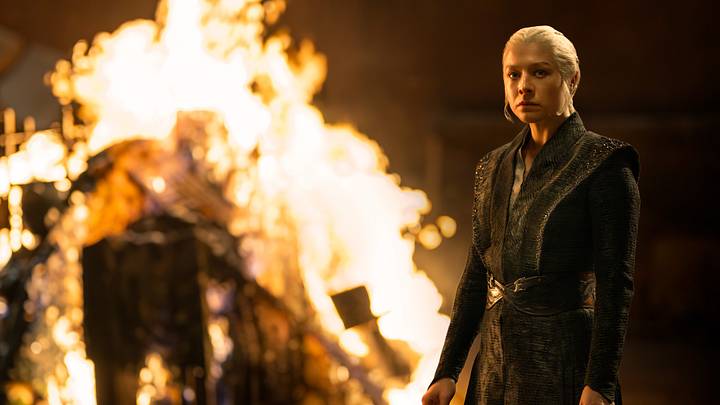
We end the episode with Rhaenyra watching a roaring bonfire consume all the Hightower and Green Targaryen banners that had lined the Red Keep...along with her father Viserys' bed. After these three tumultuous days to start off her reign, Rhaenyra will need to tread carefully with whatever comes next. She's already made new allies, new enemies, and more than a few mistakes. Something tells me the coming days will not be any kinder.

Verdict
House of the Dragon season 3's third episode is a masterful hour of television. By eschewing many of the series' staples, like bloody violence and a larger focus on the dragons, this episode manages to carve out much more time for quiet politicking and character development. The result is immaculate. While there are a few plot points that still ring oddly, as a whole the episode is more sharply written than either that came before. Bolstered by top tier performances from its cast and a standout score from Ramin Djawadi, it very much earns its place as one of the most notable episodes of the entire series. If there's any justice in the world, this is the episode that will win Emma D'Arcy an Emmy.
Episode grade: A+
 Add us as a preferred source on Google