

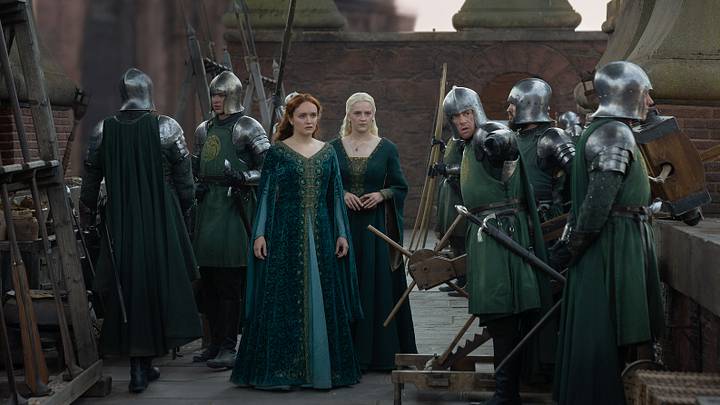
The second episode of House of the Dragon season 3 has been unleashed, and just like last week's action-packed premiere, it wastes no time plunging viewers into the bloody thick of things. Episode 302 spends a good amount of time on the fallout from the Battle of the Gullet, but it also features two important setpieces late in its runtime: Aemond Targaryen's (Ewan Mitchell) assault of Harrenhal, and the Fall of King's Landing, when Rhaenyra Targaryen (Emma D'Arcy) finally claims the Iron Throne.
While this was undeniably an exciting episode of television, it continued the season premiere's streak of making some absolutely baffling decisions with several of its characters, including one scene that completely betrayed one of the show's earliest promises to viewers in a careless, infuriating way.
We've got a lot to talk about, so buckle in for the full recap and review of House of the Dragon season 3 episode 2, "Queen's Landing." FULL SPOILERS beyond this point.

The Black Queen's grief
Before getting into the events of the episode itself, we have to take a second to shout out the new opening credits. I've generally liked the new animations and modified score from Ramin Djawadi, and the more I see it, the more that's the case. Episode 2 adds two new images to the tapestry of House Targaryen's downfall: Corlys Velaryon fighting Sharako Lohar on the deck of a ship at the Gullet, and Jacaerys Velaryon floating in water and blood, punctured with arrows. It's a brutal way to remind us of the devastation we witnessed in the premiere.
From there, the episode kicks off in a way I didn't expect: with a final bit of wrap-up for the Battle of the Gullet that sees the dragonseeds arrive and add to the carnage on their mounts, Vermithor, Silverwing, and Seasmoke. This went at least a little way toward calming my disappointment at not seeing those three involved in the battle during "Sea and Salt, Fire and Blood," even if it's such an afterthought that actors Kieran Bew (Hugh), Tom Bennett (Ulf), and Clinton Liberty (Addam) don't appear in a single shot of the sequence.
The reason for that is that the dragonseeds are not the focus of the episode's start: it's all about Jace, as it should be. We see Baela Targaryen (Bethany Antonia) continuing to prove she's one of the single most capable people on Team Black as she carries Jace's corpse back to Dragonstone on her dragon, Moondancer. When she arrives, Ser Lorent Marbrand (Max Wrottesley) anxiously asks after the battle, to which Baela somberly replies, "It is won." The idea that the Blacks won a pyrrhic victory runs strong through this episode, and House of the Dragon plays it up in beautifully tragic fashion with its haunting cinematography and score in these opening minutes. I especially loved the shot of Jace being carried onto the catwalk of the Dragonmont by the dragonkeepers.
The looming question going into this episode is how Rhaenyra Targaryen (Emma D'Arcy) will react to the news of her son's death, and fortunately House of the Dragon answers it pretty immediately. Rhaenyra stumbles in right as Jace's body is placed on the floor of a chamber in Dragonstone. D'Arcy delivers an astounding performance in this scene, grieving over Jace's body and aptly portraying the push-and-pull between Rhaenyra's agony at losing her son and fury at him for defying her — and inadvertently wounding her in a way from which she'll never fully recover.
For as moving as Rhaenyra's grief is, I also can't help but note a few oddities in this scene. The first is we never see how Rhaenyra reacted to Ser Lorent when she was finally released from her room, and that's an odd thing to fully skip here. The second is that Rhaenyra's meltdown in front of so many people once again paints a conflicted image of the Black Queen. This is the first of several scenes meant to be heartwrenchingly difficult for her, but they also make her look weak in front of her subjects in ways I don't necessarily think the show intends. No one can deny Rhaenyra is entitled to her grief, but it is a choice to make her suffer it in this public of a manner. No one thought to clear the room for her so she could have a few minutes alone with her dead son?
Another oddity: Baela tells Rhaenyra that Jace's death is the fault of the wild dragon Sheepstealer and his mystery rider. When Baela's sister Rhaena (Phoebe Campbell) learned of Sheepstealer in the season 2 finale, it was treated as a revelation that this dragon existed at all, and if its presence was widely known outside the Vale, the show never conveyed it. How does Baela know the name of this dragon? How would she even know what it looks like, when it's so reclusive that it's rarely ever seen?
I hate to be nitpicking already, but alas, these are the first of many plot holes and contradictions in House of the Dragon season 3 episode 2.

Rhaena Targaryen, menace of the Vale
After a few quick scenes showing Triarchy pirates landing on a beach in the Crownlands and Alyn of Hull (Abubakar Salim) searching for his father, Corlys Velaryon (Steve Toussaint), our next substantial plot point is in the Vale, where we catch up with Rhaena Targaryen, public enemy number one, and her dragon Sheepstealer.
Rhaena is torn up about the debacle at the Gullet, where she got her own stepbrother Jacaerys killed. Lady Jeyne Arryn (Amanda Collin), however, is not torn up at all, but understandably furious that Rhaena has come back to the Vale seeking asylum from Rhaenyra. After all, Rhaena was supposed to be aboard a merchant cog with her two young charges, Aegon and Viserys, headed for Pentos. Instead she ran away, bonded a wild dragon, and took it into a battle where it attacked the Blacks' own ships and caused the death of the crown prince. Suffice to say, Lady Jeyne has no interest in sheltering Rhaena.
However, she does still want a dragon to protect the Vale, should the likes of Vhagar come sniffing around. So she ultimately concedes that the misty landscape is vast and she cannot control where Sheepstealer should choose to make his den. It's about as good of an invitation as Rhaena's like to get.
Despite some misgivings about how the show is replacing the book character Nettles with Rhaena, I did like this scene quite a lot. Just like Abubakar Salim, Amanda Collin is a veteran of the HBO Max sci-fi show Raised By Wolves, and if you haven't seen it believe me when I say that she is a chillingly excellent actor. House of the Dragon hasn't made much use of her talents yet, so I'll take any crumbs I can get. Campbell is also doing her best work of the series so far as Rhaena. It's the only brief scene we get with these characters in episode 2, but it's a good one.

House of the Dragon skips the Fishfeed
Another set of characters we visit only briefly this episode is Daemon Targaryen's army of rivermen and Winter Wolves. They're holding a banger of a party in the middle of the forest to celebrate their recent victory for a battle they've nicknamed the Fishfeed. That would be the Battle by the Lakeshore, and oh boy are we going to talk about it in a second.
In general, this is a fun scene that helps viewers connect with the likes of Roddy the Ruin and Black Aly (Annie Shapero), two of House of the Dragon's most exciting new characters this season. It's nice to see Daemon relaxing after some victories well won, especially after he was cooped up at Harrenhal for nearly all of season 2. Even if it's shortlived thanks to news of Jace's death, which arrives courtesy of Ser Simon Strong (Simon Russell Beale), it's an important scene to show a bit more of these characters before Daemon leaves them with orders to march toward King's Landing, while he sets off on Caraxes to be with Rhaenyra.
Now that all that has been said: I was shocked that House of the Dragon chose to skip the Battle by the Lakeshore. If you haven't read Fire & Blood, you have no idea what the show just glossed over, and this scene does a terrible job at conveying just how brutal of a battle it was — which essentially means that in the show, it wasn't.
But for book readers, this is going to be a change that sticks in many of our throats. Sidelining the Battle of the Red Fork in the season premiere was understandable and a small loss, relatively speaking. But the Battle by the Lakeshore is the single bloodiest land battle of the entire war, which essentially cuts House Lannister out from taking part in any more battles when the last of their host is destroyed. The Winter Wolves also suffer substantial losses, as they charge again and again into the Lannister host, pinning them against the Gods Eye lake near Harrenhal and forcing them back into the war.
I'm sure House of the Dragon cut this sequence for budgetary or pacing reasons — there is another battle coming later on in the Riverlands, and that one is absolutely essential for the story. But it is beyond me how anyone could look at the source material for the Fishfeed and think "that's a battle we could stand to lose." Even the show's jolly take on the nickname feels like a betrayal; this thing is called the Fishfeed in the book in a haunted sort of way by those that survived it, because of the sheer amount of corpses left floating in the lake. Just like the Battle of the Gullet, it is a pyrrhic victory which continues to drive home the idea that neither side will leave the Dance in tact.
I don't think House of the Dragon conveyed that at all, and for as much as I'm trying to judge it primarily on its own merits rather than as a comparison to Fire & Blood, in this instance it's impossible for me to let this decision slide. So for as nice as it was to get a party scene with Daemon in the Riverlands, I can't help but shake my head at the fact that the show didn't even attempt to give us any sort of adaptation of the Fishfeed, even if it was pared back or held in a restrictive point of view that could have kept the costs down while still delivering the horror.

Be reasonable, Alys
There's one other part of Daemon's Riverlands story we have to address here: his final meeting with Alys Rivers (Gayle Rankin), the woods witch of Harrenhal. Alys was one of the more interesting parts of Harrenhal last season, and I fully expect that to be the case again in season 3 based on where we leave her by the end of this episode. However, her last season with Daemon is...just kind of ridiculous?
After some very cool dragon VFX of Caraxes drinking out of a lake, Alys asks Daemon for a boon: that Rhaenyra grant her the castle of Harrenhal. Daemon laughs this off, as he should. No matter how helpful Alys Rivers is, no matter how tied to the castle she feels, it's absurd to think that Daemon could give her any other answer than a no to this request. Harrenhal is the largest and one of the most storied castles in the Riverlands, and while House of the Dragon has fleshed out the curse surrounding the castle, it remains an important seat of power. Rhaenyra cannot give Alys Harrenhal without every lord in the realm wanting to know why, and who this strange witch is who has somehow swayed the queen into such folly.
Alys Rivers has so far come off an intelligent character with lots of secrets, but in this moment she seems totally delusional in a way that lessens her. She should know that the ownership of Harrenhal does not happen in a vaccuum; even if Rhaeyra wanted to gift her that castle, doing so would sow doubt in her judgment and draw the scrutiny of great lords and ladies across the Seven Kingdoms. So while Alys' threat that Daemon should not return to Harrenhal holds weight here, it's hard to take any of it too seriously given the ridiculous set up for their rift.

Aegon and Larys head to Rook's Rest
Another pair of characters we see only briefly in this episode are Aegon Targaryen (Tom Glynn-Carney) and Larys Strong (Matthew Needham). Their section of the premiere ended with them being captured by House Staunton guards loyal to Rhaenyra, who planned to bring the duo to Dragonstone in hopes of a reward. That plan goes about as well as you'd expect, and by the end of their brief scene Aegon and Larys are once more back on the road together, this time headed for Rook's Rest at Aegon's insistence.
Aegon and Larys haven't had a lot of screentime yet this season, but every time they pop up it's a highlight. Glynn-Carney is giving a career-best performance as Aegon, now in his tortured, exiled king phase where very movement is agony and every interaction humbling. Larys adds a dry, quiet humor that calls to mind Tyrion and Varys' journey across Essos in Game of Thrones season 5; I especially loved his self-reflective observation that he was actually surprised to see that their caravan had been attacked by the Triarchy, of all people. I really hope House of the Dragon leans more on these two in the coming episodes.
As for why Aegon wants to go to Rook's Rest, there's one obvious answer: he wants to see his dragon Sunfyre with his own eyes. House of the Dragon has alluded multiple times to Sunfyre dying after Rook's Rest, which would represent a massive departure from the book since Aegon's dragon has a few utterly critical things left to do in the Dance. I haven't bought that he's actually dead for a second, and I'm looking forward to Aegon and Larys' storyline finally putting the mystery to rest.

House Velaryon, assemble!
The last disparate party we need to check in with before we head into the main events of the episode is the remnants of House Velaryon. Following Corlys Velaryon's fall into the ocean during the Battle of the Gullet, nearly all of his remaining blood relations have turned out to search for him. Alyn scours the beach, while Baela and Addam scour the area from their dragons. There's an interesting scene where Baela offers Alyn some emotional support, which serves as a very small bit of foreshadowing at a long-game arc these two characters will have together by the end of the Dance.
Eventually, Addam does find Corlys, and he delivers an iconic line of his from the book: "If this be victory, I pray I never see another." Except in House of the Dragon, this line is delivered in a strangely awkward fashion with an unnatural zoom on Corly's face out of nowhere, rather than as a response to anyone congratulating him on the battle like in the book. The show also tweaked the line just slightly, to "If this be victory, I hope I never see another." It's such a minor change it's hardly worth mentioning, except that it's a perfect example of House of the Dragon tweaking the source material in unnecessary ways that really add nothing except make what we get ever so slightly worse. Martin's original line is poetic and sorrowful; the show's version doesn't ring with quite the same beauty, both because of the change to the dialogue as well as the way it's executed. It's a shame, because this is a line I've been waiting to hear from Steve Toussaint since the show began, and somehow it didn't quite pull it off even though it included it.
That somewhat pedantic gripe aside, the big takeaway from this sequence is that Corlys recognizes the remaining family he has, and wants them to know he values them. His treasures at Hightide may be gone after the Triarchy's sack, but he can still have Alyn and Addam legitimized as true Velaryons. That's all Alyn wanted anyway. It's a touching payoff for Corlys and Alyn especially, and Toussaint and Salim did great worth with the material.

The capture of Harrenhal
Now we're into the real meat of the episode: dual sequences that show Aemond Targaryen capturing Harrenhal, while Rhaenyra and Daemon take King's Landing. Let's start with Aemond.
As Criston Cole (Fabien Frankel) and his army prepare to break camp in the Riverlands, they see a massive dragon fly overhead: Vhagar. Of course, the oldest, nastiest dragon in Westeros could only be heading to Harrenhal, where Aemond had planned to meet with Criston to plan the next stage of their campaign in the Riverlands. Surprisingly, this brief glimpse is all we get of Criston this episode.
Aemond, meanwhile, gets a much stronger spotlight as Vhagar torches the garrison around the castle and proceeds to slice his way through any remaining soldiers as he fights toward the high seat of the castle. It's great action for Mitchell, who hasn't had a real fight scene on this show in far too long. When he finally cuts his way through, he finds Ser Simon Strong and his sons waiting. Simon tries to surrender bloodlessly like he did to Daemon, but Aemond isn't in the headspace to entertain it and kills Simon in cold blood. Simon's sons then attack, and Aemond cuts them all down too. However, one manages to land a lucky strike on Aemond's back, and he passes out pleading for help from none other than Alys Rivers.
While I don't love Aemond getting taken out by one of Simon Strong's sons so that he's not meeting Alys on even footing, the sequence up to that point was excellent. Mitchell perfectly captured both Aemond's physicality and his quiet villainy. The fact that he demands Simon Strong fight him is straight out of the book, and while things go down a little differently from there, it's close enough that it's obvious the show tried to pay homage to this particular part of Martin's story. Aemond and Alys Rivers have an intriguing relationship in Fire & Blood, and I'm very much looking forward to seeing what happens next for them now that they've met in the show.

Alicent Hightower can't catch a break
Now we head at last to King's Landing. We spend quite a lot of time there with Alicent Hightower (Olivia Cooke) during the lead up to the Fall, where she enacts her schemes to ready the city for Rhaenyra's coming. There are two scenes where this primarily happens. The first sees Alicent head to the barracks of the gold cloaks, where walks by a bunch of naked guys to have a conversation with Ser Luthor Largent, the city watch commander played by Tom Cullen who makes his debut in this episode. Luthor Largent is one of those character I largely glossed over in the book, but Cullen gives him a real charisma that's fun to watch on screen. I quite enjoyed his scenes with Alicent here, even though something about Alicent having to endure being ogled by naked dudes set off a warning bell in my mind — one which came full circle only a short while later in the worst scene of the episode.
From there, Alicent enlists her daughter Helaena (Phia Saban) to order the guards on the wall to stand down when Rhaenyra arrives. Beyond the fact that this whole conceit of Alicent making the Red Keep ready to surrender is very much the exact opposite of what she does in the book, it is nice to see her being so proactive with her schemes here. Helaena is also as endearing as ever; she really just wants to go raise chickens, and who could blame her?
However, Alicent's treachery against the Green does eventually catch up with her. After stonewalling the protests of her Kingsguard protector Ser Rickard Thorne (Vincent Regan), the knight alerts Lord Jasper Wylde (Paul Kennedy), the master of laws on the Small Council. Wylde, known as "Ironrod," strangely then decides to take the law into his own hands in the most reprehensible way possible: he corners Alicent in her room, and attempts to rape her.
While this scene is thankfully cut short by an intervention from Grand Maester Orwyle (Kurt Egyiawan), the damage is already done both to the episode and Alicent's story therein. I cannot emphasize it enough: I loathe this choice of House of the Dragon, which cannot seem to figure out what to do with Alicent unless it's heaping yet more humiliations on her for totally arbitrary reasons. This assault, for example, only happened so that Jasper Wylde could get sent to the dungeon, which later on serves as an excuse for Daemon Targaryen to go down there, where he finds a surprise left for him by Larys Strong. Suffice to say, that's a pretty paper thin reason to insert a totally unnecessary sexual assault scene, which exists far more to expedite a plot point than it does for any sort of impact on Alicent herself.
This kind of lazy usage of sexual assault made me cringe so hard when I watched. If the show was exploring the effect this had on Alicent it would be one thing; but to use it almost as set dressing for a lame excuse to get a guy down to the dungeon took me completely out of the episode. I highly doubt we'll see this scene addressed again for Alicent after this episode, which makes it even worse. It's a far cry from the show's first season, where writer and executive producer Sara Hess proudly claimed House of the Dragon would not "depict sexual violence" on screen, breaking from its frequent usage in Game of Thrones.
This assault on Alicent — which was also written by Hess — feels like a betrayal of that promise in the worst way, because it is a lazy depiction of sexual assault on screen that is there only as a plot contrivance. At least Alicent doesn't hang around the Red Keep too long after it happens before gathering Helaena and her granddaughter Jaehaera, and trying to escape into the chaos as Rhaenyra's dragons fly over the city. But the stain of having this scene back-to-back with Aemond's unconsented kiss in episode 1 will loom over Alicent's season 3 story until the show finds some other way to utilize her than just as a perpetual victim of every single man around her.

Team Black prepares to make their move
While Alicent is enacting her schemes in King's Landing, Daemon Targaryen returns to Dragonstone to support Rhaenyra. To his surprise, he finds Hugh and Ulf there, having abandoned their post on the Isle of Faces after their encounter with Alys Rivers. This frustrates Daemon, since their absence leaves the garrison he left at Harrenhal exposed to Aemond — a mistake that we see come back to bite Team Black in this very episode. He puts Hugh and Ulf in their place, including a harsh slap for Ulf when he mouths off.
Once more, I can't help but wonder about some of these logistics. Rhaenyra sent her three least experienced dragonriders — two of whom had only just claimed their dragon days earlier — to ambush the single most dangerous dragon in the war. Were they supposed to feel like anything other than expendable cannon fodder? To me, it feels like House of the Dragon is heavily frontloading the set up for a fateful decision Hugh and Ulf will make in the First Battle of Tumbleton, and it's almost a bit too much. We need more development of these two than just having Daemon crap on them when he's feeling grumpy.
Daemon then runs into Mysaria (Sonoya Mizuno), and the two have some good verbal sparring as he realizes that his former lover has wormed her way into becoming Rhaenyra's closest advisor. This seems to threaten Daemon, which is an odd choice.
When word comes that Vhagar was sighted near Harrenhal, Daemon finally goes to Rhaenyra and manages to galvinize her out of bed. The two suit up in their armor, and Rhaenyra announces to her advisors that she, Daemon, and the dragonseeds are going to take King's Landing. The advisors argue, and while this has served a specific purpose of adding to Rhaenyra's frustrations in the past, here it just feels totally forced so that she and Daemon will have some dissent to put down. Why is the maester arguing military strategy to Daemon freaking Targaryen? Why does Mysaria, someone the show has built up as clever, try to pit Rhaenyra against Daemon afterward in such a heavy-handed, transparent way? House of the Dragon's character decisions continue to leave me confused.
That said, credit where it's due: "Ser Lorent can choose how he dies" might be the single hardest line Rhaenyra has delivered in the entire series. Here's hoping we get more of this side of Rhaenyra throughout the season.

The Fall of King's Landing
As for the actual Fall of King's Landing, the show does pay off all that set up. Seeing Syrax, Caraxes, Vermithor, and Silverwing sweep down over the city is awe-inspiring, Daemon's fight scene in the Red Keep is visceral, and the final showdown with Rickard Thorne in the throne room is tense. The show calls back to the gold cloaks' betrayal of Ned Stark in Game of Thrones season 1 when Luthor Largent leads his soldiers into the room, trapping Rhaenyra and Daemon between two forces. Except this time, the gold cloaks betrayal serves the characters we're rooting for. I loved the callback to the fact that Daemon is the one founded this incaranation of the city watch in the first place, and that this created a long-lasting loyalty for veteran members like Largent. Smith and Cullen play off this moment of two long-separated allies coming uncertainly back together really well.
For as smooth as things went up to that point, they fast start unraveling. Aegon II is nowhere to be found, and after accosting Orwyle, Daemon ends up going to the dungeon to get Jasper Wylde instead, and releasing all the nobles who stayed loyal to Rhaenyra. While down there, a jailor invites him to receive a present left from Larys Strong: none other than Otto Hightower (Rhys Ifans), who has been missing since episode 2 of last season.
The idea that Otto has been a captive in the Red Keep this whole time works surprisingly well; it's a twist I did not see coming at all, that snaps Otto back into place to receive the same sort of exit he got in the book, as one of the first executions Rhaenyra enacts upon seizing power. Daemon insists Otto's death can be a symbolic stand-in for Aegon, since he's gone. However, House of the Dragon then does what might be the most asinine thing of the entire episode: Daemon forces Rhaenyra to behead Otto herself.
At its core, House of the Dragon is a story about a woman denied her rightful place as a ruler because the patriarchal system is too baked into Westerosi culture to allow her it unimpeded. The show hasn't shied from exploring what this means for Rhaenyra, and how she as a woman can still command the respect of those around her in a system designed to undermine her at every turn. The show has wavered in how well it's executed this idea, but Rhaenyra's execution of Otto might be the single most idiotic choice it's made in this regard. This is a standard that pretty much no kings of Westeros adhered to: Aegon the Conqueror did not do his own executions, Viserys did not do his own executions, hell, even Robert Baratheon, a guy who probably would have enjoyed lopping off a few heads for old times' sake, did not do his own executions. Instead they exercise their power as rulers to have other people do their dirty work, which they can only do because everyone has to obey them.
House of the Dragon seemed to have the idea that making Rhaenyra behead Otto would be empowering somehow, but in my opinion it is very much the opposite look. There is no logical reason Rhaenyra should be doing her own beheadings, and it leads to her literally weeping as she takes the Iron Throne — which is exactly the sort of thing that would have started all sorts of bad gossip in George R.R. Martin's written world. Despite good performances from D'Arcy, Smith, and Ifans, this scene is utterly undercut by its silly conceit. At least Daemon had the decency to behead Jasper Wylde himself, I guess.
House of the Dragon season 3 episode 2 ends with Alicent and Helaena being brought to the throne room after they were presumably captured off screen. Alicent and Rhaenyra lock eyes over Otto's corpse. It's very obvious this was meant to be the final scene of season 2, but it works just as well as a closer for this episode. For better or worse, Rhaenyra and Alicent are finally back together in the way the source material intended. Now we just have to wait and see if House of the Dragon does anything substantial with it, or if it's as thin as half the turns in this episode.

Verdict
The second episode of House of the Dragon season 3 has some great scenes, but on the whole it is so heavily weighed down by nonsensical decisions that it's hard to get as invested in them. From the assault on Alicent Hightower to Rhaenyra meting out justice with her own hand, forced tension between characters who should be allies and more, this episode rarely misses a chance to undercut its own storytelling with baffling decisions. I'm hoping that House of the Dragon starts tying things together more tightly after this, because I spent far more time than I expected frustrated with this episode's many missteps, making it hard to fully enjoy even when it was pulling off massively important sequences like the Fall of KIng's Landing.
Episode grade: C+
 Add us as a preferred source on Google