

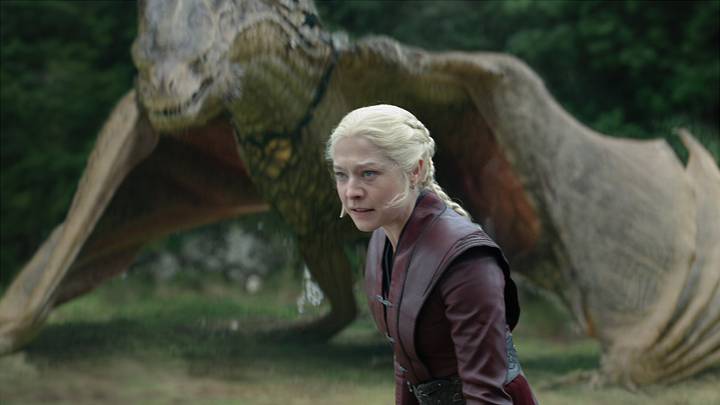
A Song of Ice and Fire and Game of Thrones are famous for presenting morally gray characters rather than arch villains and noble heroes. The franchise certainly has characters that do more good than evil, and vice versa, but all believe their actions are justified in one way or another.
House of the Dragon has captured that spirit well as it built up to this civil war, even if it did take a long time for Rhaenyra (Emma D'Arcy) to turn down a darker, more ruthless path. She certainly did so in the second half of season 3, and now that she has, she shares a surprising number of similarities with a much darker character in the franchise: Aerion "Brightflame" Targaryen (Finn Bennet).
Aerion made his on-screen debut earlier this year in A Knight of the Seven Kingdoms, and he was adapted relatively well from George R.R. Martin's novella The Hedge Knight. Of course, Rhaenyra is not as cruel, vindictive, or stupid as Aerion — even in the book Fire & Blood, which utilizes an unreliable narrator with a bias against her. However, these similarities are interesting now that House of the Dragon has shown how much House Targaryen was driven by prophecy over the years and how much that prophecy was misunderstood. They may help us untangle the legend of "Targaryen madness" in Westeros and help us understand what other characters are up to.

Rhaenyra and Aerion have a lot in common
First and foremost, Rhaenyra and Aerion both believe they are meant to fulfill prophecies. Rhaenyra ends season 3 with a speech to King's Landing about the prophecy of Aegon the Conqueror, claiming that she herself is "The Prince That was Promised."
Aerion seemed to have had his own delusions of grandeur related to prophecy—his brother Daeron (Henry Ashton) explained in the show that Aerion believed he was a dragon trapped in human form and that he could transform back into a dragon. He later died gruesomely trying to do so, and in A Feast for Crows, Maester Aemond told Sam that all of his brothers "dreamed of dragons," and that the dreams got them all killed. This may mean Aerion had prophetic dreams he did not understand.
Aerion and Rhaenyra also both chose dubious names for their children. Aerion named his one true-born son Maegor after the third Targaryen king to reign over Westeros, "Maegor the Cruel." Maegor was the son of Aegon the Conqueror and his elder sister Visenya, and he was a despot even before he plunged Westeros into war. He famously massacred all the masons who helped build the Red Keep so that no one would know the castle's secrets, and he was hated by the people of Westeros for going to war against the Faith of the Seven.
House of the Dragon did not actually name the daughter Rhaenyra gave birth to in season 1, episode 10, but in the book, she names this girl Visenya. Visenya was the eldest of the three Targaryen sibling-spouses who conquered Westeros and was widely regarded as a witch, a kinslayer, and a cruel ruler. All of this is debatable, and Rhaenyra is not the only Targaryen who later tried to reclaim Visenya's name and legacy, but it was undeniably a bad look in the eyes of other Westerosi lords.
That leads to another similarity between these characters: both Rhaenyra and Aerion were hated and resisted by many of the people in Westeros. Of course, the nature of the hatred against them is vastly different—many lords hated Rhaenyra for having the audacity to try and claim the throne as a woman, and many of the accusations against her stemmed from that hatred. Still, it's notable that both spinoff shows have emphasized the view of Targaryens as foreign invaders and Westeros' hatred of their unfamiliar customs.

"The human heart in conflict with itself"
Martin is brilliant at writing high-stakes sci-fi and fantasy stories with deeply personal, emotional cores. In this, Rhaenyra and Aerion have another parallel that's not necessarily a similarity: their struggles to fit in within House Targaryen as a family. Rhaenyra faced derision from Rhaenys (Eve Best) in season 1, episode 2, for believing that she would actually inherit the throne. She also failed to build relationships with her younger half-siblings, which could have helped prevent war in the first place. The heartbreaking scenes between Rhaenyra and Helaena (Phia Saban) in season 3 emphasize that.
Aerion's antisocial behavior is obviously another story. He is abusive to his siblings, threatening Egg (Dexter Sol Ansell) with mutilation and sexual assault, among other things. However, deep at the emotional root of these crimes is an anxiety similar to the one Rhaenyra felt—that he was in competition with his family members and that they would always see each other as threats. We see it on a smaller scale when Aerion taunts his cousin, the heir to the Iron Throne, Prince Valarr (Oscar Morgan), and when he volunteers his brother Daeron to join him in a trial by combat.
Ultimately, stories about House Targaryen are tragic stories about the peril of living with too much power—be it political, military, or magical. These characters all struggle with the pressure and lust for power in different ways that mirror and intersect one another, but the magically skeptical historians of Westeros can only uncover part of the story.
Those who burn too hot are written off as "mad Targaryens," but that's clearly an oversimplification. It's not an accurate description for Rhaenyra as far as we can see, just as it wasn't the full story for Aerys II, and it likely won't be the full story for Daenerys Targaryen when Martin finally finishes A Song of Ice and Fire. Knowing Martin, the tragedy may be that the history books condemn Dany while only the readers know the truth.
 Add us as a preferred source on Google