

The third episode of the third season of House of the Dragon mostly reinvents book canon, further diverging from the source material written by George R.R. Martin in Fire & Blood. Let's dive in.
Prince Daeron Targaryen… the fake?
The episode’s cold open sees Lord Ormund Hightower (James Norton) and his army from the Reach in battle formation, facing Prince Daemon Targaryen (Matt Smith), his mount Caraxes, and the dragonseeds. With the impending threat of burning by dragonfire, Ormund is forced to swear his fealty to Rhaenyra to save his life and that of his army.

Daemon also demands that his nephew Prince Daeron Targaryen — King Viserys’s youngest child who has been fostered at Oldtown since he was a child, now serving as Lord Ormund’s squire — be turned over to him as a hostage. Ormund begrudgingly agrees but secretly hands Daemon the wrong boy. There is a dragon-shaped plot hole here: how did Daemon not find it strange when Daeron’s dragon Tessarion did not put up a fuss at her rider being taken hostage? Or when Tessarion did not follow her rider?
Later in the episode, Queen Rhaenyra (Emma D’Arcy) also meets her half-brother for the first time, and therefore falls for Ormund’s scheme. Despite their complete estrangement, Rhaenyra’s concern for the boy is poignant. Even knowing Daeron is a threat to her claim and to the lives of her remaining children (Princes Joffrey, Aegon, and Viserys), Rhaenyra treats Daeron with a kindness that’s almost motherly, and refuses to condemn him to death for crimes committed by his family.
In Fire & Blood, Prince Daeron went to serve as Ormund’s cupbearer and squire at twelve years old, but he was raised in King’s Landing alongside his siblings Aegon, Helaena and Aemond, and nephews through his half-sister Rhaenyra, Jacaerys, Lucerys, and Joffrey. Daeron even shared a wet nurse with Jace, as per the king’s wishes, given that the two were of the same age, in the hope that the enmity between the family would subside.

In King’s Landing
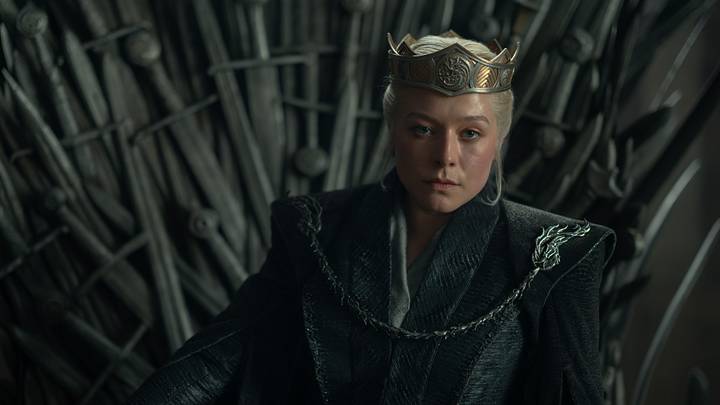
Now ascended to the Iron Throne, Rhaenyra finds herself with plenty of issues, especially because the royal coffers are empty, due to Tyland Lannister hiding the gold. Without it, Rhaenyra can’t have a proper coronation ceremony and she can’t aid the people of King’s Landing who beg for help. In fact, Rhaenyra makes it clear that the smallfolk are a priority for her, partly thanks to the perspective offered by her adviser Mysaria (Sonoya Mizuno).
Throughout the episode, Rhaenyra turns to Dowager Queen Alicent (Olivia Cooke) with questions, asking for advice as if Alicent is the epitome of queenly experience, even if the show established that it was her father Otto who virtually ruled the realm in the final years of King Viserys’s reign. The writers seem to be determined to weaken Rhaenyra’s image, as if she also hadn’t learned from her father from attending his Council meetings and later from ruling her court on Dragonstone for years.
Alicent and Queen Helaena (Phia Saban) are hostages at the Red Keep, but they are treated with the respect afforded to prisoners of their station; they are allowed chambers and maids and even to walk around the Keep, as shown by Alicent visiting Rhaenyra in her room — although this, perhaps, is a bit of a stretch. In the book, where Rhaenyra and Alicent are linked by nothing but hate for each other, Alicent is treated differently:
"Queen Alicent was fettered at wrist and ankle with golden chains, though her stepdaughter spared her life “for the sake of our father, who loved you once.” "Fire And Blood, George R. R. Martin
On the show, Alicent suggests that Rhaenyra declare Aegon to be dead, as no one would ever recognize him after his injuries and burns. In Fire & Blood, Rhaenyra puts out a manhunt for “the usurper styling himself Aegon II” and his remaining children, Jaehaera (who’s in the Red Keep on the show), and Maegor (who doesn’t exist… yet?).

What the show does right this episode
As for her court and council, Rhaenyra executes many traitors in the book, which earns her the nickname “King Maegor with teats," after the (ruthless) third king in the Targaryen dynasty. In HOTD, she is more forgiving, letting all lords who swear fealty to her keep their lives; she even lets Orwyle stay as Grand Maester, but she doesn’t call her other council members from Dragonstone. In the book, Rhaenyra names Lord Bartimos Celtigar her Master of Coin and he institutionalizes old and new taxes to replenish the treasury.
On the show, Rhaenyra takes a very different approach, and seizes food from the nobles to feed the starving people of King’s Landing and to request gold from the Great Houses. She foregoes the official coronation — also given the High Septon’s refusal to anoint her while Aegon may still live — and chooses instead to focus on regaining the trust and love of the smallfolk. One of her first acts as queen is putting the nobles in their place, obviously making enemies during that rat banquet — something that will undoubtedly come back to bite her later. Triumphantly, even for a short while, Rhaenyra graciously distributes food to the people, and lets that be her coronation. Here in King’s Landing, she is the Realm’s Delight returned, a proto-Daenerys in her Mhysa days.
Another much welcome change is the variation in the bonds between Daemon, Rhaenyra, and Mysaria. The book narrates that, when Mysaria comes to court as Rhaenyra’s unofficial Mistress of Whisperers, she also took up her former role as Daemon’s lover, with Rhaenyra’s apparent blessing: “Let Daemon slake his hungers where he will,” she is reported to have said, “and we shall do the same.”
House of the Dragon has created a much more refreshing dynamic where Mysaria is as close to Rhaenyra as Daemon is, both as a trusted advisor and as a lover. In fact, while Daemon does not express explicit jealousy to his wife, he is clearly bothered by Mysaria’s constant presence and influence, and vice versa.

What the show gets wrong this episode
In this episode, Lord Corlys Velaryon (Steve Toussaint) finally opens up to Rhaenyra about Alyn (Abubakar Salim) and Addam (Clinton Liberty) being his sons, and goes so far as to petition that the queen legitimize them as Velaryons. At first, Rhaenyra stalls, but when Corlys renews his request on a different occasion, the queen admits she cannot grant his wish at present. This instigates a fight in the middle of the Red Keep, in which Rhaenyra apologetically admits she cannot be seen to be favoring bastards, with the whispers that have followed her since Jace, Luke and Joffrey were born. Corlys retaliates and loudly calls her children bastards repeatedly, just so he can hurt Rhaenyra, knowing where to hit full well, with Jace’s death still an open wound.
Rhaenyra’s reasons are sound and her Hand of the Queen — who himself refused to acknowledge his bastard sons for decades — should understand them. While his frustration is justified, it is also noteworthy that Corlys doted on Jace and Luke and treated them like his grandsons all their lives, and he knows how much the accusations of bastardy hurt them growing up. Rhaenyra and Corlys’s son Laenor Velaryon were in a lavender marriage; Laenor proudly claimed the children as his and loved them truly. It’s important to point out that, unlike Corlys, Rhaenyra wasn’t unfaithful to her spouse; her husband encouraged her to look elsewhere because he would not give her children. Corlys simply sired other children outside of wedlock. Lastly, the line that Corlys cruelly spats at Rhaenyra, “Jacaerys lived and died as a bastard!” is gratuitous. On the show, Jace died for no other reason than to protect the Velaryon fleet and Corlys’s home.
In Fire & Blood, things go very differently. Corlys petitions Rhaenyra to legitimize Addam (who’s the elder in the book) and Alyn as soon as Addam rides Seasmoke, and he never officially claims them as his sons, passing them as Laenor’s instead. The real irony? “When Prince Jacaerys added his voice to the request, the queen complied. Addam of Hull, dragonseed and bastard, became Addam Velaryon, heir to Driftmark.” Jace, who Corlys insulted so openly with his body not yet cold on the show, is the reason why Rhaenyra grants him his request.

That same old misogyny plaguing Rhaenyra
I found the scene of Daemon and Rhaenyra discussing their diverging ambitions very on point. Despite the fierce love they hold for each other, the Queen and Prince Consort are not always of the same mind, particularly in private. It is entirely in Daemon’s character to want to conquer all of Essos, and it is in line with Rhaenyra’s to want to consolidate what she has here, before waging war on the world, and to be wary of using dragons as the ultimate weapons even when they are not unnecessary.
I just wish that Rhaenyra’s sanity was shown as wisdom instead of a weakness, and I wish other characters could stop narrating her life to her as a series of failures. Daemon accuses her of not knowing who she is — but I think that’s incorrect. She knows exactly the type of Queen she wants to be: someone who can care for the smallfolk, who can be just and merciful but who can show determination when necessary. Her caution just doesn’t align with her husband’s proverbial megalomaniac plans, so he instinctively wants her to make her feel small as a result.
However, this belittling of Rhaenyra’s character doesn’t stop there. It’s heterodiegetic, whether the show writers are doing it on purpose or not. It’s in crediting all of her good choices to other characters, in having her ask her very enemy for advice, in mentioning she’s on her period for no apparent reason, just to remind the audience she has “the weak body of a woman,” as she herself said in the first episode of the season. Misogyny is embedded in the very frame of the world Rhaenyra lives in, we get it, but also in our own, and it is not solved by dropping a feminist one-liner here or there, especially not after showing gratuitous sexual assault scenes that serve no purpose. I wish the writers could do Rhaenyra — and the other women of the show — justice.
Episode rating: B-
 Add us as a preferred source on Google