

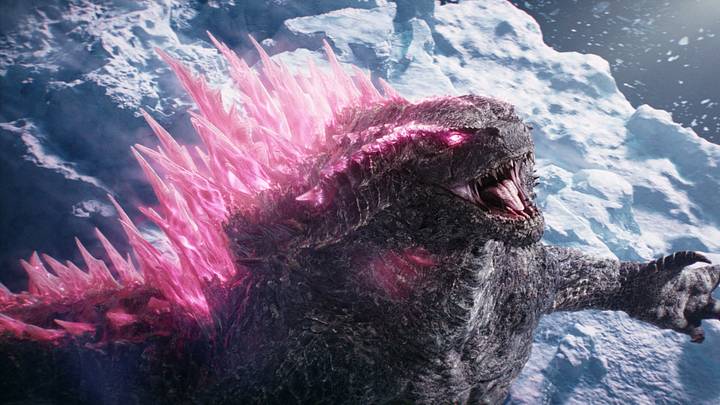
Though the Godzilla franchise is now a multi-faceted and long-running media machine unto itself, there was once a time when Godzilla was little more than an ambition in the mind of director Ishirō Honda. In 1954, his Toho-produced original Godzilla film was released to Japanese audiences and clearly struck a nerve. The film combined groundbreaking effects (that hold up to this day) with a searing look at post-war Japan and the lasting physical and psychological effects of atomic warfare, resulting in a project rooted in genre storytelling but decidedly anchored in real-world trauma.
The film remains a harrowing watch to this day, which makes it all the stranger to think that America (the country who, you know, created and ultimately dropped those atomic bombs) saw the movie and apparently thought, “Hey, this would be pretty cool if it just starred white people.” The result was the 1956 film, Godzilla, King of the Monsters!, which took footage from Honda’s film and spliced it together with American footage shot by Terry O. Morse, essentially replacing the vast majority of the human characters while keeping the same Kaiju footage. This began the tumultuous and complicated relationship between America and the Godzilla franchise that has carried on ever since; something that Takashi Yamazaki’s new Toho-produced installment, Godzilla Minus Zero, astutely taps into.
To be clear, this is not to say that every American version of Godzilla is inherently wrong or unjust. Even King of the Monsters!, bewildering choice that it was, played an integral role in helping bring Godzilla as a character and as a franchise to English-speaking audiences, so that’s something. Though efforts like the 1999 Roland Emmerich-directed effort are much maligned (rightfully so), there have now been over a decade of American-produced Godzilla-related projects thanks to Legendary’s MonsterVerse (movies like Gareth Edwards’ 2014 Godzilla, Adam Wingard’s 2021 Godzilla vs. Kong, etc.), many of which have been well-received by fans and critics alike. But even with all of that considered, it’s undeniable that there is a contention of sorts between Godzilla’s very origins as a film and America as a country trying to co-opt that narrative for their own purposes, especially back in the ‘50s.
Fascinatingly, while the majority of Godzilla Minus Zero takes place in Japan and centers on Japanese characters, there is a faction of American military personnel who are introduced sparingly throughout the film, and the relationship between American and Japanese citizens is something of a focal point of the story. Hysterically, Yamazaki positions the American characters in much the same way that American films often position other cultures in their own films; the Americans are dull, stilted in their delivery, and full of nefarious intentions. These American characters are also characterized in their brief screentime by constant clichés: they chew gum, spit tobacco, and are equipped with a comical amount of weaponry at any given time.
All of this is already supremely entertaining and very much in line with Yamazaki’s larger themes and commentary from across both of his Godzilla Minus films, regarding how he realigns the franchise with its atomic-dread-induced roots. But then, in the film’s final moments, Yamazaki uses all of this as a platform to reach an even more deliberate point. By the end of Godzilla Minus Zero, a central character is revealed to have a connection of sorts with Godzilla that can act as something of a summoning for the beast, turning the Kaiju and this individual into the equivalent of a weapon of mass destruction and the trigger for it. The American characters become hell-bent on not killing Godzilla during the final act, because they instead want to use the monster for their own purposes.
It’s difficult not to see the clear parallels between this development in the narrative and the real-world “Americanizing” of Godzilla as a film in the ‘50s. In the film, the Americans are ultimately prevented from getting control of Godzilla or the trigger, but it’s clear that they are far from through with trying. In this way, Godzilla Minus Zero is able to further expand the cultural touchpoints of this era of the franchise, and overtly become a film about reclaiming the cultural legacy of this franchise for Japanese audiences, and I think that rules.
 Add us as a preferred source on Google