

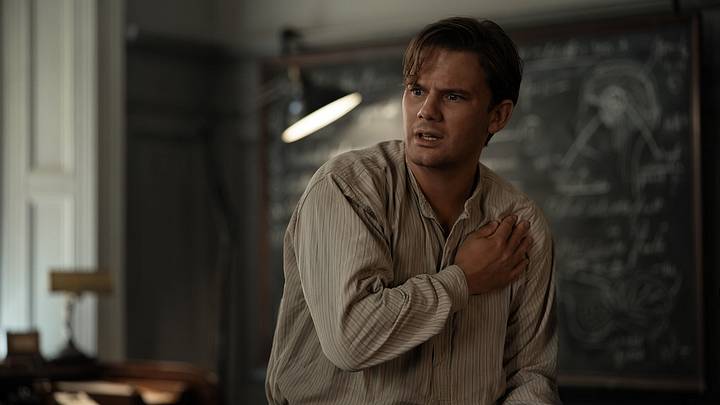
It is no secret that Henry Beauchamp has been fighting some demons of his own. We just didn’t know that the worst was yet to come in season 2 of Outlander: Blood of My Blood.
The first episode opened the season with some of the most dramatic scenes written and directed for the Outlander spinoff. We see Henry, father to the Outlander protagonist Claire, being interrogated in 1924 Inverness, and deemed unstable because of his fractured and, apparently, nonsensical answers.
Henry is then transferred to the “Inverness lunatic asylum,” a more archaic and barbaric version of a psychiatric hospital, where he is placed in the custody of Dr. Perryman. He submits Henry to what can only be described as torture.
Jeremy Irvine, Henry’s actor, says in the production notes released before episode 1: “I went for costume fittings before I received the scripts for season 2 and it was quite a surprise to be fitted for a straitjacket!”
Being more curious than dedicated to his well-being, the doctor starts an experimental treatment on Henry: electroshock therapy. He deems it to be successful when conducted on soldiers left shell-shocked by World War I. What he doesn’t know, of course, is that not all of Henry’s trauma is caused by the war. The more recent distress is actually connected to time travel: he is traumatized by the fact that he has left his wife and his newborn son in the 18th century, and even before that, he was separated from his daughter, Claire. The doctor is actually making him worse, causing him to bury his darkest memories deep inside his mind as a trauma response and survival mechanism.

Jeremy Irvine’s research on electroshock therapy
Irvine explained his process in preparation to his slightly more broken role in season 2. In a roundtable discussion attended by Winter is Coming, he said that he did his own research and sent some materials to director Azhur Saleem to illustrate how he intended to portray Henry’s deteriorating mental state. “It's the part of Henry that I find quite interesting — the broken mind he has to deal with,” Irvine said. “I get to explore that more in this season. As an actor, it's the sort of stuff you can really get your teeth into.”
“Jeremy playing these scenes in the asylum, having his seizures, are genuinely uncomfortable to watch,” said Saleem. “He went to physical lengths on set which were harrowing. We wanted the audience to feel as trapped as he was.” For example, during the electroshock therapy scenes, the blinds are drawn on the windows so the audience, alongside Henry, can never see the outside world, and the paintings are hanging high on the walls, out of patients’ reach.

Mrs. Graham and Reverend Wakefield return in season 2
Season 2 also brings back two familiar Outlander characters: Reverend Wakefield and Mrs. Graham. Their involvement in Blood of My Blood is ultimately important to Henry’s story.
Executive producer Maril Davis, who’s been working on the Outlander franchise since the beginning, said at the roundtable discussion: “Their story fit organically. It was such a natural progression to have Henry interact with both of them. They don't come out of the blue. They feel very enmeshed in that storyline.”
Mrs. Graham especially has a significant role in Henry’s story, as Davis said: “It was fun to have Mrs. Graham, who read Claire’s palms and helped her understand the mysteries of time travel, to have her also do that with Claire’s father.” And Irvine added: “Mrs. Graham sees truth in Henry when no one else does — she is a ray of hope in a very dark time for him.”
Watch the next episode of Outlander: Blood of My Blood this Friday on Starz.
 Add us as a preferred source on Google