

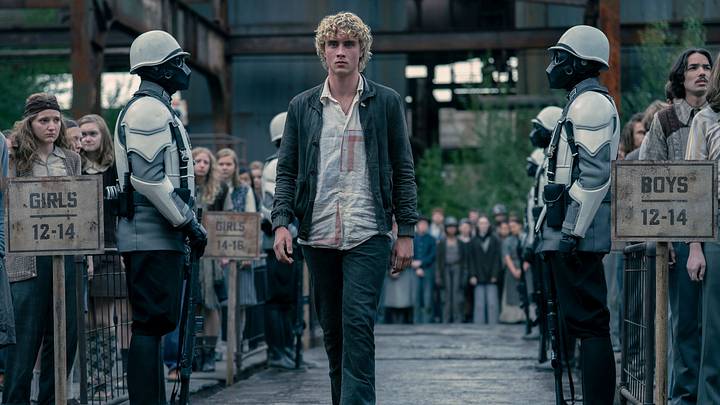
It’s finally here! The countdown to The Hunger Games: Sunrise on the Reaping is over. The sixth installment and second prequel of the saga set in Panem opens the doors to the 50th Hunger Games.
Set 40 years after The Ballad of Songbirds & Snakes and 24 years before the first Hunger Games movie, Sunrise on the Reaping (based on Suzanne Collins' book of the same title) starts on Haymitch Abernathy’s 16th birthday, which coincides with the Reaping Day of the second Quarter Quell. This year holds a special kind of cruelty: twice as many tributes will be reaped from each district, for a total of 48 children going to the Capitol.
Sunrise on the Reaping is a solid and extremely entertaining new installment of the Hunger Games franchise, and a satisfying portrayal of Haymitch’s Games. Despite a few missing pieces, the film welcomes back long-time fans and successfully draws in newcomers.
Haymitch (Joseph Zada) is forced to enter the games after physically preventing his sweetheart, Lenore Dove (Whitney Peak), from being killed by peacekeepers, and is sent to the Capitol as punishment. Haymitch is accompanied by his fellow tributes: Louella McCoy (Molly McCann), his 12-year-old neighbor, Maysilee Donner (McKenna Grace), the stuck-up girl from town whose family owns the candy shop, and Wyatt Callow (Ben Wang), an oddsmaker forced to work for his booker family, who bets on the Games every year.

The movie has a stellar cast. Elle Fanning is the young, aspiring, and patriotic Effie Trinket. Kieran Culkin brings a colder depiction of TV host Caesar Flickerman. Billy Porter and Glenn Close appear as the mad stylist Magno Stift and the cruel and sadistic escort Drusilla Sickle assigned to District 12. Lily Taylor and Maya Hawke also make brief appearances as Haymitch's mentors, playing Mags and Wiress respectively.
The question at the heart of Haymitch’s story is not strictly how he won his Games — we’ve known since 2009, when Katniss and Peeta watched the tape in Catching Fire — but how the Capitol was able to rework and exploit them as propaganda.
Haymitch starts off as a goodhearted, sunny, and loving boy, but his idealism is weaponized against him. By the end of the movie, he is a broken shell of a man, a pariah drowning himself in alcohol to forget, and forced to mentor tributes who inevitably die every year. What brought him there was the Capitol and how it twisted Haymitch’s rebellion into the cowardly actions of a rascal.

Sunrise on the Reaping succeeds entirely in this. However, the PG-13 rating might have stunted the movie, making it look like this once daring franchise has briefly lost its focus.
Sunrise feels light years away from the original trilogy. All the movies tackle rebellion, capitalism, fascism, propaganda, and war. But, despite the highly violent and bloody Games that Haymitch wins, Sunrise tones down the violence in the arena considerably. The way they went about it somewhat took me out of the scenes.
The deaths of Haymitch’s allies look almost confusing: Ampert gets devoured by mutt squirrels, but he dies in Haymitch’s arms with nothing but a scratch on his forehead; Maysilee’s throat is cut to the bone by murderous birds, but Haymitch spends her final minutes pressing down a barely bleeding neck. Finally, during the last fight against District 1’s Silka, she slashes Haymitch in the stomach; the wound would’ve been fatal if he hadn’t won, but we barely see any blood. In comparison, the bloodbath scene from The Hunger Games appears jarring. The book is brutal; the film doesn’t get anywhere near that level.
But the biggest issue is undoubtedly the pacing. The whole thing feels incredibly rushed, with sequence after sequence of rapid-fire dialogue and barely any breathing room. Despite the 138-minute runtime, there are practically no filler or transition scenes — not even enough to justify how Haymitch manages not to die of starvation or dehydration in the arena. More importantly, there is no space for the audience to process what is happening or understand the emotional consequences of certain events.

And this is where the cuts become particularly damaging. For instance, Maysilee’s death feels random rather than calculated, and Silka is stripped of much of her humanity — something the previous movies consistently managed to avoid when portraying their Career tributes. By removing some significant nuances, the adaptation chose to sacrifice character development for the sake of moving the plot along.
Haymitch’s story deserved to be told with patience and care, but it felt like the movie was constantly in a hurry to get somewhere. To its credit, the movie follows the book’s structure, and at times — especially in the beginning — adapts some dialogues word-for-word (which was chilling and exciting as a book fan). This does not necessarily mean preserving the story’s emotional weight. Several scenes I had sincerely hoped would make it into the adaptation were cut, and their absence is felt throughout the movie.
The epilogue, meanwhile, deserves a category of its own. What should have been an emotionally significant conclusion ended up being one of the most distracting parts of the movie. The long anticipated scene ended up looking goofy and like it was thrown together at the last minute (Peeta’s abomination of a wig will forever be ingrained in my brain). But as a fan, it was heartwarming to see Jennifer Lawrence, Josh Hutcherson, and Woody Harrelson reprising their roles for what I think will be the last time.

That said, a lot of what I saw was not disappointing. The Second Quarter Quell arena was hauntingly beautiful and viciously breathtaking, the mutts and natural set designs hypnotizing. I also appreciated the 70s-inspired clothes and architecture.
The performances were a definite highlight, in particular Joseph Zada, who delivers a devastatingly convincing young Haymitch. He is the beating heart of the movie, and has made history with this portrayal.
Jesse Plemons’ Plutarch and Kelvin Harrison Jr’s Beetee also cleared the board. They understood the material and brought depth to their respective characters in the few, short minutes of screen time they were allocated. Harrison Jr. was especially good in portraying Beetee’s mannerisms: it looked like I was watching a younger Jeffrey Wright explaining to Katniss how forcefields work.

On the other hand, I’m still not totally convinced Ralph Fiennes was the right choice for President Snow. While he is a great actor, his Snow felt at times out of place. But I have to remind myself that this is neither Donald Sutherland’s nor Tom Blyth’s evil dictator, simply for a matter of timing.
It is evident that the people behind the scenes had every intention of creating a faithful adaptation, presenting a product that does justice to Suzanne Collins’ books. I would gladly watch another 20 of these movies if it meant having more of her work portrayed so beautifully.
The Hunger Games: Sunrise on the Reaping is now in theaters everywhere.
 Add us as a preferred source on Google