

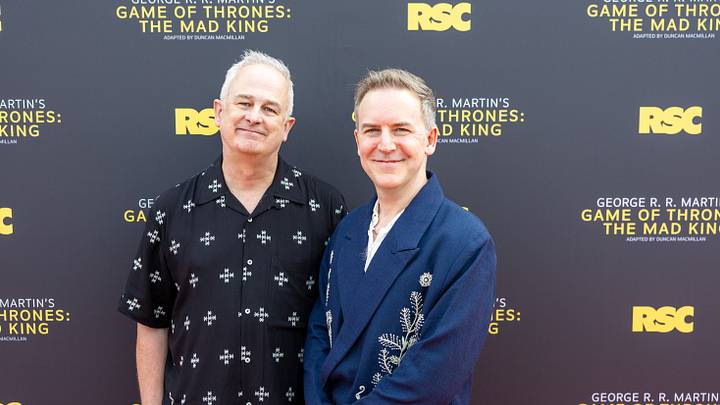
On August 8, 2026, the doors of the Royal Shakespeare Theatre in Stratford-upon-Avon, England finally opened for the premiere of George R.R. Martin’s Game of Thrones: The Mad King. Alongside Winter Is Coming's Federica Bocco, I had the honor of talking with the creators of the theatre adaptation: director Dominic Cooke and playwright Duncan Macmillan.
Both Cooke and Macmillan have extensive theatre resumés. Early in his career, Cooke was first assistant and then associate director at the Royal Shakespeare Company; he directed Shakespearean plays such as Macbeth, The Winter’s Tale, and As You Like It, as well as Arthur Miller’s The Crucible, for which he won Olivier Awards for Best Director and Best Revival.
Macmillan is both a playwright and director. His plays include Lungs, People, Places and Things, and Every Brilliant Thing. He also co-wrote and co-directed the stage adaptation of George Orwell’s 1984, which played in the West End and on Broadway.
What emerged from our conversation was an undeniable passion for theatrical storytelling and a deep commitment to displaying the rich world created by George R.R. Martin.

“You never finish a piece of theatre”: The eight-year-long creative process behind The Mad King
Both director and playwright were ecstatic on the red carpet. After five early performances were canceled due to needing more time to be refined, the creatives and talent of The Mad King were finally having their moment during opening night.
“We’re excited to show it to George and the world,” said Macmillan.
When asked if the show is finally ready, Cooke wisely said: “You never finish a piece of theatre; it's always growing and evolving. This is something that is ready to be shown to the world, fully.”
Our next questions delved into the creative process, which was long and painstakingly planned out. Cooke came on board first in 2018, while Macmillan was brought into the project in late 2019. “We went over to see George right before lockdown,” said Cooke. “Duncan took advantage of lockdown because that’s when he did all the work.”
Playwright Duncan Macmillan talks about the first conversations he and director Dominic Cooke had with @GRRMspeaking on adapting #GameofThrones: #TheMadKing.@TheRSC @GameOfThrones pic.twitter.com/uZ8rYraznX
— Winter Is Coming (@WiCnet) August 9, 2026
Macmillan recounted the first conversation he and Cooke had with Martin. “We had a conversation about Shakespeare’s tragedies and histories, and the opportunity to make something on that sort of scale, while honoring George’s work, his fans, his characters, and his world. [We asked ourselves] can we make something about power, and the people who seek power, and what power does to people and the rest of the realm — which is a huge theme in Shakespeare and George’s works.”
Cooke added: “To create anything around [Martin’s] material, you have got to get so deep into it — because there’s so much! George has an extraordinary imagination, you know — millennia of stuff. [Duncan] did an amazing work. We were very much in tandem with George on what elements we would use from what he’d given us. We were invited to step into that space.”
Reassuringly, Martin and his team have been involved since the very beginning, from research to rehearsal. Macmillan said: “[Martin] has been an incredible trusting collaborator. There were some situations — which I’m sure you’d all want to be in — of me actually sitting with George and saying the things I’ve pored over, pulling threads, arguing on why did this happen, who was that. I was able to sit and ask him. Sometimes he had the answer, sometimes he would say, ‘I don’t know because I haven’t written it yet.’
He added: “I’m really hoping he loves it. That’s what I wanted from the beginning — that George and his fans would love this.”

A symbolic storytelling: Adapting Westeros with a Shakespearean approach
The story is monumental, spanning leagues and years. We asked Cooke how he managed to include fight scenes, a tourney, and a whole rebellion.
“That was part of the attraction of it, really,” he said. “We started with the books, but of course, the story is known to the wider public through TV. I think it's very important that you find a language, a theatrical language, that makes it necessary as a piece of theatre, rather than just putting the TV show on stage.
So we took a very different approach. Theatre’s not so good at realism. Theatre is much more about symbolic ways of telling stories, and of course that's so much part of this material. There was a natural synergy between the world that George created, the section of his story we were invited to work on, and theatre.
Right at the start, I told the producers, ‘I think we should take a sort of Shakespearean approach to it,’ because that was one of George's inspirations for the first book — those Shakespeare history plays. When we first met that's what we talked about, so we rooted [the play] in that world.”
Director Dominic Cooke explains his theatrical approach to @GRRMspeaking’s #GameofThrones: #TheMadKing.@TheRSC @GameOfThrones pic.twitter.com/aGX6MAFtDS
— Winter Is Coming (@WiCnet) August 9, 2026
“What were your non-negotiables?” we asked him.
“My first instincts about how to do it have actually been borne out in the final thing, which doesn't always happen. I had two instants about it. One was to not be literal-minded, because the TV show had done realism so brilliantly. It did the gore and the reality of it. And then the other thing was — I felt very strongly it shouldn't be a proscenium show. There’s a joust in the centre of it, the tournament of Harrenhal, and I wanted the audience to experience that as if they were there.
When the RSC expressed interest in opening the play a couple of years ago, one of my first conversations with one of the artistic directors Daniel [Evans] was about how I wanted to do it in the space, immersively. It takes a long time to convert the theatre, and it’s really complicated. But he was up for it, and so here we are!”

“Westeros is the world”: Writing queer characters and the ambiguity of prophecy
In the play, one noticeable change was the adaptation of some characters as queer. For example, Princess Elia Martell, who is married to Crown Prince Rhaegar, is in a committed relationship with Lady Ashara Dayne. We asked Macmillan how he decided to expand the story of these queer characters.
“Westeros is the world. Queer people have existed throughout history. We wanted the world to feel big and truthful, and that characters are complex and have different motivations. One of the things that is very humbling as a writer working with George’s books is that every character is very distinct. He doesn’t rely on these stock tropes of how people behave. Every single one of them is distinct and they remain constant to themselves — and yet they change. Every single one changes enormously. It’s not a homogeneous world, as our world isn’t homogeneous.
Queer characters are in the books. Particularly when it comes to the Dornish, I thought it would be interesting to have a Dornish character [Elia] who was completely monogamous. And you’ve got Oberyn, you’ve got Ashara Dayne, you’ve got all these legendary, polyamorous lovers. Those dynamics, I think, are incredibly interesting. There are queer characters in the books, like Jon Connington. We’ve sort of amalgamated him into another character.”

Macmillan also talked about their version of the Tourney of Harrenhal. “We wanted it to feel like the Olympics, the Super Bowl, the Met Gala… like the whole world is gathering for this occasion. Our Westeros maybe feels more global. We wanted to feel the scale and magnitude. When it comes to people’s desires and personal lives, we wanted to reflect the detail and the complexity and nuances of motivation present in George’s books.”
Since both director and playwright have mentioned the Bard multiple times, we asked Macmillan which Shakespearean play they drew most of their inspiration from.
“We talked to George a lot about the history plays, in particular the Henry plays, Richard III, as well as King Lear,” said Macmillan. “We talked a lot about about tragedies like Romeo and Juliet for obvious reasons, and Hamlet. But also Macbeth for the central prophecy, which is open to interpretation and sometimes may be more destructive to follow than constructive.
One of the things that keeps fans so invested in [Martin’s] works is the ambiguity: was this magic or coincidence? What did I actually see with my own eyes, what is reported? And what really happened with Rhaegar and Lyanna? I wanted to honor these characters, showing them making truthful choices. But there’s also going to be a lot that you’re still going to debate coming out of the theatre.”

Lastly, we asked about Rhaegar and Lyanna’s connection: was it prophecy, fate, or determinism?
Macmillan cheekily replied: ”You tell me!”
After a beat, he added: “I wanted to keep the [Song of Ice and Fire] prophecy ambiguous: is it delusion, is this a way of masking your own ambition, or is it genuinely from the gods? And it’s easy to do that somehow on the page; you can do that better on the stage because it can be so metaphorical and subjective.
It’s harder to do that on the screen. I do have so much empathy for screen adaptation. Although they can do much more realistic battle scenes and dragons than us, we have the ability to be much more subjective and show what it feels like to be in those situations. That’s what we wanted to try to achieve.”
For more information about George R.R. Martin's Game of Thrones: The Mad King, check out theRoyal Shakespeare Company's website.
 Add us as a preferred source on Google