

This review contains SPOILERS for IT: Welcome to Derry Episode 7, "The Black Spot."
The penultimate episode of IT: Welcome to Derry, titled “The Black Spot,” is so easily the best episode of the series thus far that it’s genuinely kind of surprising. Written by showrunners Jason Fuchs and Brad Caleb Kane and directed by franchise steward Andy Muschietti, “The Black Spot” is a culminating moment for the series that also pretty clearly feels like the entire reason this season of television was made; the creators knew they wanted to arrive here, and worked backwards from there. So despite the fact that the series has had its ups-and-downs en route to this episode, “The Black Spot” feels like a crystalizing moment, in which every disparate element suddenly snaps into place, resulting in a harrowing, affecting, and absolutely thrilling hour of television.
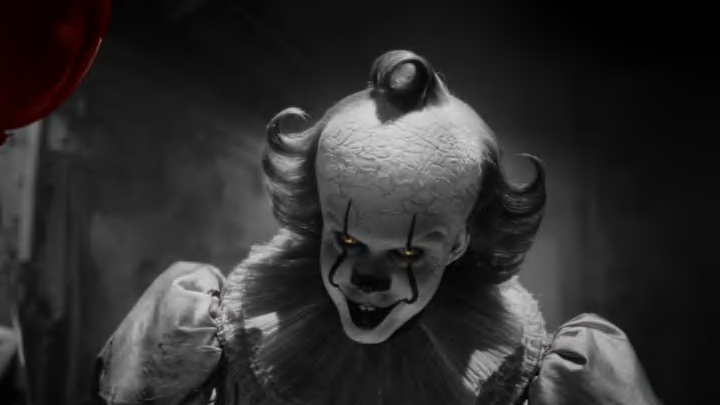
Throughout its run, IT: Welcome to Derry has consistently featured incredible production design and genuinely great performances, and that all remains as true as ever here. In fact, the episode opens with a flashback sequence to a Derry-based carnival in 1908, where audiences are treated to an extended prologue centering on young Ingrid Kersh (performed by Tyner Rushing in flashback and Madeleine Stowe in the present-tense) and her father Robert Gray, a.k.a. the original human version of Pennywise the Dancing Clown (performed by the incomparable Bill Skarsgård). After really enjoying the kind of complicated and emotionally-dense relationship the series had begun to lay out for these characters in last week’s episode, I was concerned that the show would take the least interesting route possible and simply turn Kersh into a sidekick of sorts for Pennywise in the final two episodes. However, delightfully, this extended cold open proves me wrong, digging into their relationship in a way that feels both fascinating and tragic.

The sequence gives Skarsgård a chance to really show off a different side of this performance (since it's technically a different character altogether) while also reverse-engineering key bits of his iconic villainous Pennywise performance. It’s absolutely riveting to watch, especially during the first few minutes, which sees his on-stage clown performance at the carnival playing out in full. Muschietti ingeniously seizes this opportunity and turns the bit into an extended comedic-dramedy mime performance, with Skarsgård at the center of it all. It’s like watching Charlie Chaplin’s The Kid, but with this human Pennywise as the star, and it manages to be unnerving while emotionally entangling you as a viewer with this complicated father-daughter duo.
It also must be mentioned what a smart narrative move this is from Jason Fuchs and Brad Caleb Kane’s script. You’ve undoubtedly seen countless seasons of television that build to a narrative apex only to cutaway to a flashback sequence and make you wait even longer to get to the culmination the whole thing has been building towards, but I don’t believe I’ve ever seen it work this well. After the final moments of last week’s episode saw things crescendoing to a deafening roar at the Black Spot, cutting away to this extended flashback risked deflating the tension and causing a frustrating viewing experience. But the flashback is so good and delivers so wholeheartedly on Skarsgård’s return by delving into this crucial bit of character work that it feels like a long-awaited payoff in and of itself. Then, when the show cuts back to the present-tense material, with the mob assembling outside of the Black Spot, it is able to feel that much more tense.
The Black Spot sequence justifies IT: Welcome to Derry's entire first season
And good lord, we need to talk about that Black Spot sequence. From Mama to IT to IT: Chapter Two to The Flash, Andy Muschietti’s work as a director has always had its ups-and-downs for me. I find him to be a really talented visual storyteller who brings a distinct style to his work, but I also find some of his stylization to be a bit garish and ineffective at times. But in returning to this series for this final stretch of episodes, Muschietti has delivered the single strongest, most concentrated, and effective cinematic work of his career. The way in which he stages and executes the entire Black Spot sequence is astounding, and hits you live an absolute freight train. As the mob barricades the doors of the club and begins burning it down with all of the people and many of the show’s main characters still inside, Muschietti and his team capture the entire first few minutes of the sequence in one long extended shot with a few skillfully placed stitches along the way.
The result is a technically astound piece of filmmaking, but more importantly, a bona fide incredible way to directly emotionally anchor the audience in that building alongside the characters. The resulting visual work feels chaotic, inescapable, and flat-out experiential a lot of the time. Things get even crazier when Pennywise shows up to feast upon all of the fear and desperation in the middle of it all, and it feels nothing short of monumental in its impact. The highest compliment I can give to all of this is that it genuinely feels like the cinematic equivalent of reading a great Stephen King setpiece; it swallows you whole.
It’s worth noting how common these kinds of technically complex long-takes have become in recent years, given technology’s capability to make this far more feasible than ever before. Thus, as a rule, I generally don’t get nearly as excited about this kind of camera trickery as I once did, as many of the uses in projects over the years have grown increasingly disconnected from the actual emotional intent of the scene, and are far more motivated by surface-level technical wizardry. However, this could not be farther from the truth with Muschietti’s use of it here; it’s a shining example of just how immersive and affecting this can be when put to use in proper ways that are motivated by character, story, and theme.

Amidst all of this, this episode also allots for the entire ensemble of wonderful performers to deliver some of their best work of the season. We’ve already talked a bit about Skarsgård in the opening, but he continues to grow even nastier and more complex in his performance as it moves into the present-tense. Elsewhere, shining stars of the series as a whole like Chris Chalk, Taylour Paige, and Jovan Adepo continue to do absolutely remarkable work. Chalk as Hallorann is put front and center during the Black Spot sequence and he takes his performance to new heights. Later, there’s a little emotional beat between Paige and Adepo’s characters as they sit in their car and share their disbelief about the near-death of their son, Will, that feels so authentic and empathetic. Such a great distillation of the heart and soul of these characters from these performers in such affecting fashion.
The younger performers also really shine here. Blake Cameron James, Matilda Lawler, Clara Stack, and most notably, Arian S. Cartaya all deliver their best work of the season. The emotional culmination of Lawler and Cartaya’s characters' arcs in the Black Spot sequence is great, Stack’s emotionally distant work effectively characterizes Lilly as a hollowed-out shell of a person, and Blake Cameron James’ final beat of the episode (a direct visual callback to Invasion of the Body Snatchers by Muschietti) requires him to go way out on a limb, performance-wise, and he absolutely nails it.
It should also be said that this is musical composer Benjamin Wallfisch’s finest work within the series to-date. From his classical piano arrangements during the carnival flashback, to the harrowing use of invasive horror tactics during the Black Spot setpiece, to the Raiders of the Lost Ark John Williams-indebted work done in the episode’s back half as the military gets one of the Pillars, he knocks it out of the park here in ways that I frankly didn’t know he had in him. It's great stuff that really complements the episode’s visuals incredibly well.
Verdict
Altogether, it’s difficult to overstate just how great “The Black Spot” is. As a longtime King reader, this episode genuinely felt like seeing some of the most storied and mythic elements of King’s IT franchise come to life in startlingly authentic ways. Though Welcome to Derry as a whole has ebbed and flowed in terms of quality, in the years to come, this will be the episode you can point to as proof that this entire venture was more than worthwhile, because the franchise as a whole is made that much richer by its existence. Muschietti and company have delivered a jaw-dropping penultimate episode here that sets the stage for a riveting finale, but even if the final episode is lackluster, I’m just delighted to have this.
Episode grade: A
 Add us as a preferred source on Google